Star of Spirit and Circle of Power
The Pentagram and Pentacle as Living Symbols of Witchcraft
Article · 7 min read · ·
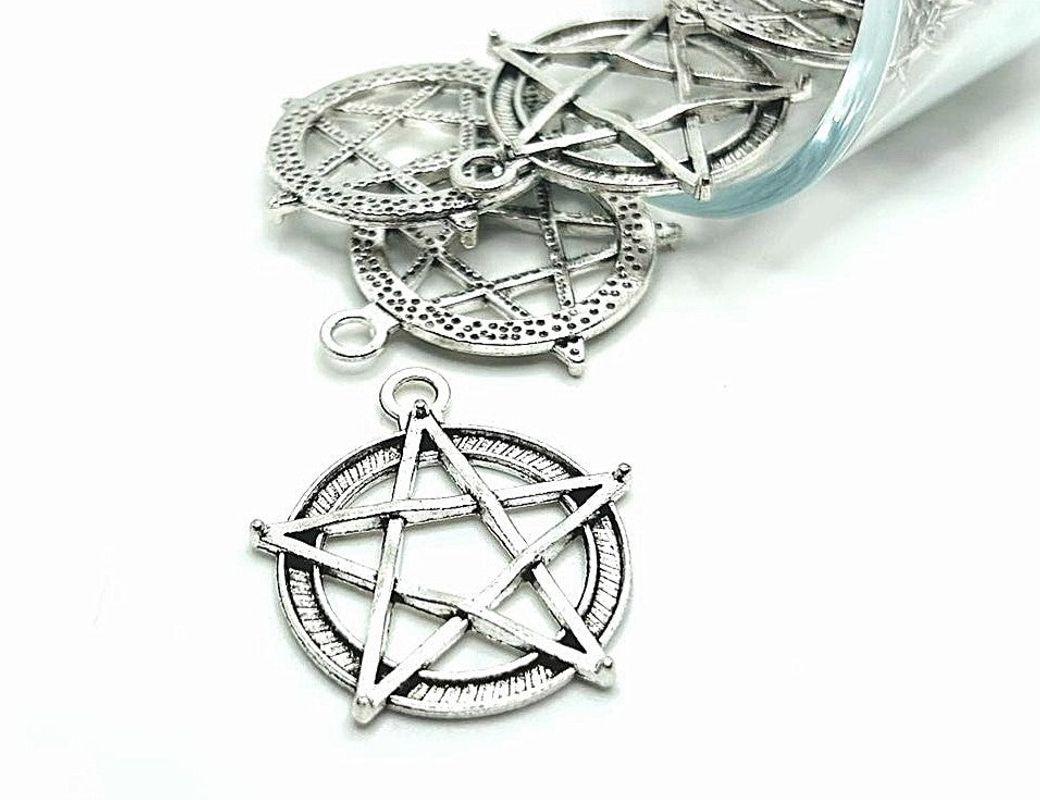
Within the language of witchcraft, few symbols are as instantly recognizable or as deeply layered as the pentagram and the pentacle. They appear across cultures, religions, and magical systems spanning thousands of years, and yet they are often misunderstood or used interchangeably without reflection on their distinct identities. In truth, these two symbols are closely related but not identical, and their differences matter, especially within ritual practice and altar work. To understand them is to understand how witches encode cosmology, ethics, elemental balance, and spiritual authority into form.
The Pentacle
Definition, History, Uses, and Magical Meaning
The pentacle is most commonly defined as a five pointed star enclosed within a circle. That enclosing circle is not decorative but essential, as it transforms the pentagram into a consecrated symbol of wholeness, protection, and sacred space. The word pentacle derives from medieval Latin and Middle French, historically referring to a talisman or magical seal inscribed upon parchment, metal, or stone. Over time, the pentacle became strongly associated with Western ceremonial magic, folk traditions, and later, modern witchcraft.
Historically, the pentacle appears in grimoires such as the Key of Solomon, where it functions as a protective seal and a conduit of authority. In these traditions, the pentacle is not merely symbolic but operative. It binds, invokes, and stabilizes spiritual forces. In medieval Christianity, it was also known as the Star of Bethlehem or the Seal of Solomon and was associated with divine order and sacred geometry rather than transgression. Its later association with witchcraft emerged not from inherent meaning but from the growing suspicion of folk practitioners and magical literacy.
Magically, the pentacle represents the integration of the five classical elements, earth, air, fire, water, and spirit, within a unified whole. The circle signifies containment, continuity, and the boundary between the mundane and the sacred. This makes the pentacle a symbol of balance, manifestation, and protection. It is a map of a cosmos in which all forces are held in harmony and none dominate the others. For this reason, the pentacle is often considered receptive, grounding, and deeply aligned with the material plane.
In modern witchcraft, the pentacle is most strongly associated with the element of earth. It governs abundance, physical health, stability, protection, and the anchoring of spiritual work into tangible reality. It is often viewed as feminine in nature, not because it excludes masculine force, but because it reflects cycles, gestation, embodiment, and the womb of creation. The pentacle does not thrust energy outward but receives, organizes, and sustains it.
The Pentagram
Definition, History, Uses, and Magical Meaning
The pentagram is the five pointed star alone, without the enclosing circle. It is one of the oldest known sacred symbols in human history, appearing as early as ancient Mesopotamia, where it was associated with celestial movements and divine kingship. The Pythagoreans later adopted it as a symbol of mathematical perfection, health, and harmony, viewing it as an emblem of sacred proportion and cosmic order.
Throughout antiquity and the early medieval period, the upright pentagram represented the microcosm of humanity. One point for the head, two for the arms, and two for the legs, reflecting the human being as a living embodiment of elemental balance infused with spirit. In Christian mysticism, it symbolized the five wounds of Christ and divine protection. Only in later centuries did inverted forms become associated with imbalance or transgression, and even then, such meanings were highly contextual rather than universal.
Magically, the pentagram is more dynamic than the pentacle. It is a symbol of movement, intention, and invocation. Where the pentacle contains, the pentagram acts. It is traced in the air during ritual to call in or banish elemental forces, directing energy through will and knowledge. Each point corresponds to an element, with spirit reigning above in its upright form, affirming spiritual sovereignty over matter and instinct.
In elemental terms, the pentagram is often associated with spirit as the governing force, particularly in its upright orientation, though it simultaneously expresses all five elements in motion. Unlike the pentacle, which is firmly rooted in earth, the pentagram moves fluidly between realms and is therefore less materially anchored. Energetically, it is commonly understood as more projective and active. While not exclusively masculine, it is frequently described as carrying a masculine or solar current in contrast to the receptive lunar nature of the pentacle. Together, they form a complementary polarity rather than an opposition.
The pentagram is closely associated with will, alignment, and magical direction. It represents the witch as mediator between worlds, standing at the center of the elements and engaging them through relationship rather than domination. While it can be used for protection, its primary power lies in orientation and active spellcraft. It is less about grounding and more about conscious movement within the magical current.
Relationship, Distinction, and Shared Symbolism
The pentagram and the pentacle are best understood as different expressions of the same sacred geometry. The pentagram is the energetic blueprint, while the pentacle is that blueprint embodied and made whole. One moves, the other anchors. One invokes, the other stabilizes. Neither is superior, and neither replaces the other. Together, they describe the full magical process from intention to manifestation.
Philosophically, the pentagram corresponds to motion, breath, and spellwork in progress, while the pentacle corresponds to outcome, containment, and sacred space. The pentagram can exist in gesture, flame, or visualization, while the pentacle exists in matter, engraved on tools, worn as an amulet, or placed upon the altar. Together, they form a complete circuit of magical action.
Both symbols share associations with balance, protection, and elemental wisdom, yet their emphasis differs. The pentagram is often perceived as more neutral or androgynous in expression, while the pentacle leans toward the feminine current of earth, receptivity, and embodiment. This distinction reflects function rather than hierarchy and underscores the importance of polarity in magical systems.
Witchcraft Practice, Altar Use, and Elemental Alignment
On the altar, the pentacle serves as the primary earth tool. It is traditionally placed at the center or on the northern side, aligning with the direction of earth. Upon it are placed items to be consecrated, talismans, offerings, crystals, spell jars, or written intentions. The pentacle sanctifies whatever rests upon it, grounding spiritual energy into physical form. It functions as both altar surface and sacred symbol, providing a stable foundation for magical work.
The pentagram appears most often in motion. It is drawn in the air with the finger, wand, athame, or candle flame during casting, invocation, and banishing. It marks thresholds, calls quarters, and directs energy with precision and clarity. When physically present in the magical space, the pentagram may be placed above the altar, behind it, or on the practitioner’s person, emphasizing its role as a symbol of spiritual authority and active engagement. It may also appear on ritual tools, floor diagrams, or temple walls to orient the working and define sacred direction.
Both symbols are commonly worn on the body, though with different magical implications. A pentacle worn as jewelry acts as a grounding and protective talisman, offering stability and shielding. A pentagram worn alone often signals spiritual alignment, magical identity, and conscious participation in elemental balance. In this way, the pentacle protects the body, while the pentagram declares the path.
Traditionally, both symbols are associated with the element of earth and with feminine mysteries, though modern witchcraft recognizes that all tools contain both receptive and projective currents. The pentacle reflects the womb, the field, the cauldron of manifestation. The pentagram reflects the crossroads, the raised hand, and the awakened human spirit.
On the Inverted Pentagram and Pentacle
The inverted pentagram and inverted pentacle are comparatively modern interpretations rather than ancient or universal ones. While inversion appears occasionally in earlier esoteric systems to denote descent into matter or engagement with the chthonic, its association with rebellion, transgression, or opposition to religious authority largely emerged in the twentieth century. This shift was shaped by occult revival movements, countercultural symbolism, and reactions against dominant religious narratives rather than by traditional witchcraft practice itself.
In modern contexts, inversion may be used deliberately to explore shadow work, taboo, or the reclamation of stigmatized power. However, these meanings are culturally constructed and not inherent to the symbols themselves. Historically, the pentagram and pentacle were protective, harmonizing, and sacred forms long before they were framed as provocative. Understanding this distinction allows practitioners to approach these symbols with discernment rather than fear.
Together, the pentagram and pentacle form a complete magical language. They teach that witchcraft is not only about power, but about balance, not only about intention, but about embodiment. To place them upon the altar is to acknowledge that magic lives both in motion and in stillness, in invocation and in form. In understanding these symbols, the witch learns not only tradition, but responsibility, not only symbolism, but cosmology itself. Thus, the pentagram survived for millennium as representations of balance, order, protection, and magic.
Responses
No responses yet — start the conversation.
More from the Magazine
Your Witchcraft Doesn't Need to Cost More Than Your Grocery Bill
Build a meaningful practice with ordinary objects, intentional actions, and what you already own.
The Owl - Secrets of Wisdom
The symbolism of the nocturnal bird in mythology, magic, and spiritual practices
How to Attract and Maintain Positive Energy
In Your Home and Other Spaces