Shamans Across Cultures:
Those Who Hear the Spirits
Article · 4 min read · ·
The word “shaman” comes to us from Siberia. But the phenomenon itself—a person who serves as a bridge between the human world and the spirit world—exists on every continent. Anthropologists note that nearly every culture has experienced shamanism at some point in its history.
Today, we’re going on a journey through different cultures to see how differently this calling can sound—and what remains the same.
Siberia: The birthplace of the word
Siberia is considered a classic region for the study of shamanic practices. It’s here, among the Evenki, Buryats, Yakuts, and Tuvans, that shamanism has survived in its most complex and developed forms.
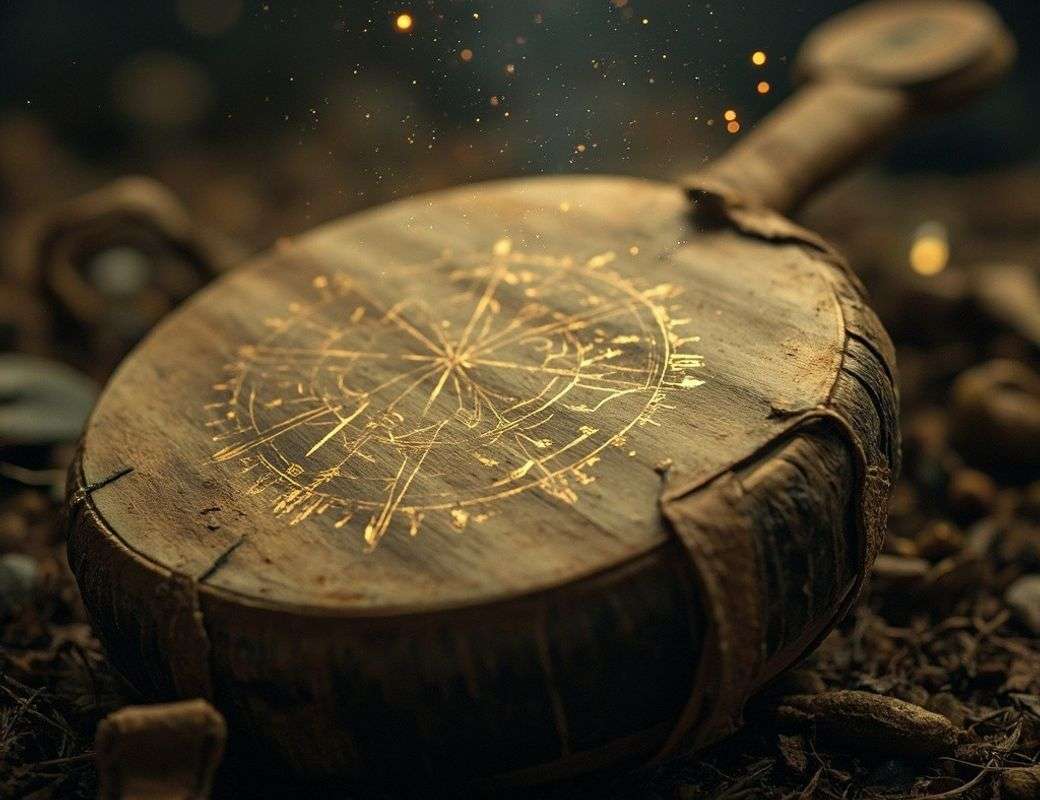
Among the Evenki, a shaman is a mediator between people and spirits. The shaman communicates with them during kamlanie, a ritual in which they beat a drum to make contact with the other world. The drum is more than just an instrument: it may be seen as a reindeer on which the shaman travels to other worlds, or as a boat sailing along rivers in the sky. The shaman’s costume is decorated with pendants shaped like animals and birds, each symbolizing a helping spirit or a magical ability.
Among the Buryats, shamans were divided into white and black. White shamans served western deities and performed rituals for births and weddings. Black shamans served eastern deities, and people both feared and disliked them, believing they could bring illness and death. Among the Yakuts, blacksmiths often became shamans. It was believed that a blacksmith gained magical power in the ninth generation, and that “the blacksmith and the shaman come from the same nest.”
Korea: Women Who Hear
In Korea, shamanism has a long, unbroken tradition connected not only with hunting but also with farming and urban life. There’s one important difference here: shamans are more often women.
Korean shamans (mudang) are healers, seers, and mediators in conflicts. Their rituals (kut) are more than ceremonies: they’re theatrical performances with singing, dancing, and music that last for hours, and sometimes for days. It’s believed that a woman becomes a shaman either through inheritance or through a “calling sickness”—a crisis after which she accepts her gift.
The Americas: From the Amazon to the Great Lakes
Shamanism took many different forms across the Americas.
In the Amazon region (Colombia, Ecuador, Peru, and Bolivia), shamans use plants of power to enter altered states of consciousness.
Among the Navajo in North America, healers are called hataalii. Their training takes years: they have to memorize dozens of ceremonies, each involving chants, prayers, and procedures. If a ceremony is performed incorrectly, it won’t work. That’s why hataalii often specialize in a few ceremonies rather than trying to perform them all.
Among the peoples of the Great Lakes, there was a “Society of Healers” (Midewiwin). A new initiate was symbolically “killed”—“pierced” with cowrie shells—and then “reborn” in a healers’ lodge. This was an initiation after which they were given the right to heal.
The North and the Arctic: Shamans Who Were Bound
Among Arctic peoples—the Inuit, Chukchi, and Sámi—shamanic practices were less complex than in southern Siberia, but more intense.
Some groups, such as the Algonquins of North America, had a “shaking tent” ceremony: the shaman was bound tightly inside a tent, and the spirits shook it so violently that it seemed as if it might take off at any moment. At the end, the spirits “freed” the shaman by untying the bonds. This was visible, physical contact with the other world.
Among the Sámi (Lapps), shamans were called noaidi. They weren’t divided into “white” and “black”—they served both benevolent and malevolent forces, depending on the circumstances.
What Remains the Same
Despite the differences in cultures and practices, there are things that shamans everywhere have in common.
A shaman isn’t a priest. A priest receives their religious standing through an institution, training, and ordination. A shaman, by contrast, often receives their gift through a personal crisis—illness, a vision, or a brush with death. They’re “chosen” by the spirits, not by people.
A shaman is a healer. Their role isn’t to preach, but to help. They explain why a misfortune happened and find a way to set things right: through a ritual, by bringing back the soul, or by driving out whatever brought on the illness.
A shaman knows how to exist “between” worlds. They don’t live only in the human world. They know the way to the spirit world and how to return. And it’s this very ability—to be a guide—that makes them someone people turn to when ordinary methods don’t work.
In Closing
Shamanism isn’t “ancient magic” or something “exotic.” It’s one of the oldest and most universal forms of human experience: the need for someone who hears more than we do and sees more deeply than we do.
There’s something of a shaman in each of us—the ability to hear subtle signals, trust our intuition, venture into the dark, and come back with an answer. And perhaps, by learning about shamans from different cultures, we learn to hear the part of ourselves that can also serve as a bridge.
P.S. If you feel you have a “shamanic” gift—the ability to sense more, see more deeply, and hear what others don’t—share it in the comments. Sometimes acknowledging this gift is the first step toward no longer being afraid of it.
Responses
No responses yet — start the conversation.