Riders in the Storm
The Wild Hunt Across Myth and Legend
Article · 26 min read · ·
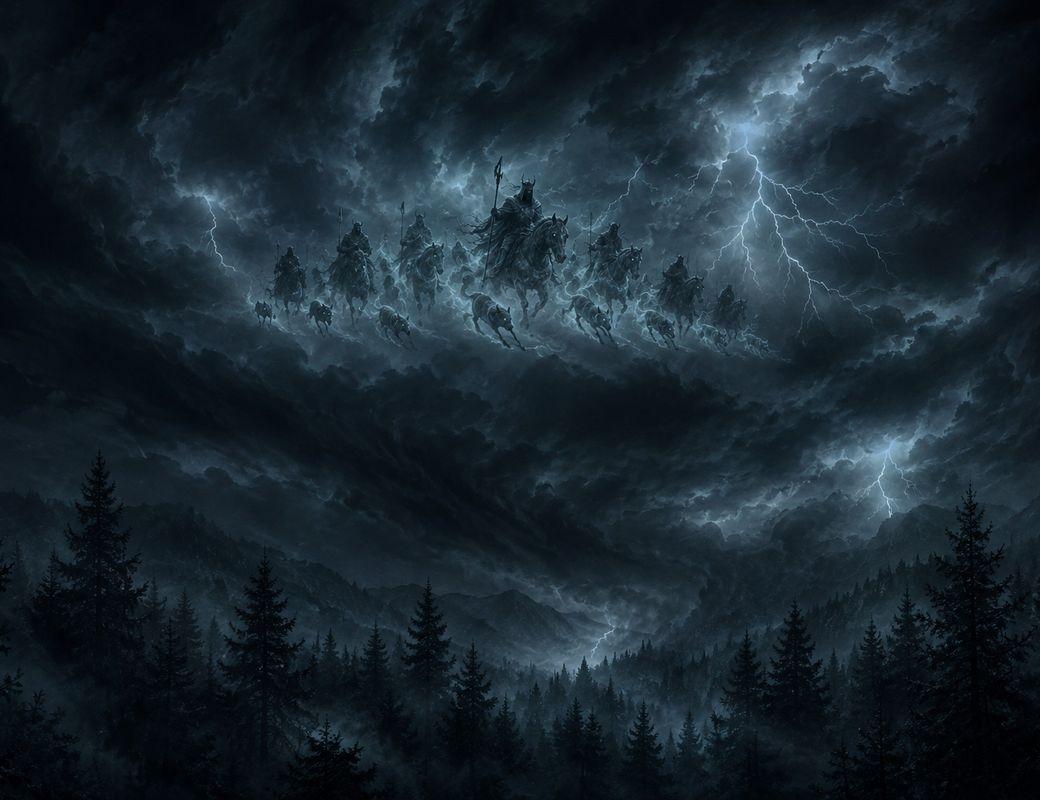
There are nights when the wind does not simply blow. It howls.
It tears through bare branches, rattles shutters, and sends clouds racing across the moon. Somewhere beyond the walls, a dog begins barking. Then another answers farther away. For those of us safely indoors, it is the familiar soundtrack of a storm.
But centuries ago, in villages scattered across Europe, there were nights when people listened to those sounds and wondered whether something else was moving through the darkness.
First came the hounds.
Their baying carried across forests and fields, sometimes close enough to hear and sometimes seeming to come from impossibly far away. Then came the wind, rising suddenly. The pounding of hooves followed, faint at first, then growing louder until it seemed an entire company of riders was racing through the night.
If you heard them coming, folklore offered one piece of advice.
Stay inside.
Do not follow the sound.
Do not call out.
And whatever you do, do not place yourself in their path.
Because the storm might not be a storm at all.
It might be the Wild Hunt.
For centuries, stories told of a supernatural procession that appeared during the darkest and most unsettled nights of the year. Sometimes it thundered across the earth. Sometimes it swept through the forest. Sometimes the riders seemed to cross the sky itself, accompanied by spectral horses, howling hounds, and a host of beings that belonged more to the Otherworld than to ours.
Those unfortunate enough to encounter the procession were rarely said to walk away unchanged. The Hunt could bring omens of death and disaster. A traveler caught outside might be pursued, carried away, or even forced to join the riders themselves. Sometimes simply witnessing it was enough to invite misfortune.
Yet ask who rode at the head of this terrifying procession, and the story begins to change.
So does the answer to what the Hunt actually was.
The legend crossed countries, religions, and centuries, gathering new riders as it traveled. Gods rode with the dead. Ghosts mingled with fairies. Ancient supernatural processions collided with medieval visions of damned souls. Hunters became demons, spirits became sinners, and stories that may once have had little to do with one another gradually became tangled together.
What emerged was one of European folklore’s most enduring images:
a storm gathering in the darkness,
the distant cry of hounds,
and an unseen company of riders drawing closer.
Long before anyone called it the Wild Hunt, Europe was already listening for the hoofbeats.
Where Did the Wild Hunt Come From?
Trying to find the beginning of the Wild Hunt is a little like trying to find the beginning of a storm.
There is no single moment when it appears.
The Wild Hunt is often presented as an ancient Germanic myth that spread across Europe, changing as it traveled. The reality is considerably messier, and much more interesting. Rather than one story branching into many versions, what we now call the Wild Hunt appears to have grown from several supernatural traditions that existed alongside one another for centuries.
Historian Ronald Hutton has argued against the idea of a single, continuous Wild Hunt tradition stretching unchanged from the ancient pagan world into later European folklore. Instead, stories about supernatural riders, wandering spirits, nocturnal processions, phantom hunters, and companies of the dead gradually became associated with one another.
Some were connected with gods. Others belonged to the dead or the fairy world. Certain traditions centered on supernatural women traveling through the night, while others told of hunters condemned to an endless chase. Depending on where the story was told, the procession might cross the sky, race through a forest, pass along a road, or come dangerously close to the homes of the living.
Even the idea of a “hunt” was not always present.
What connected these stories was something more elemental: the belief that certain nights belonged to forces beyond ordinary human control. Darkness, winter, storms, death, and the wilderness created spaces where the boundary between worlds seemed less certain.
As Christianity spread through Europe, the stories changed again. Older spirits could become demons. The wandering dead might be recast as sinners receiving eternal punishment. Local legends absorbed new religious meanings while continuing to preserve pieces of what had come before.
Centuries later, folklorists looked across this enormous collection of stories and recognized similarities among them. In the nineteenth century, Jacob Grimm helped popularize the idea of a broader Germanic Wild Hunt tradition, bringing many scattered beliefs into a more unified mythology.
That gave the Hunt something folklore rarely possesses: a cleaner history than the stories themselves actually provide.
The truth is less orderly.
There was no single rider who always led the procession, no single night when it always appeared, and no single explanation for what its riders were. The Wild Hunt we recognize today emerged from centuries of storytelling, borrowing, religious change, and local belief.
Before Europe had one Wild Hunt, it had many restless things moving through the dark.
Only later did they begin to ride together.
Odin and the Furious Host
Of all the figures associated with the Wild Hunt, none has become more closely identified with it than Odin.
The one-eyed god of Norse mythology already inhabits a world of wandering, war, magic, and death. He travels between realms, seeks forbidden knowledge, and speaks with the dead. His ravens, Huginn and Muninn, cross the world gathering information, while the wolves Geri and Freki remain at his side. He rides Sleipnir, an extraordinary eight-legged horse capable of carrying him where ordinary travelers cannot go.
Odin is a wanderer by nature. Among his many names is Jólnir, associated with Yule and the depths of winter. He sometimes appears in stories as an old man traveling beneath a cloak or broad-brimmed hat, his identity concealed from those he encounters. The road, especially at night, is very much his territory.
So is the realm of the dead.
The Valkyries choose among warriors slain in battle, and some of the fallen are brought to Valhalla, where they join the einherjar, the warriors who will fight beside Odin at Ragnarök. He also seeks wisdom from those who have died, crossing the boundary between living and dead in pursuit of knowledge.
These qualities made Odin a natural figure around whom later traditions of supernatural riders could gather.
In German folklore, Wotan, his Germanic counterpart, became associated with the Wildes Heer, the Wild Army or Furious Host. Rather than moving silently through the night, this company announced itself with a confusion of sound. Horses galloped where no riders could be seen. Hounds barked and howled. Strange voices carried through the darkness, mingling with the wind.
Farther north, Scandinavian traditions preserved similar supernatural rides under names such as Oskoreia and Asgårdsreien. Here, too, hearing the procession could be as important as seeing it. Hoofbeats might approach through the darkness while hounds bayed somewhere beyond sight. At other times, the warning was an unnatural silence settling over the forest.
Winter made such encounters easier to imagine. Darkness came early, storms transformed familiar landscapes, and sounds traveled strangely across forests and valleys. A branch snapping somewhere beyond the firelight could be an animal. Hoofbeats in the distance might belong to a traveler.
Or they might not.
People who believed the Furious Host was passing had little reason to investigate. The supernatural company was dangerous, unpredictable, and best allowed to continue on its way. A person unfortunate enough to cross its path risked being swept into something that belonged neither to the ordinary world nor entirely to the world of the dead.
There is, however, an important distinction between these later traditions and the surviving Norse myths themselves.
The old Norse sources do not give us a single story called the Wild Hunt in which Odin explicitly leads an army of ghosts across the winter sky. The image familiar to us developed gradually as traditions surrounding Woden, supernatural riders, winter storms, and the restless dead became intertwined.
That does not make Odin’s place in the legend any less compelling. If anything, it helps explain why the connection endured. He already belonged to the road, to winter, to battle, and to those who had crossed beyond mortal life.
When later generations imagined a host of the dead riding through the darkness, Odin did not need to be forced into the story.
There was already a place for him at its head.
The Women Who Rode at Night
Not every supernatural company followed a male god into the darkness.
Alongside the furious hosts associated with Woden existed another tradition, one centered on mysterious women who traveled during the night. Their processions did not always resemble hunts, nor were they necessarily armies of the dead. They belonged to a different current of European folklore, one that later became entangled with the stories we now recognize as the Wild Hunt.
In northern Germany, one of the most important of these figures was Holda, also known as Holle. Her character varies considerably across time and place, but she became associated with winter, spinning, household order, and the spirits of children. She could be generous to those who pleased her and severe with those who violated the customs connected with her season.
Farther south, particularly in Alpine regions, similar traditions surrounded Perchta. Like Holda, she was associated with the winter season and the domestic world. During the darkest part of the year, she was said to travel among human communities, inspecting households and judging whether certain work had been properly completed.
Spinning held particular importance in traditions surrounding both figures. The ordinary work of the household became part of a larger seasonal order, with certain nights set aside for labor and others when the spindle was expected to remain still. Ignoring those boundaries could invite the attention of a supernatural visitor.
These stories brought the otherworldly remarkably close to everyday life. A supernatural procession did not have to thunder across a distant sky. Its leader might be concerned with the work left unfinished beside your own hearth.
Medieval church records preserve another variation of the night-riding tradition.
The Canon Episcopi, a medieval ecclesiastical text, condemns the belief that certain women traveled at night with the goddess Diana, riding great distances in her company and obeying her as their mistress. Other traditions named Herodias, the biblical figure who took on an entirely different supernatural identity in medieval legend.
Church authorities dismissed these journeys as illusions inspired by the Devil, but their condemnations preserved something they never intended to save. Beneath the warnings against superstition lies evidence that people were telling stories about women leaving the ordinary world behind and traveling through the night in the company of a powerful female leader.
What is especially striking is how different these processions could be from the Furious Host.
There might be no battlefield, no fallen warriors, and no thunderous army sweeping across the sky. Instead, the supernatural entered the intimate spaces of village life. Spirits traveled from house to house. Food and drink could be left for unseen visitors. A household that observed the proper customs might receive favor, while one that ignored them risked punishment.
Fear was certainly part of these traditions, but it was not the only emotion they inspired.
Holda and Perchta could punish, yet they could also reward. The mysterious company passing through the night might be dangerous, but its arrival could carry blessing and abundance as easily as misfortune. Even the women condemned for riding with Diana were imagining something more complicated than an encounter with a monster. They were joining the procession.
That possibility gives these stories a very different character.
The Furious Host was something a traveler hoped never to meet. These female-led traditions allowed for another relationship with the supernatural, one in which the otherworldly might cross the threshold, inspect the household, accept an offering, or invite someone beyond the boundaries of ordinary life.
Perhaps that is why the Church found the stories so troubling. The women at their center were not merely being pursued by supernatural powers. In some accounts, they traveled with them.
Over time, Holda, Perchta, Diana, Herodias, wandering spirits, and nocturnal companies would become tangled with the larger body of folklore surrounding the Wild Hunt. Their stories remind us, however, that the procession was never only an army of dead men following a god through the storm.
There were other roads through the winter darkness.
And some of them belonged to women.
The Hunt Across Europe
Beyond the Germanic and Scandinavian worlds, the riders changed again.
Across Europe, stories emerged of supernatural hunters, phantom hounds, wandering spirits, and airborne companies of the dead. They did not share a single leader or purpose, but they carried the same uneasy sense that something from beyond the ordinary world was moving through the night.
In Wales, that presence could be heard in the cries of the Cŵn Annwn, the supernatural hounds associated with Annwn, the Welsh Otherworld, and its ruler, Gwyn ap Nudd. The hounds were traditionally described as white with red ears, colors that marked them as otherworldly beings.
Their cries were said to behave strangely. When the hounds were far away, their baying could sound terrifyingly loud. As they drew nearer, the sound grew softer.
It is a wonderfully unsettling reversal. A traveler who thought the pack was disappearing into the distance might discover that it was coming closer.
Across the border in England, the supernatural hunt found one of its most enduring figures in Herne the Hunter, the ghost associated with Windsor Forest. Shakespeare mentions Herne in The Merry Wives of Windsor, describing a spirit who walks around an oak tree at midnight during winter, wearing great horns upon his head. Later folklore developed the image further, transforming Herne into the spectral, antlered huntsman familiar today.
France had its own phantom companies.
The medieval Mesnée d’Hellequin was a noisy and frightening host associated with spirits and the dead. Its name appears centuries before the Wild Hunt became a neatly defined folkloric category, another reminder that supernatural companies were already roaming European imagination under many different names.
Other French legends reduced the great procession to a single condemned hunter. Around Fontainebleau, stories were told of Le Grand Veneur, the Great Huntsman, whose spectral hunt moved through the forest. In Poitou, tradition remembered a hunter sentenced to ride endlessly because he had chosen to hunt on a Sunday.
Here the endless chase acquired a moral purpose. The hunter was no longer simply supernatural. He was being punished.
Farther north, the Hunt crossed into the dangerous territory between ghosts and fairies.
Scottish tradition told of the Sluagh, a host of restless or dangerous spirits believed to travel through the air. They were feared for carrying mortals away and, most ominously, for seizing the souls of the dying.
The Sluagh were particularly associated with the west. In some traditions, when a person lay close to death, west-facing windows and doors were kept shut to prevent the host from entering the house and stealing the departing soul.
It is one of the most intimate versions of the supernatural procession. There is no need to wander into a forbidden forest or stand beneath a storm-darkened sky. The danger comes to the window while a family sits beside the bed of someone they love.
Even on the Orkney Islands, stories told of fairies or ghosts galloping through the night on white horses, another echo of the same haunting image.
These traditions were never identical, and forcing them into a single mythology strips away much of what makes them interesting. Gwyn ap Nudd is not Herne the Hunter. The Sluagh are not the Mesnée d’Hellequin. Each belongs to its own landscape and history.
What connects them is not a single story, but a recurring fear.
The night was not empty.
Forests, roads, mountains, and skies could belong to other travelers after darkness fell. Some hunted. Some wandered. Some carried the dead, while others came looking for them.
Their names changed from one region to another, but the old warning followed them.
If you heard something approaching in the darkness, you did not always want to know what it was.
When the Hunt Became the Damned
As Christianity spread across medieval Europe, the old riders did not disappear.
They changed.
The Church inherited a landscape already crowded with supernatural beings, wandering spirits, local gods, dangerous nights, and stories of the dead returning to the world of the living. Rather than erasing those beliefs completely, Christian culture often gave them a different explanation. A mysterious procession could become a company of damned souls. A supernatural hunter might be recast as a sinner serving an eternal punishment. What had once belonged to the Otherworld could now be interpreted through the language of Heaven, Hell, sin, and judgment.
Medieval accounts of ghostly companies show this transformation particularly well.
One of the most famous comes from the Anglo-Norman chronicler Orderic Vitalis, writing in the twelfth century. He recorded the story of a priest named Walchelin who supposedly encountered a terrifying procession on New Year’s night in 1091. At first, Walchelin believed he was hearing the approach of an army. Instead, he witnessed a great company of the dead.
The procession was filled with suffering.
Among its members were people carrying the consequences of their earthly lives. Some were burdened by possessions or tormented according to the sins they had committed. Knights appeared in the company as well, armed and mounted but enduring punishment rather than riding in triumph.
Orderic called this spectral company the familia Herlechini, the household or company of Herlechin.
The account is important because it shows how easily the image of a supernatural host could be absorbed into a Christian understanding of the afterlife. These were no longer simply mysterious beings abroad in the darkness. They were souls whose condition after death reflected the lives they had led.
The endless ride could itself become a punishment.
That idea appears repeatedly in later hunting legends. A hunter who refused to observe Sunday or another sacred obligation might find himself condemned to continue hunting forever. The chase that had once seemed wild and supernatural acquired a moral lesson: someone had broken the proper order of things, and now there would be no rest.
Even the identity of the Hunt’s leader could change under this new interpretation. Older supernatural figures could be recast as demonic, while the Devil himself sometimes took the place of the hunter. The creatures following behind were no longer simply spirits or inhabitants of another world. They could become the damned.
Yet Christianity did not create these supernatural processions from nothing.
That distinction matters.
Stories of night travelers, wandering spirits, otherworldly companies, and the returning dead already existed in different forms. Medieval Christianity provided another framework through which people could understand them. The older imagery survived, but its meaning shifted.
A procession in the night could now become a glimpse of judgment.
A restless spirit might be restless because of sin.
A rider condemned to circle the world forever offered a warning to anyone tempted to make the same mistakes.
And the Wild Hunt became more frightening in a new way. It was no longer dangerous only because something supernatural might carry you away.
You might look into the passing host and see what awaited you after death.
When the Nights Belonged to the Dead
The Wild Hunt did not ride according to one calendar.
In many Germanic and Scandinavian traditions, its strongest associations belonged to winter, particularly the long nights surrounding Yule and the darkest part of the year. Elsewhere, supernatural processions gathered around other dangerous or sacred nights. What mattered was not always the date itself, but the sense that certain moments stood outside ordinary time.
These were thresholds in the year.
Winter naturally lent itself to such beliefs. Darkness arrived early and lingered. Roads became difficult, storms isolated communities, and the cultivated landscape seemed to retreat beneath cold, snow, and bare earth. The world beyond the firelight became harder to see and, consequently, easier to populate with things that might not belong to the living.
The Christmas season itself accumulated supernatural traditions. The Twelve Nights, stretching across the period between Christmas and Epiphany, were treated in parts of Europe as an unsettled interval filled with omens, spirits, prohibitions, and strange visitors. In German-speaking and Alpine regions, this period became particularly associated with figures such as Holda and Perchta, whose winter journeys we encountered earlier.
The Christian calendar had not eliminated the older sense that midwinter was uncanny. It had given sacred names and meanings to the season, while folk belief continued to fill its nights with supernatural possibilities.
Samhain belongs to a somewhat different tradition.
The ancient Irish festival marked the beginning of winter and appears throughout medieval Irish literature as a time of gatherings, feasting, and supernatural encounters. Later folklore, modern Paganism, and popular culture would strengthen its association with the dead and with the idea that the boundary between worlds becomes especially permeable at this time of year.
That makes the Wild Hunt feel perfectly at home at Samhain, but the connection requires some care.
There was no single ancient European belief that the Wild Hunt always rode on Samhain night. The traditions developed in different places and followed different seasonal calendars. Connecting them too neatly risks turning several complicated histories into one convenient story.
What they genuinely share is the threshold.
Samhain stands at the entrance to winter. Yule occupies the darkest portion of the year. The Twelve Nights sit between one sacred observance and another. Again and again, supernatural folklore gathers around moments when one season, year, or state of being gives way to the next.
At such times, ordinary boundaries were imagined as less dependable.
The living might encounter the dead. Spirits could travel. Strange visitors might approach the house, and the night itself seemed to demand greater caution than usual.
This is where the Wild Hunt belongs most naturally.
Not to one fixed night on the calendar, but to the uncertain space between what has ended and what has not yet begun.
The old stories placed their riders there, at the edge of the season, where darkness deepened and familiar roads became strange.
Perhaps that is why they still feel so close when autumn gives way to winter.
The year is crossing a threshold.
And somewhere in the darkness, something else may be crossing with it.
The Hunt Rides On
Eventually, fewer people feared hearing the Wild Hunt outside their windows.
They did not stop telling stories about it.
As folklore became the subject of antiquarians, collectors, writers, composers, and artists, the Hunt moved from oral tradition into literature and art. The same qualities that had once made it frightening proved irresistible to the Romantic imagination: storm-darkened landscapes, ruined forests, ghostly riders, supernatural hounds, and the uneasy meeting of the living and the dead.
The nineteenth century was particularly important in shaping the Wild Hunt familiar to us today. Folklorists such as Jacob Grimm gathered regional traditions and attempted to connect them with an older Germanic past. In the process, stories that had developed separately began to look more like pieces of one enormous mythology.
Artists and writers embraced the image.
One of the most famous literary treatments appeared in Gottfried August Bürger’s eighteenth-century ballad Lenore. In the poem, a grieving young woman is visited by a rider who carries her away on a terrifying nighttime journey. The ride ends not with a reunion with her lost lover, but at the grave, surrounded by the dead. Although Lenore is not simply a retelling of the Wild Hunt, its furious supernatural ride helped popularize the same imagery that would flourish during the Romantic period.
Music gave the spectral hunt an even louder voice.
Carl Maria von Weber’s opera Der Freischütz drew upon German supernatural folklore, filling its famous Wolf’s Glen scene with demonic forces, ghostly apparitions, and the atmosphere of a world in which the wilderness could still belong to something dangerous. Later composers returned repeatedly to the image of riders racing through the night.
Richard Wagner also drew heavily from Germanic and Norse mythology, helping bring gods, Valkyries, warriors, and supernatural riders into the enormous mythic landscape of nineteenth-century opera. The famous Ride of the Valkyries is not the Wild Hunt itself, but the resemblance is easy to understand. Once again, supernatural riders thunder through the air while the worlds of gods, warriors, and the dead collide.
Literature continued the transformation.
Writers including William Morris helped revive medieval and northern European mythology for new audiences. By the twentieth century, fantasy authors had inherited a Wild Hunt that was no longer tied to one particular region or storyteller. It had become an archetype, instantly recognizable even when its leader, riders, and purpose changed.
Modern fantasy has taken full advantage of that freedom.
In Andrzej Sapkowski’s Witcher series, and later in the games and television adaptations inspired by it, the Wild Hunt appears as a terrifying company of otherworldly riders. The details belong to Sapkowski’s fictional universe, but the old bones of the legend remain visible: riders emerging from beyond the ordinary world, an ominous appearance in the sky, and the fear that anyone caught in their path may be carried away.
That adaptability may be one reason the Hunt has survived so well.
It does not require one particular god, one country, or even one explanation. Remove Odin and another hunter can take his place. Replace the dead with fairies, demons, or beings from another world, and the procession still feels familiar. Horses can become monsters, the forest can become another dimension, and medieval villagers can become fantasy heroes.
The details change.
The sound approaching through the darkness does not.
Centuries after people told one another to stay indoors when the riders passed, storytellers are still sending the Wild Hunt across the night.
Only now, we tend to follow it.
Riding With the Dead
The Wild Hunt has not remained confined to folklore books, operas, and fantasy novels.
In some contemporary Pagan and witchcraft traditions, the old procession has taken on new spiritual meanings. Rather than viewing the Hunt solely as something terrifying to avoid, modern practitioners may approach it as a symbol of ancestry, seasonal transition, death, and the mysterious boundary between worlds.
This is a modern interpretation, not a single ancient practice carried intact into the present.
Historical Wild Hunt traditions varied enormously, and the people who once feared supernatural riders passing through the night did not leave behind one universal ritual for honoring them. Contemporary practitioners are working with old stories through modern religious and magical frameworks, sometimes drawing inspiration from several traditions at once.
For some, the Hunt has become closely associated with ancestor work.
The image lends itself naturally to it. A company of the dead moving through the darkness can be understood not simply as a threat, but as a reminder that the living exist within a much longer procession. We inherit names, stories, customs, wounds, knowledge, and memories from people who came before us, including those we never knew.
Samhain has become an especially natural setting for this interpretation.
Many modern Pagans and witches observe Samhain as a time for remembering the dead, tending ancestral altars, leaving offerings, or reflecting upon mortality. Because the festival also marks the beginning of the darker portion of the year within many contemporary Wheel of the Year traditions, the Wild Hunt fits easily into its imagery.
Yet, as we saw earlier, that does not mean the historical Wild Hunt universally belonged to Samhain.
Much of the older folklore places supernatural rides in winter and around the Yule season. The modern connection between Samhain and the Hunt grows instead from themes the two traditions readily share: darkness, transition, the presence of the dead, and the possibility that boundaries normally taken for granted have become less certain.
Modern practice has also created renewed interest in figures such as Holda and Perchta.
Rather than treating them merely as alternate names for a Wild Hunt leader, some practitioners approach them as distinct beings with their own folklore, seasonal customs, and devotional traditions. In that sense, contemporary interest can sometimes pull the stories apart again, recognizing differences that earlier folklorists attempted to smooth into a single mythology.
The Hunt itself can also become a metaphor for necessary change.
A procession that once represented chaos and danger can be interpreted as the force that sweeps away what has reached its end. Autumn gives way to winter. The old year dies. The dead are remembered, the past is acknowledged, and space is made for whatever must eventually follow.
There is something appealing about that interpretation, but it also changes the old stories considerably.
The Wild Hunt of folklore was not always benevolent, cleansing, or interested in personal transformation. Sometimes it was simply dangerous. People closed their doors because they did not want to encounter it. Preserving that darker edge keeps the modern symbol connected to the stories from which it grew.
Perhaps the two ideas do not need to contradict each other.
Death can be sacred and frightening. Change can be necessary and unwanted. Ancestry can offer belonging while carrying burdens of its own. The old folklore understood that the boundary between reverence and fear was not always particularly wide.
The Wild Hunt still occupies that uncertain territory.
For some today, hearing its imaginary hoofbeats is no longer a warning to hide from the dead.
It is an invitation to remember them.
When the Riders Pass
For centuries, the Wild Hunt has changed almost every time someone told its story.
Its leader has been a god, a goddess, a legendary king, a ghostly hunter, and the Devil himself. Its company has included warriors, spirits, fairies, sinners, and the restless dead. The procession has thundered across winter skies, swept through forests, crossed lonely roads, and eventually found its way into literature, art, fantasy, and modern spiritual practice.
There may never have been one original Wild Hunt.
Perhaps that is precisely why it survived.
Beneath its many forms lie questions much older than any single version of the story. What happens to the dead? Can they return? Are there moments when the boundary between their world and ours becomes uncertain? And what happens when darkness, wilderness, storms, or death remind us how little of the world we truly control?
For generations, people answered those questions with riders in the night.
As beliefs changed, the Hunt changed with them. Older supernatural figures acquired Christian meanings. Regional legends mingled with neighboring traditions. Folklorists gathered scattered stories beneath a common name, while writers and artists transformed them into something new. More recently, modern practitioners have found spiritual meaning in tales that once warned people to shut their doors and stay out of the way.
Yet the heart of the legend endured.
The Wild Hunt gives motion to something we usually imagine as still. The dead do not remain quietly in their graves. The Otherworld does not stay safely beyond reach. For one unsettling moment, everything hidden breaks loose and comes rushing through the familiar world.
We may no longer hear a winter storm and believe Odin is riding overhead. We may not close the shutters for fear that a supernatural procession will carry us away.
But the image still works on us.
A dark sky.
A rising wind.
The distant baying of hounds.
Hooves where no horses should be.
The stories will continue to change, just as they always have.
But when the night grows wild enough, it is still possible to understand why someone once looked into the darkness and believed the riders were coming.
Responses
No responses yet — start the conversation.