𝓟𝓸𝔀𝓮𝓻 𝓐𝓷𝓲𝓶𝓪𝓵𝓼 II 🦅🐍🪬
𝚃𝚑𝚎𝚒𝚛 𝚝𝚎𝚊𝚌𝚑𝚒𝚗𝚐𝚜
Article · 6 min read · ·
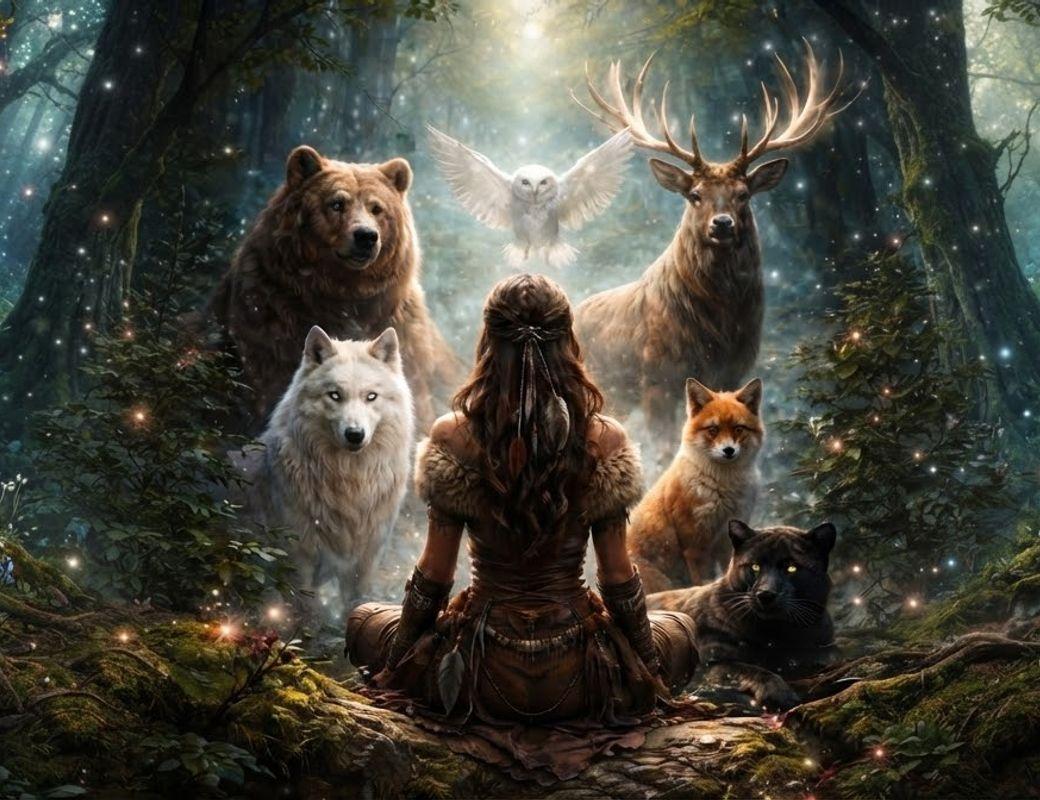
A guide to understanding animal symbolism without turning spirituality into a personality quiz
In the first article, we talked about how to recognize your connection with a power animal. Now let's go a step further. This guide doesn't present meanings as absolute truths. It offers doorways for inquiry.
Observe the animal. Learn its nature.
Then notice what this presence awakens in you.
⸻
🐺 1. Wolf — instinct, belonging, and autonomy
The wolf often appears in spiritual imagery associated with instinct, strength, social intelligence, and the ability to navigate between belonging and autonomy. And there's something fascinating about this animal's actual behavior: wolves establish complex social relationships, cooperate, and depend on communication within the pack.
The wolf can also lead us to the theme of instinct. Ask yourself:
Do I listen to what I feel, or do I spend too much time trying to rationalize everything?
⸻
🦉 2. Owl — perception and what lies hidden
The owl is associated, across many traditions and symbolic systems, with perception, the night, and the ability to see what remains concealed.
In nature, its nocturnal life requires highly developed senses and a precise ability to locate prey in low-light conditions.
This is why its image works with the theme of perception beyond immediate appearance.
The owl doesn't need to represent "wisdom" in a generic way. It asks:
"What am I seeing but not yet recognizing?"
⸻
🐍 3. Serpent — transformation, instinct, and renewal
Few animals carry as many different meanings as the serpent.
In some traditions, it's associated with healing, renewal, knowledge, or power. In others, it appears linked to danger, fear, or the unknown. This shows exactly why we shouldn't create a universal definition for these animals.
In nature, the serpent grows, sheds its skin, and adapts its behavior to the environment.
In spirituality, its image can open pathways related to transformation, instinct, regeneration, and passage between phases.
⸻
🐆 4. Jaguar — presence, power, and territory
The jaguar holds an important place in different Indigenous cosmologies of South America. In ethnographic records, the relationship between shamanism and big cats appears associated with power, transformation, protection, and otherness.
This deserves respect: we shouldn't extract elements from specific cosmologies and turn them into a universal formula for "jaguar meaning."
In personal interpretation, we can first observe the animal itself. The jaguar is silent, territorial, adaptable, and extremely efficient in hunting.
Its presence can invite reflection on strength without the need for constant display.
⸻
🦅 5. Eagle — vision, height, and perspective
The eagle commonly appears in different spiritual systems associated with vision, freedom, elevation, and perspective.
Its behavior also offers a powerful image: from above, it perceives the environment in a completely different way than those who remain on the ground.
This may be the eagle's great lesson:
shift your perspective before trying to change the situation.
Not every problem needs immediate action.
Some need enough distance to be understood.
⸻
🦊 6. Fox — adaptation, intelligence, and strategy
The fox is often associated with cunning and the ability to find alternative paths.
In nature, its survival involves adapting to the environment, exploring available resources, and behavioral flexibility.
So its message doesn't have to be "be clever." It might be:
"Stop insisting on the same strategy when the environment has already changed."
The fox teaches a different kind of intelligence from one based on force.
It observes.
Assesses.
Adapts.
Acts.
⸻
🐻 7. Bear — strength, protection, and withdrawal
The bear can represent strength, protection, presence, and the capacity for withdrawal in different contemporary spiritual readings.
Its own biology offers an interesting reflection: periods of intense activity alternate, in some species and conditions, with periods of lower activity and energy conservation.
This is why the bear can bring a question that goes beyond the idea of "strength":
"When do I need to push forward, and when do I need to conserve my energy?"
Strength is also knowing when to stop.
⸻
🦌 8. Deer — sensitivity and attentiveness
The deer is frequently associated with gentleness, sensitivity, and connection with nature in different symbolic traditions.
But there's an even more interesting interpretation when we observe its behavior.
Prey animals need to develop constant awareness of their environment.
Sensitivity, in this context, doesn't mean fragility. It means perception.
The deer can bring the question:
"Is my sensitivity a weakness or a form of intelligence?"
⸻
🐎 9. Horse — movement, freedom, and direction
The horse has a profound historical relationship with different human societies and appears in countless traditions as a symbol of movement, journey, strength, and freedom. In personal interpretation, it can represent the need to break free from stagnation.
But there's a more important question than simply "do I need to be free?":
"Free to go where?"
Movement without direction can also be escape. The horse can teach strength accompanied by purpose.
⸻
🐦⬛ 10. Raven — intelligence, mystery, and transformation
The raven occupies very different symbolic positions across cultures. In some traditions it appears connected to creation, intelligence, transformation, or the spiritual world; in others, it may carry associations with death and omens.
This makes the raven an excellent example of how there is no universal meaning for an animal.
Its intelligence and adaptability are also part of what we can observe in nature.
In personal interpretation, the raven can open questions about shifting perspective, mystery, and what needs to be understood before being judged.
⸻
🕷️ 11. Spider — creation, patience, and construction
The spider has one characteristic that's impossible to ignore: it builds.
Its web requires precision, repetition, energy, and time.
This is why, in contemporary spiritual readings, it can represent creation, connection, patience, and conscious construction. But there's another important dimension. The spider also teaches that what we build requires maintenance.
⸻
🦋 12. Butterfly — transformation and passage
The butterfly is one of the most popular symbols when we talk about transformation. But there's a concrete reason for this: its life cycle involves profound changes in form.
The butterfly can also speak about time, vulnerability, adaptation, and passage between states.
It reminds us that transformation doesn't happen only in the moment when something new appears. There's an entire process before that.
⸻
🐾 To close
Don't choose your power animal based on appearance. Or because someone said it matches your personality. Or because it's the prettiest animal on the list.
Observe.
The true value of a power animal isn't in being able to say: This is my animal.
It's in being able to look at it and understand: **There's something here I need to learn.**🐾🌿✨
✨Light on your paths ☀︎︎
𝒫ℴ𝓇
𝒮𝒶𝓃𝓉 𖦹
Responses
No responses yet — start the conversation.
More from the Magazine

Your Witchcraft Doesn't Need to Cost More Than Your Grocery Bill
Build a meaningful practice with ordinary objects, intentional actions, and what you already own.
The Owl - Secrets of Wisdom
The symbolism of the nocturnal bird in mythology, magic, and spiritual practices
How to Attract and Maintain Positive Energy
In Your Home and Other Spaces