Libanomancy
How to read answers in incense smoke
Article · 6 min read · ·
Have you ever noticed how mesmerizing the smoke from a lit incense stick can be as it dances? It rises, twists and forms strange shapes before dissolving into the air. In ancient times, people saw these movements as more than a physical phenomenon—they believed they were a language through which higher powers spoke to us.
Libanomancy (from the Greek libanos, meaning “frankincense,” and manteia, meaning “divination”) is an ancient practice of predicting the future by observing the smoke from burning incense. It’s one of the most poetic and meditative forms of divination. It doesn’t require complicated tools, but it does call for quiet, attention and trust in your intuition.
What is libanomancy, and where did it come from?
This practice goes back to ancient times. The earliest guides to libanomancy date to the Old Babylonian period (around 2000–1600 BCE). In those days, priests and seers used frankincense smoke to learn the will of the gods. From Mesopotamia, the practice spread to Egypt and later became known in Europe.
In ancient times, libanomancy was closely tied to religious rituals. In Ancient Greece and Rome, for example, priests watched the smoke rise from sacrifices to see whether the gods had accepted the offering. Frankincense was also used for divination in Rus’: people judged a sick person’s health or the outcome of an important undertaking by how the smoke from the censer dispersed.
Interestingly, some sources treat libanomancy as the same thing as capnomancy—divination by any kind of smoke. But classical libanomancy does have its own particular focus: it works specifically with the smoke of incense (frankincense, myrrh or sandalwood) and often includes observing how the ash falls.
How to prepare for a reading
Libanomancy isn’t just “telling your fortune with smoke.” It’s a ritual that calls for respect for the process and attention to detail.
What you’ll need:
Incense. Natural resins such as frankincense or myrrh work best, as do quality incense sticks with a clean scent, such as sandalwood or juniper. Scented candles are also an option, but traditional frankincense is thought to have a special energy.
A heat-safe surface. A ceramic or metal holder, an incense burner or a heatproof bowl.
A quiet place. You’ll need somewhere you won’t be disturbed, with still enough air that drafts won’t distort the smoke. It’s also a good idea to air out the room beforehand so the smoke doesn’t linger in stale air.
A notebook and pen. First impressions are often the most accurate, but memory has a way of distorting details. Write everything down right away.
Prepare the space: Clear the area where you’ll practice. Put away anything that might distract you. Light a candle, if you’re using one, and settle into a calm state of mind.
Formulate your question: Like most forms of divination, libanomancy calls for a clear, specific question. Don’t ask, “What’s in store for me in life?” Try asking, “Should I accept this offer?”, “What do I need to know about my relationship with this person?” or “What lesson should I take from my current situation?” The clearer the question, the easier the answer will be to understand.
How to read signs in the smoke
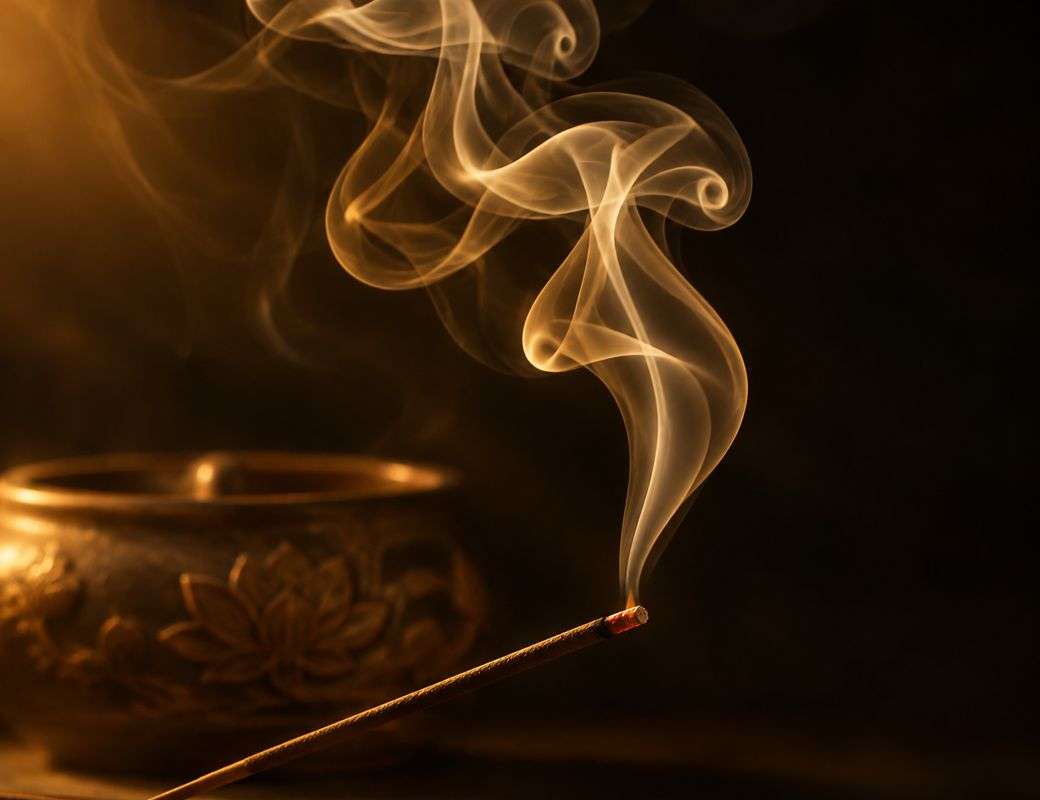
Once you’ve lit the incense and focused on your question, the most important part begins: observation. The smoke may move quickly or slowly, rise in a column or drift along the floor, form rings or break apart into wisps. In libanomancy, each of these signs has its own meaning.
Here are the main things to look out for:
The direction of the smoke:
If the smoke rises straight up in a column, it’s a favorable sign that points to success and support from higher powers.
If the smoke drifts to the right, ancient texts interpreted this as victory over enemies or overcoming obstacles.
If the smoke stays low or “crawls” along the floor, it’s a warning. You may be heading in the wrong direction, or the situation may need your immediate attention.
Shape and movement:
Rings and spirals point to change and energy in motion. Small rings may mean minor troubles, while large ones point to major events.
Thick, billowing smoke points to great joy or, in some traditions, financial success.
A thin, curling stream points to a pleasant encounter, an interesting new connection or a long-awaited guest.
Broken, chaotic clouds of smoke suggest uncertainty, obstacles or a need to clarify your question.
Two columns of smoke were considered an unfavorable sign in ancient texts, even a sign of a loss of mental clarity.
The color of the smoke:
White or silvery smoke is a favorable sign, suggesting clarity and spiritual support.
Bluish smoke points to a successful outcome.
Dark, dingy gray or black smoke is a warning of uncertainty and possible difficulties.
Ash: Although libanomancy is primarily about smoke, some practitioners also watch how the ash falls. If the ash stays on the tip of the incense for a long time without falling, it may mean the situation hasn’t been resolved yet and needs more time.
Remember: these aren’t hard-and-fast rules. Libanomancy is a dialogue. If the smoke forms a shape that feels familiar or brings up a strong association, trust that image more than interpretations you read in a book. Your intuition is your most important tool.
The practice: a step-by-step ritual
Here’s how to do a libanomancy reading on your own.
Step 1. Prepare. Choose a quiet place. Air out the room. Set your incense burner or holder on a heat-safe surface. Get your notebook and pen ready.
Step 2. Settle in. Sit comfortably. Take a few deep breaths. Formulate your question. Repeat it silently three times as you picture the situation you’re asking about.
Step 3. Light the incense. Let the flame burn for a little while, then extinguish it (or let the incense burn down to a glowing ember). Let the smoke rise freely.
Step 4. Observe. Don’t try to analyze it right away. Just watch. Notice the movement, shape, color and speed. Let images come to you on their own. If the smoke forms a shape that reminds you of something, make a note of it.
Step 5. Write it down. After a few minutes, or once the incense has burned down, write down everything you noticed. Don’t edit it. Just pour your impressions onto the page.
Step 6. Close the ritual. Give thanks to the space and the forces you called upon. Put out the incense if it’s still burning. Take a few breaths to “come back” to your usual state.
Step 7. Interpret. Come back to your notes after a while, perhaps the next day. Ask yourself, “What does this mean to me?” Bring together traditional meanings and your personal associations.
In closing
Libanomancy is more than fortune-telling. It’s a practice of paying attention. In a world where we’re always rushing and getting distracted, simply sitting and watching the smoke dance in silence can be healing in itself.
Smoke doesn’t give clear instructions. It doesn’t say, “Do this” or “Don’t do that.” It shows you images that resonate with your question. And often, the answer comes not in words but in a feeling: “Yes, this is about me” or “No, that’s not it.”
Give it a try. Light some incense. Ask a question. And let the smoke tell you a story.
P.S. If you try libanomancy, share in the comments: Which image or shape in the smoke resonated with you most strongly? Sometimes simply describing what you saw is the first step toward understanding.
Responses
No responses yet — start the conversation.