Into the Apple
Myth, Magic, and Harvest
Article · 24 min read · ·
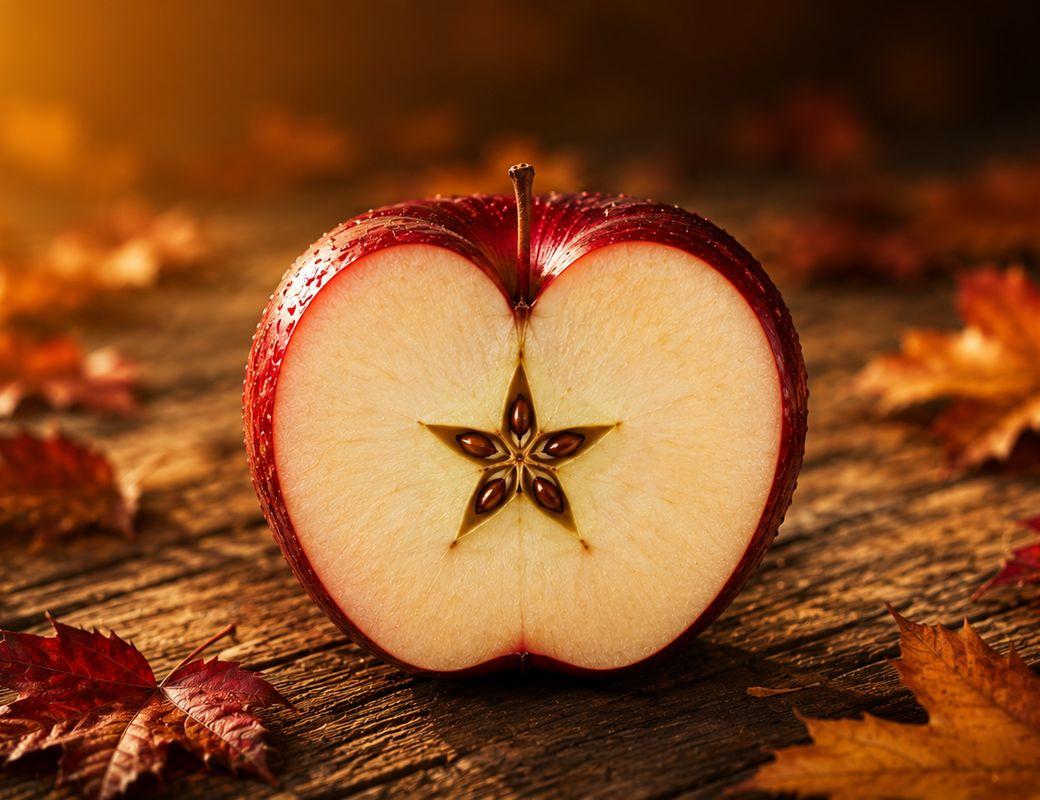
Cut an apple crosswise and something unexpected appears.
At the center, five seed chambers form the shape of a star, hidden beneath the skin and flesh of one of the most ordinary fruits in the world. Modern magical traditions sometimes see a pentagram there, a symbol of protection, the elements, and the sacred patterns concealed within nature. Whether our ancestors saw the same symbol is another question, but the image feels strangely appropriate. Few fruits have gathered as many stories around themselves as the apple.
In myth, apples have belonged to gods and goddesses. They have preserved youth, grown in gardens at the edges of the known world, and appeared on mysterious islands associated with healing and the Otherworld. One golden apple helped set the Trojan War in motion. Another tradition transformed an unnamed biblical fruit into the enduring symbol of temptation and forbidden knowledge. Fairy tales made the apple poisonous, while generations of young people peeled, cut, counted, and bobbed for apples in hopes of discovering whom they would marry.
Again and again, the apple appears at a threshold: between youth and age, knowledge and innocence, love and betrayal, mortality and immortality, this world and whatever might lie beyond it.
Perhaps that is why it feels so at home in autumn.
As the wheel of the year turns toward the autumn equinox and Mabon, orchards grow heavy with fruit. Apples fill baskets and market stalls. They become cider, pies, offerings, decorations, and the familiar tastes and scents of harvest season. Yet beneath all that comfortable familiarity lies something much older and stranger.
From Iðunn’s precious apples in the Norse world to the golden fruit of the Hesperides, from Avalon and the apple-filled Otherworld of Celtic tradition to Eden, Snow White, and old autumn fortune-telling games, the apple has spent centuries carrying our hopes and fears inside its skin.
So before we place another apple on the harvest table, perhaps it is worth cutting one open and looking a little closer.
There is far more hidden inside than a star.
Iðunn’s Apples: Youth in the Hands of a Goddess
In the Norse world, even the gods could grow old.
Their defense against age rested, at least in part, with Iðunn, a goddess associated with youth and renewal who kept precious apples in her care. In the Prose Edda, Snorri Sturluson describes the gods eating her apples when they begin to age, becoming young again. Iðunn’s role is so essential that when she disappears from Asgard, the consequences are immediate.
And, naturally, Loki is involved.
The trouble begins when Loki encounters the giant Þjazi. After a disastrous confrontation, Þjazi forces Loki to make a bargain: he must lure Iðunn out of Asgard, bringing her apples with her.
Loki does exactly that.
He tells Iðunn that he has discovered apples in the forest that she might find remarkable and persuades her to bring her own so that the two can be compared. Once she is beyond the safety of Asgard, Þjazi arrives in the form of an eagle, seizes Iðunn, and carries her away to his home in Jötunheim.
Without her, the gods begin to age.
The change is alarming enough that they gather to determine when Iðunn was last seen. Their attention quickly settles on Loki, who is threatened with death unless he brings her back.
So Loki borrows Freyja’s falcon plumage and flies into Jötunheim. Finding Iðunn alone while Þjazi is away, Loki transforms her into a nut and carries her back toward Asgard in his claws. Þjazi discovers what has happened, takes eagle form once more, and pursues them.
The gods see them approaching and build a fire at the walls of Asgard. Loki crosses safely. Þjazi does not. His feathers catch in the flames, and when he falls, the gods kill him.
Iðunn returns, and with her comes the renewal the gods had lost.
There is something unusual about this Norse vision of divinity. These are powerful beings, but they are not untouched by time. Youth is not simply theirs by right. It must be renewed, and that renewal depends upon something that can be guarded, stolen, lost, and recovered.
The apple becomes more than a symbol of youth. It marks the fragile boundary between flourishing and decline.
And Iðunn stands at that boundary, keeper of the fruit that turns age backward.
The Apple of Discord: The Fruit That Helped Start a War
Some apples preserve youth. Others start wars.
According to Greek myth, this particular trouble began at the wedding of Peleus, a mortal hero, and Thetis, a sea goddess who would later become the mother of Achilles. The gods had gathered for the celebration, but one goddess had deliberately been left off the guest list: Eris, goddess of strife and discord.
Leaving the goddess of discord out of a party, as it turned out, did not prevent discord.
Eris appeared at the celebration and cast a golden apple among the guests. Upon it were words that amounted to a challenge: “To the fairest.”
Three goddesses immediately laid claim to it: Hera, queen of the gods; Athena, goddess of wisdom and warfare; and Aphrodite, goddess of love and beauty. None was willing to concede the prize to another, and Zeus was unwilling to choose between them. Instead, the decision eventually fell to Paris, a Trojan prince who was asked to judge which goddess deserved the apple.
Each offered him something in return for his favor. Hera tempted him with power and kingship. Athena offered victory and glory in war. Aphrodite offered something far more personal: the love of the most beautiful woman in the world.
Paris gave the apple to Aphrodite.
There was, however, a complication.
The woman Aphrodite had promised him was Helen of Sparta, and Helen was already married to King Menelaus.
From there, myth tumbles toward catastrophe. Helen goes to Troy with Paris, Menelaus calls upon his allies, Greek armies sail across the Aegean, and a war begins that will consume heroes on both sides and end with the destruction of Troy.
Of course, no single apple truly causes the Trojan War. Greek mythology gives the conflict deeper roots in divine rivalries, human desire, wounded pride, broken obligations, and fate. But the golden apple becomes the moment when all those forces begin to converge.
And perhaps that is why the story has endured.
The Apple of Discord is not really a story about fruit. It is a story about wanting to be chosen. Hera, Athena, and Aphrodite all reach for the same declaration of superiority. Paris chooses according to what he desires most, and that desire carries consequences far beyond anything he could have imagined.
In Iðunn’s story, the apple restores what time threatens to take away. Here, the apple exposes something far more dangerous: vanity, rivalry, and the human hunger to possess what has been promised.
A golden apple is tossed into a wedding feast.
By the time it stops rolling, Troy is already somewhere on the road to ruin.
The Hesperides: Golden Fruit at the Edge of the World
Not every golden apple in Greek mythology was meant to be fought over.
Some were meant to be guarded.
Far from the familiar world, in a garden at the distant western edge of the earth, grew a tree bearing golden fruit. The garden belonged to Hera, and its keepers were the Hesperides, mysterious nymphs associated with evening and the setting sun.
But the nymphs were not alone. Coiled around the tree was Ladon, a great serpent or dragon who never slept. The details vary among ancient sources, but the message is clear: this fruit was not meant for mortal hands.
Heracles was commanded to retrieve it anyway.
As one of his Twelve Labors, he had to find the garden and bring back its golden apples. Even finding the place was a challenge. Ancient storytellers disagreed about its location, placing it somewhere at the distant boundaries of the known world, where ordinary geography gave way to myth.
The stories also differ on how Heracles obtained the fruit. In one tradition, he kills Ladon and takes the apples himself. In another, he seeks the help of Atlas, the Titan condemned to bear the heavens on his shoulders.
Heracles offers to take Atlas’s burden while the Titan retrieves the apples. Atlas agrees and returns with the fruit, but after tasting freedom from his punishment, he is understandably reluctant to resume it. He offers to deliver the apples himself while Heracles continues holding the heavens.
Heracles appears to agree. He asks Atlas to take back the weight for just a moment while he adjusts the padding on his shoulders.
Atlas does.
Heracles picks up the apples and leaves.
Yet even after such an extraordinary journey, the golden fruit does not remain in the mortal world. In one ancient account, Athena eventually returns the apples to the garden, because sacred things cannot simply be removed from the places where they belong.
The apples of the Hesperides are often described today as fruits of immortality, but the ancient stories are less explicit. What is unmistakable is their sacredness. They belong to Hera, grow in a divine garden, and are guarded at the very edge of the world.
Once again, the apple marks a boundary.
With Iðunn, it stands between youth and age. With Eris, it becomes a prize that exposes vanity and desire. In the garden of the Hesperides, it marks the line between the mortal world and the divine.
Perhaps the mystery of these golden apples lies not in what would happen if someone ate one.
Perhaps it lies in the fact that mortals were never supposed to have them at all.
Avalon: The Island of Apples
From the golden garden at the edge of the Greek world, we travel to another mysterious place beyond ordinary reach: Avalon.
In Arthurian legend, Avalon is the otherworldly island where the wounded King Arthur is carried after his final battle. Its very name has long been connected with apples, most often through the Welsh afallen, meaning “apple tree.”
One of the earliest detailed descriptions appears in Geoffrey of Monmouth’s twelfth-century Vita Merlini, where he calls the place Insula Pomorum, the Island of Fruit Trees. It is a land of extraordinary abundance, where crops grow without the need for ordinary cultivation and nature seems freed from the hardships of the mortal world.
Nine sisters inhabit the island, foremost among them a woman named Morgen.
Morgen is skilled in healing and understands the properties of plants. She can change her shape and move through the air, and when Arthur is brought to the island, she says his wounds may be healed if he remains with her for a long enough time.
This Morgen would become associated with the figure later known as Morgan le Fay, one of the most complicated women in Arthurian tradition. Across centuries of retelling, Morgan shifts between healer, enchantress, adversary, sister, and guardian of Arthur’s final journey. But in this early vision of Avalon, she is first and foremost connected with healing and an island of supernatural abundance.
Later tradition would also connect Avalon with Glastonbury in Somerset, particularly after monks at Glastonbury Abbey claimed in the late twelfth century to have discovered the graves of Arthur and Guinevere. Whether that identification grew from genuine local tradition, medieval politics, the needs of the abbey, or some combination of all three, Glastonbury and Avalon became permanently intertwined in the popular imagination.
But Avalon belongs to something larger than Arthur alone.
Across medieval Welsh and Irish tradition, apples and apple-bearing places repeatedly appear near the edges of the Otherworld, places of abundance, healing, beauty, and mysterious journeys beyond ordinary human experience.
That makes Avalon’s apple connection feel especially fitting.
Once again, the apple grows at a threshold.
Not simply between mortals and gods, but between this world and another, between injury and healing, and, in Arthur’s case, perhaps even between death and the possibility of return.
The road to Avalon leads away from the battlefield.
And somewhere at its end, the apple trees are waiting.
Apples Beyond the Veil: Celtic Otherworld Traditions
Avalon is not the only otherworldly island associated with apples.
Across medieval Irish tradition, the sea is dotted with strange islands and distant realms that exist somewhere beyond the boundaries of ordinary life. They are places of beauty and abundance, where sickness and sorrow may be absent, where time moves differently, and where a mortal traveler can cross into another world without immediately realizing how far from home they have gone.
Among them is Emain Ablach, a legendary island whose name is commonly understood as something like “Emain of the Apple Trees.” It is associated with Manannán mac Lir, the great supernatural figure connected with the sea and the Otherworld, and belongs to a larger landscape of enchanted islands imagined somewhere beyond mortal shores.
The apple tree, then, is not simply growing in an orchard. It is growing on the far side of a boundary.
That same sense of invitation into another world appears beautifully in the medieval Irish tale The Voyage of Bran.
Bran is walking near his stronghold when he hears music so beautiful that it lulls him to sleep. When he wakes, he discovers a remarkable silver branch beside him, covered in white blossoms.
Later, a mysterious woman appears before Bran and his gathered company. She tells him the branch comes from another land and sings of a place across the sea where there is no grief or treachery, no sickness or death. It is a world of beauty, music, abundance, and perpetual delight.
Then she disappears, and the branch disappears with her.
Bran cannot simply forget what he has heard.
He gathers his companions and sails west in search of the world she described.
What follows is not merely a voyage across water. It is a journey away from ordinary human reality. Bran encounters Manannán mac Lir traveling over the sea and eventually reaches the Island of Women, where he and his companions remain in happiness for what seems to them like a relatively brief time.
Eventually, homesickness draws them back toward Ireland.
But Ireland has moved on without them.
When they approach the shore, the people there know Bran only from ancient stories. Generations have passed while the travelers believed themselves gone for a much shorter time. One of Bran’s companions steps onto Irish soil and immediately crumbles to dust, as though all the missing years descend upon him at once.
The Otherworld may offer freedom from ordinary time, but returning to ordinary time is another matter entirely.
The mysterious flowering branch in The Voyage of Bran is not always explicitly identified in the earliest text as an apple branch, although later tradition and interpretation have often connected it with one. That distinction matters. But placed beside Emain Ablach and the wider association between fruit-bearing islands and the Otherworld, the imagery belongs to a recognizable pattern.
We encounter another piece of that pattern in The Voyage of Máel Dúin.
During Máel Dúin’s long journey through a sea filled with extraordinary islands, he and his companions reach a place where they find enormous apples. One apple is so abundant that it sustains the voyagers for many days. Something completely familiar has become impossibly plentiful.
And that may be one reason the apple fits these stories so well.
An apple is not an exotic fruit from some unimaginable land. For the people telling these tales, it belonged to the recognizable world. Yet in the Otherworld, the familiar becomes extraordinary. A branch can summon someone across the sea. An orchard can belong to an island beyond ordinary time. A single piece of fruit can contain more nourishment than nature should allow.
There is no single, universal “Celtic meaning of the apple,” and it would be misleading to invent one. What survives instead is something more interesting: a recurring relationship between apples, abundance, enchanted landscapes, and journeys across the boundary of the known world.
Avalon begins to look less like an isolated curiosity and more like part of a much wider imaginative landscape.
The apple tree has its roots in familiar earth. Its fruit belongs to orchards, kitchens, harvest baskets, and the turning seasons.
But in these old stories, its branches sometimes reach across the water and into another world.
And every so often, someone is tempted to follow.
The Forbidden Fruit: How Eden Became an Apple
For all the apples that appear in mythology, the most famous apple in Western culture may be one that was never actually there.
The Book of Genesis never identifies the forbidden fruit as an apple.
In the story, Adam and Eve live in the Garden of Eden, where they may eat from the trees around them with one exception: the fruit of the Tree of the Knowledge of Good and Evil. The serpent persuades Eve to eat from the forbidden tree, telling her that she will not die but that her eyes will be opened and she will become like God, knowing good and evil.
Eve eats the fruit and gives some to Adam.
Their eyes are opened, but knowledge does not arrive without consequence. They become aware of their nakedness, hide from God, and are ultimately expelled from Eden.
Genesis calls what they eat simply “fruit.”
So how did an unnamed fruit become an apple?
The answer is not as simple as the familiar claim that someone mistranslated the Bible.
One important piece of the story comes from Latin. The Latin noun mālum could mean “apple,” while malum, with a different vowel sound, meant “evil” or “misfortune.” Written without markings to distinguish the vowel length, the words could look identical. For medieval writers and artists, the wordplay offered an irresistible connection between the fruit and the Fall.
But the pun alone probably does not explain everything.
Apples were already familiar fruits in Europe, and over the centuries Western artists increasingly depicted the forbidden fruit as one. By the later Middle Ages and Renaissance, the image had become deeply embedded in Christian art and popular imagination.
Eventually, the apple became so inseparable from Eden that many people came to remember something the biblical text never actually says.
And once the apple entered the story, it inherited an extraordinary burden of symbolism.
This was no longer the golden fruit guarded at the edge of the world or the apple associated with supernatural abundance. The fruit of Eden became associated with temptation, disobedience, knowledge, shame, mortality, and the loss of innocence.
Yet even here, the symbolism is more complicated than simply “apple equals evil.”
Eve reaches for knowledge.
That has made the forbidden fruit a remarkably flexible symbol. Depending on who is telling the story, her act can represent sin and disobedience, dangerous curiosity, the human hunger for wisdom, or the irreversible moment when innocence gives way to awareness.
Perhaps that complexity is one reason the apple became such a powerful image.
It looks ordinary. Familiar. Harmless.
But once Western tradition placed it in Eve’s hand, taking a bite could mean crossing a boundary from which there was no return.
And from that point forward, storytellers would never look at a beautiful red apple quite the same way again.
Snow White: Beauty, Poison, and the Dangerous Apple
Once the apple became tangled with temptation, knowledge, and consequence, it was perfectly suited for darker stories.
Few made better use of it than Snow White.
In the version published by the Brothers Grimm, the jealous queen has already tried more than once to kill Snow White before she ever reaches for the apple. Disguised as an old woman, the queen first attempts to suffocate her with tightly laced stays. Later, she returns with a poisoned comb.
Both attempts fail.
So the queen prepares something far more tempting.
An apple.
The fruit is beautiful, with a red cheek so inviting that Snow White longs for it. But the queen has poisoned only part of the apple. To overcome Snow White’s suspicion, she cuts it in two and eats from the harmless portion herself.
Snow White takes the poisoned half.
One bite is enough.
She falls to the ground, apparently dead, and when the dwarfs return, they cannot revive her. Because she remains strangely beautiful and shows no sign of decay, they cannot bear to bury her. Instead, they place her inside a glass coffin, where she lies as though asleep.
Eventually, a prince encounters the coffin and becomes captivated by her. In the Grimm tale, there is no awakening kiss. As Snow White’s coffin is being carried away, one of the prince’s servants stumbles. The jolt dislodges the piece of poisoned apple from Snow White’s throat, and she awakens.
The apple has crossed another threshold.
In Eden, the fruit brings knowledge and the loss of innocence. In Snow White, it carries a young woman to the border between life and death. In both stories, something beautiful and desirable conceals a consequence that cannot be seen from the outside.
It is tempting to call Snow White’s apple simply another version of Eve’s forbidden fruit, but folklore rarely travels in such a straight line. There is no need to assume that the Grimm tale was consciously recreating Eden.
The resemblance is powerful enough on its own.
By the time Snow White entered the literary fairy-tale tradition, European audiences had spent centuries encountering fruit as a symbol of temptation and danger. A beautiful apple offered by an untrustworthy stranger already carried possibilities far darker than its shining skin suggested.
And Snow White adds another element that will matter when we turn from fairy tale to folk magic.
The apple can deceive.
Its outside tells you nothing about what waits within.
Perhaps that is why apples became so useful not only in stories, but in divination. They could be peeled, sliced, counted, broken open, and examined for secrets hidden beneath the surface.
The poisoned apple asks us not to trust appearances.
The apples of folk magic ask us to look more closely.
Apple Magic: Love, Divination, and Autumn Fortune-Telling
Not every magical apple belonged to a goddess, grew on an enchanted island, or concealed poison beneath its skin.
Some sat in an ordinary kitchen.
For generations, apples were used in folk customs and fortune-telling games, particularly those concerned with love, marriage, and the identity of a future spouse. Many became associated with autumn celebrations, especially Halloween and the older seasonal traditions that gathered around the end of the harvest.
Some of these customs survive today as children’s party games, stripped of most of their original purpose.
Bobbing for apples is a perfect example.
A tub was filled with water, apples were set floating on the surface, and participants attempted to catch one using only their teeth. Today it is mostly remembered as a messy Halloween game. Historically, however, apple-catching games could carry romantic and divinatory meanings. In different versions of the custom, success might predict good fortune in love or marriage, and apples could be associated with particular prospective sweethearts.
The game was entertainment, certainly, but it could also be a way of asking the future a question.
Other methods required nothing more than an apple and a knife.
One of the best known involved peeling an apple while trying to keep the skin in one long, unbroken strip. The peel was then thrown over the shoulder. When it landed, its shape was examined for a letter, supposedly the initial of a future husband or wife.
Apple seeds offered their own possibilities.
Young people counted them, recited rhymes over them, or used them to answer questions about romance. One old seed-counting rhyme begins, “One I love, two I love,” and continues through a sequence of possible romantic fortunes. Different places and generations preserved different versions, but the idea remained wonderfully simple: an apple already contained the answer. You only had to open it and count.
Another custom turned the seeds themselves into prospective lovers.
A person with several sweethearts in mind might name a wet apple seed for each one and press the seeds against the face or forehead. As they dried, the seeds would fall away. The one that remained attached the longest revealed the lover who was supposedly most faithful, or the person destined to become a future spouse.
Even the act of cutting an apple could become divination.
Customs recorded for Saint Thomas’s Day or Saint Thomas’s Eve, traditionally associated in parts of Britain and Europe with marriage divination, included counting the seeds inside an apple. An even or odd number might be interpreted as an omen concerning marriage, while accidentally cutting a seed could signal trouble or delay in love.
None of these practices had one universal set of rules. Folk magic rarely does. Customs changed from village to village and family to family, and printed collections often preserve several versions of what was supposedly the same game.
What remains consistent is the question people were asking.
Who will I love?
Who will love me?
Will I marry?
What does the future hold?
And the apple was particularly suited to answering.
It could float. It could be peeled into long curling shapes. Its seeds could be counted and named. It could be sliced open to reveal the five chambers hidden at its center. Nearly every part of the fruit could be turned into a sign.
There is something wonderfully human about that.
The great myths placed golden apples in divine gardens and at the edges of the world. Folk tradition brought the mystery home. You did not need to find Avalon or enter the garden of the Hesperides. You needed an apple, perhaps a candle, a few friends, and a question you desperately wanted answered.
For all the laughter these games must have inspired, there was often something serious beneath them.
The future, particularly the future of love and marriage, could determine the entire course of a person’s life. Divination offered a playful way to approach an uncertainty that was anything but trivial.
And so, on dark autumn evenings, people turned to one of the season’s most familiar fruits and asked it to reveal what they could not yet know.
Sometimes the answer was hidden in the seeds.
Sometimes it appeared in a curling strip of peel.
And sometimes you simply had to reach into the water and try to catch it with your teeth.
The Star Inside the Apple
After all these stories, it can be difficult to look at an apple as simply an apple.
Across centuries of myth, legend, religion, fairy tale, and folk practice, this familiar fruit has been asked to carry an extraordinary amount of meaning.
In one story, it renews the youth of gods. In another, it becomes the prize at the center of a rivalry that leads toward war. Golden apples grow in a divine garden beyond mortal reach, while apple trees appear on islands associated with abundance, healing, and the Otherworld.
Then the symbolism darkens.
An unnamed fruit in Genesis becomes an apple in the Western imagination, carrying with it temptation, knowledge, and the loss of innocence. In Snow White, the beautiful fruit conceals poison. And in autumn folk traditions, the apple becomes something else again: an ordinary object through which people try to glimpse the future.
The meanings contradict one another.
That may be precisely why the apple has endured.
It can represent life and death, healing and danger, wisdom and temptation, love and rivalry, abundance and loss. It belongs to gods and witches, queens and heroes, lovers and children playing games on autumn nights.
And unlike so many objects of myth, it never disappeared from everyday life.
We still pick apples from trees. We still carry them home by the basketful. We bake them into pies, press them into cider, simmer them with spices, and place them on autumn tables. At Mabon, when attention turns toward harvest, balance, gratitude, and the approaching dark half of the year, the apple feels almost inevitable.
Perhaps that familiarity is part of its magic.
The extraordinary has always been easiest to imagine when it hides inside something ordinary.
So sometime this autumn, take an apple and cut it crosswise.
Look at the five chambers arranged around its center, forming the little star concealed inside. There is no need to pretend that ancient people universally saw a pentagram there, or that the shape has carried one unbroken magical meaning across thousands of years.
The truth is more interesting.
Generation after generation looked at this ordinary fruit and found something worth telling stories about. They placed it in the hands of goddesses and queens. They planted it on the shores of other worlds. They made it forbidden, poisonous, healing, desirable, and prophetic. They peeled it and counted its seeds and asked it questions about people they had not yet met.
The apple did not begin with one meaning.
We gave it many.
And perhaps that is the secret waiting inside when we cut one open: not proof of some single ancient mystery, but a reminder of how much wonder human beings have always been able to find in the things growing right in front of us.
A fruit from the harvest.
A star at its center.
And thousands of years of stories gathered around it.