I Ching - The Ancient Book About Art of Changes
How to work with the Book of Changes, ask questions, and bring its ancient wisdom into your life
Article · 6 min read · ·
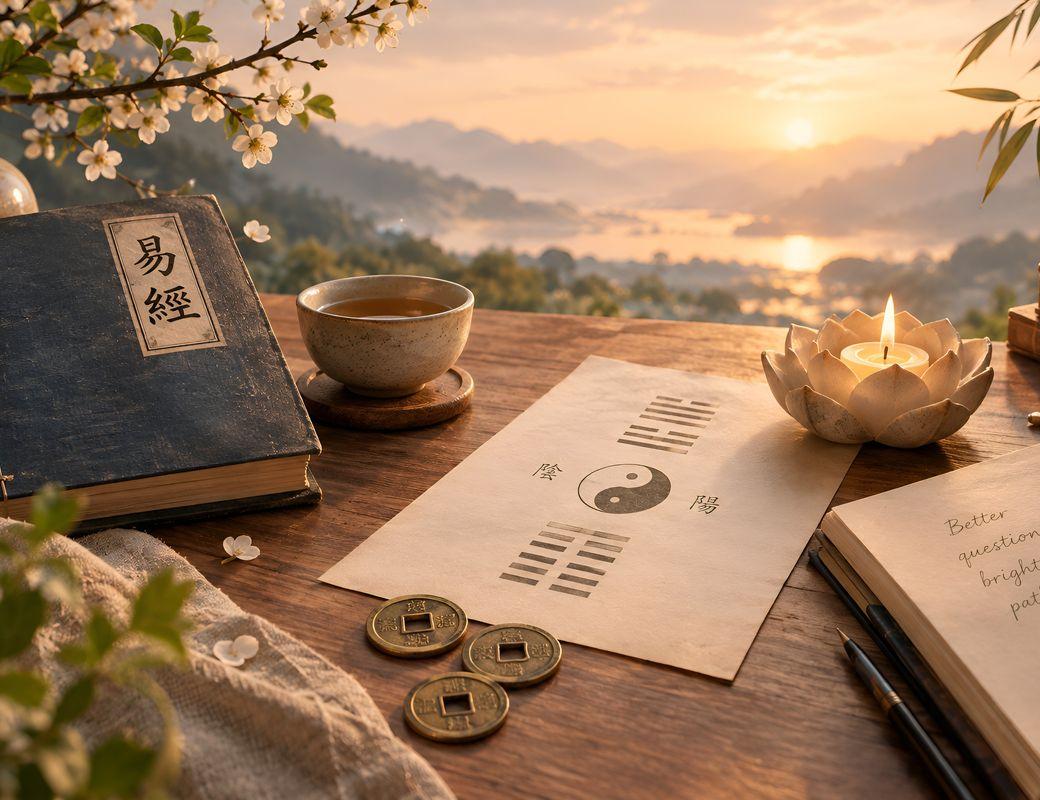
Can you receive guidance from a system that is more than two thousand years old? The I Ching - or the “Book of Changes” - offers exactly this kind of experience.
It is an ancient Chinese system that combines philosophy, symbolism, and divination. Its central idea is surprisingly modern: everything changes. What seems stable today may take on an entirely different form tomorrow. Instead of trying to obtain an exact prediction of the future, the I Ching invites us to look at the present situation, understand its dynamics, and find the most conscious way to respond.
If Tarot speaks to us through images and archetypes, the I Ching describes life through Yin, Yang, and 64 hexagrams - symbolic patterns representing different situations and processes.
What Is the I Ching?
The foundation of the system is made up of 64 hexagrams. Each one consists of six horizontal lines, which can be either solid or broken.
A solid line is associated with the principle of Yang, while a broken line is associated with Yin. These are not simply symbols of “good” and “evil.” Yin and Yang describe complementary forces - activity and stillness, light and darkness, movement and rest.
The lines of a hexagram are built from the bottom upward. Their combination creates a particular image or pattern of a situation.
Some lines can be changing lines. They indicate that a particular aspect of the situation is undergoing transformation. In this case, a second, related hexagram may emerge, helping us see the possible direction in which the situation may develop.
The word “Changes” is especially important here. The I Ching does not view life as something fixed. Every situation has its own cycle, and every change creates new possibilities.
How to Ask the Right Question
Before tossing the coins, take a few minutes to pause. The best consultation begins not with the coins, but with a good question.
The I Ching works particularly well with questions that help you understand your own position and possible actions.
For example:
“What is important for me to see in this situation?”
“What approach can help me develop this project?”
“What should I pay attention to before making this decision?”
“What is currently standing in the way of my growth?”
Questions such as “Will this happen?” or “When exactly will I get what I want?” leave much less room for reflection.
Instead of asking the I Ching what you should do, try asking what you need to understand, see, or take into consideration.
A Simple Way to Create a Hexagram
For your first introduction to the system, you can use three identical coins.
Before you begin, formulate one specific question. It is important not to change it during the process.
1 - Prepare three coins
Decide beforehand which side of the coin will represent Yin and which will represent Yang, and choose the counting method you will use. Different traditions may have different versions of the method, so the most important thing is to choose one and follow it consistently.
2 - Make the first toss
Toss all three coins at the same time and record the result.
This will become the first, bottom line of your hexagram.
3 - Repeat the process six times
Each subsequent toss creates the next line. Remember: the hexagram is formed from the bottom upward.
After six tosses, you will have a complete hexagram.
4 - Find its number
Use the resulting combination to determine the number of the hexagram in your I Ching reference guide or app.
5 - Check for changing lines
If your method produces changing lines, pay special attention to them. They show the parts of the situation where movement or transformation is taking place.
Once these lines change, a second hexagram may emerge. It can help you understand where the situation may be heading.
How to Read the Answer
Do not immediately look for a single sentence that is supposed to “explain everything.”
First, look at the overall image of the hexagram. What is the atmosphere of the situation? Does it speak about movement, waiting, conflict, beginnings, endings, patience, or the need to change your approach?
Then read the main interpretation and pay attention to the changing lines, if there are any.
After that, ask yourself the most important question:
“What can I do with this information?”
Even the most insightful interpretation cannot replace your own decision.
What Not to Do
One of the most common mistakes in any divination practice is asking the same question over and over until you get an answer you like.
If the hexagram you receive disappoints you, it does not mean that you should immediately toss the coins again. Perhaps the answer is simply showing you an aspect of the situation that you did not want to notice.
Write down the result and give it some time.
It is also better not to ask dozens of questions about the same situation in one evening. The I Ching becomes much more interesting when used as a dialogue with yourself, rather than as a way to obtain an endless stream of predictions.
The I Ching in Everyday Life
This system can be useful not only for major life dilemmas.
Work
Ask:
“What should I take into consideration in developing my career right now?”
or
“What approach would be most favorable for this project?”
Relationships
Instead of trying to find out what another person is thinking, explore your own position:
“What is important for me to understand about the dynamics of this relationship?”
Finances
Instead of asking, “Will I become rich?”, try:
“What is important for me to consider about my financial situation right now?”
The answer can then become an opportunity to reconsider your habits, strategy, or relationship with resources.
Personal Growth
The I Ching can be used as a kind of mirror for your own patterns:
“What lesson am I going through right now?”
“What is standing in the way of my growth?”
Keep an I Ching Journal
If you plan to work with the system regularly, create a separate notebook for it.
For each consultation, record the date, question, hexagram number, changing lines, your first associations, and the main interpretation.
Then return to your old entries after a few weeks or months.
This can be a fascinating experience: you may begin to see how situations unfolded and how your own understanding of the answers changed over time.
Try It Today
If you would like to get acquainted with the I Ching, start with a simple question:
“What is important for me to understand about the stage of life I am in right now?”
Create one hexagram, write down your first three associations, and then read its traditional interpretation.
And most importantly, finish by identifying one specific action you can take.
You do not have to change your entire life at once. Sometimes one small action taken at the right moment can change your direction far more than dozens of attempts to predict the future.
The Art of Not Knowing in Advance
Perhaps the most valuable lesson of the I Ching lies precisely in accepting change.
We cannot know for certain what will happen tomorrow. But we can look more carefully at what is happening today.
The I Ching does not have to be a book that tells you what will happen. Let it become a companion that helps you ask the right question, see a situation from another perspective, and understand when it is time to act and when it is better to allow things to unfold.
After all, change cannot be stopped. But we can learn how to move with it.
Responses (3)

More from the Magazine
Your Witchcraft Doesn't Need to Cost More Than Your Grocery Bill
Build a meaningful practice with ordinary objects, intentional actions, and what you already own.

The Owl - Secrets of Wisdom
The symbolism of the nocturnal bird in mythology, magic, and spiritual practices

How to Attract and Maintain Positive Energy
In Your Home and Other Spaces