From Fear to Fortune
The Story of Black Cats and Halloween
Article · 20 min read · ·
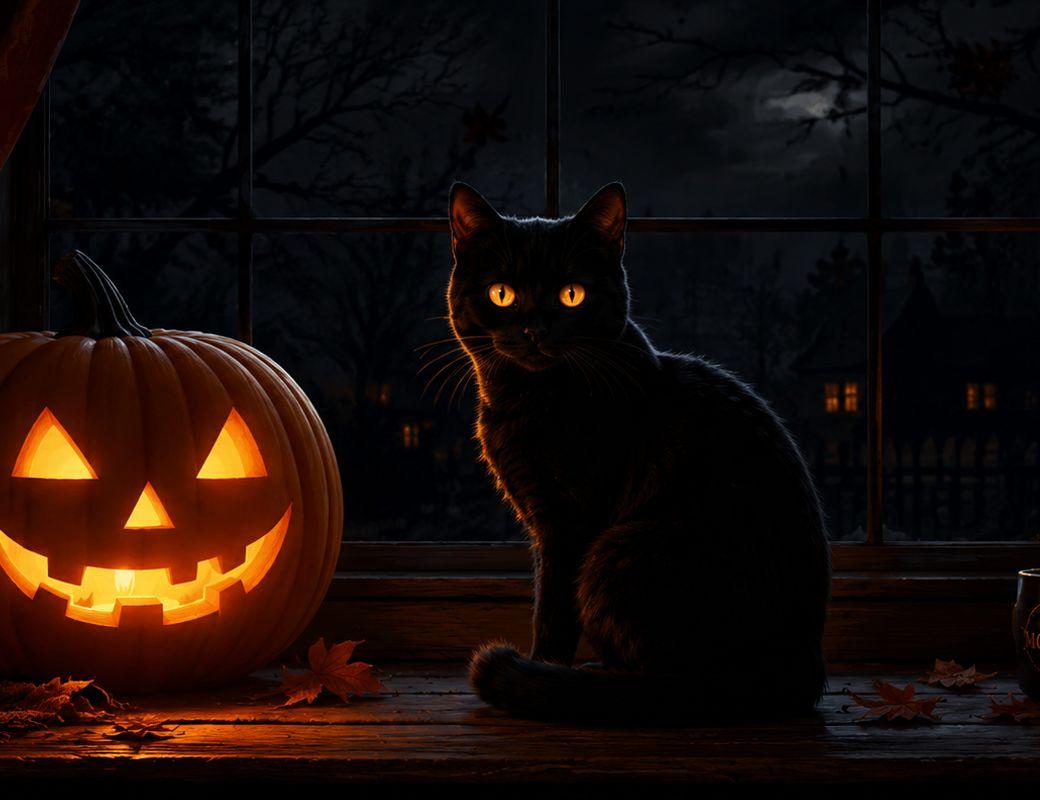
Every Halloween, black cats seem to appear everywhere. They peer from greeting cards and shop windows, curl beside witches on decorations, and slip through haunted scenes with glowing eyes and arched backs. Alongside pumpkins, ghosts, and pointed hats, the black cat has become one of the season’s most recognizable symbols.
But how did an ordinary house cat become so closely associated with Halloween?
The answer is far more complicated than the familiar idea that black cats simply mean bad luck. Their story stretches across centuries of religious fear, witchcraft accusations, folklore, literature, and changing cultural attitudes. At different times and in different places, black cats have been imagined as companions of witches, supernatural beings, omens of misfortune, protectors, and even signs of prosperity and good luck.
Some of those beliefs have deep historical roots. Others developed much later, gradually blending together until the black cat and Halloween became almost impossible to separate in the popular imagination. What looks today like one ancient tradition is actually a patchwork of stories gathered from different centuries and cultures.
So this Halloween, let’s follow the black cat out of the shadows and into the history behind the legend. Along the way, we will encounter a medieval pope, accused witches and their familiars, a mysterious fairy cat prowling the Scottish Highlands, and even the surprising origins of the belief that cats have nine lives.
Because when it comes to the black cat, bad luck was never the whole story.
The Medieval Turning Point: When the Black Cat Entered the Shadows
The black cat’s journey toward its darker reputation did not begin with Halloween. One important chapter unfolded in medieval Europe, where religious fears about heresy, magic, and the Devil increasingly shaped the way certain animals and symbols were understood. In 1233, those fears found an unusually vivid expression in a papal document known as Vox in Rama.
Issued by Pope Gregory IX, Vox in Rama responded to reports from the German churchman and inquisitor Conrad of Marburg, who claimed to have uncovered a secret heretical sect in Germany. The accusations against the supposed group were sensational, describing elaborate initiation ceremonies involving demonic figures, strange rituals, and acts of worship directed toward the Devil.
Among the most memorable figures in the account was an enormous black cat.
According to the document, a black cat described as being about the size of a dog appeared during one of these alleged ceremonies, descending backward from a statue. Members of the group were then said to approach and kiss the animal as part of their initiation. The image was disturbing, theatrical, and almost certainly intended to be.
There is little reason to treat this description as an eyewitness account of an actual secret cult. Medieval accusations of heresy frequently included lurid claims about inverted religious ceremonies, sexual misconduct, demons, and Devil worship. Such stories helped portray suspected heretics not simply as people holding forbidden beliefs, but as participants in a dangerous spiritual conspiracy.
What makes Vox in Rama particularly interesting for the history of black cats is the role the animal was given within that imagined world. The cat was no longer simply an animal moving through barns, streets, and households. In this story, the black cat became part of a ritual involving heresy and the demonic.
One papal document did not suddenly convince all of medieval Europe that black cats were evil, nor did it single-handedly create every superstition that followed. Folklore rarely develops so neatly. Beliefs accumulate over time, absorbing religious anxieties, local traditions, stories, and fears until their origins become difficult to separate.
Still, Vox in Rama offers us an important glimpse of a transformation already underway. The black cat had entered the shadows of the European imagination, and over the centuries that followed, its association with supernatural danger would become even stronger.
Soon, the cat would acquire another companion in popular belief.
The witch.
The Witch’s Companion: Cats and Familiar Spirits
By the sixteenth and seventeenth centuries, fear of witchcraft had spread across much of Europe, and animals increasingly appeared within accusations made against suspected witches. Among the most enduring beliefs was the idea of the familiar, a supernatural spirit thought to assist a witch with magical work. These spirits could supposedly appear in animal form, and cats became one of the creatures associated with them.
The familiar was not necessarily understood as an ordinary household pet. Within witchcraft accusations and popular folklore, it could be imagined as a spirit, demon, or supernatural servant that assumed the appearance of an animal. Cats, dogs, birds, and other creatures might all fill this role, depending upon the story and the region.
For the black cat, however, this association added another layer to a reputation already darkened by earlier connections with the demonic. A cat living alongside a suspected witch could become more than a companion in the fearful imagination of her neighbors. It might be interpreted as evidence that supernatural forces were close at hand.
The legends became stranger still.
Some traditions claimed that witches themselves could assume the shape of cats. Others suggested that the Devil could appear in feline form, turning an animal encountered along a road or outside a home into something potentially threatening. Once that possibility entered folklore, even an ordinary encounter could acquire supernatural meaning.
A black cat crossing someone’s path could therefore become unsettling not because the animal itself carried misfortune, but because people might wonder what, or who, they had actually encountered.
These ideas flourished during an era when accusations of witchcraft could have devastating consequences. They also helped create an image that would survive long after the European witch trials themselves had faded into history: the witch accompanied by her cat.
Today, that pairing is so familiar that it appears almost playful. Halloween decorations show witches flying beneath full moons while black cats arch their backs nearby. Costumes, greeting cards, films, and seasonal displays repeat the image every October.
Yet beneath that familiar Halloween scene lies the memory of a much older fear, one in which the boundary between human, animal, spirit, and witch was believed to be frighteningly thin.
That belief that a witch might take the shape of a cat produced another, rather unexpected piece of folklore. According to one early English account, a witch could assume a cat’s body not just once, but repeatedly. That curious idea leads us to one of the most familiar sayings about cats today: that they have nine lives.
Nine Lives: A Witch in a Cat’s Body
Cats have an uncanny ability to escape situations that look as though they should have ended badly. They leap from impossible heights, squeeze through spaces that seem far too small, and occasionally emerge unharmed from mishaps that leave their humans wondering how they managed it. It is easy to understand why we eventually began joking that cats must have more than one life.
But an intriguing early appearance of the idea of a cat having nine lives has much less to do with feline survival and considerably more to do with witchcraft.
The connection appears in Beware the Cat, an unusual work attributed to the English writer William Baldwin. Written around 1553 and published in 1584, the book is sometimes described as one of the earliest English novels. Among its strange collection of stories and supernatural ideas is a passage connecting cats, witches, transformation, and the number nine.
The text declares that “a Cat hath nine lives,” but the explanation that follows is very different from the saying as we understand it today. Baldwin connects those lives with the belief that a witch could assume the body of a cat nine times. After the ninth transformation, according to the account, she would remain trapped in feline form.
It is a wonderfully strange piece of folklore, especially because the expression survived while its supernatural explanation largely disappeared.
Over time, the nine lives of the cat became associated instead with the animal’s remarkable agility and apparent talent for surviving danger. The witch faded from the saying, but the mysterious number remained. What had once belonged to a world of transformation and supernatural suspicion gradually became a familiar expression about the resilience of cats.
Yet stories of humans becoming cats were not confined to English witchcraft lore.
Far to the north, among the traditions of the Scottish Highlands, another mysterious black cat prowled through the imagination. Larger than an ordinary cat, marked by a patch of white upon its chest, and sometimes described as either a fairy creature or a witch capable of transformation, it belonged to a world where the boundaries between the natural and supernatural were never entirely secure.
Its name was the Cait Sìth, and unlike many of the legends we have encountered so far, its story brings us directly to Samhain.
The Cait Sìth: The Black Cat of Samhain
If medieval Christianity helped connect the black cat with the Devil and European witchcraft lore transformed it into a familiar or shape-shifting witch, the folklore of the Scottish Highlands gives us something altogether different.
Here we meet the Cait Sìth, a mysterious supernatural cat whose legends bring the black cat directly into the traditions surrounding Samhain. Its name comes from Scottish Gaelic and is often translated as “fairy cat.” The creature was typically described as an unusually large black cat with a distinctive white patch upon its chest.
Depending upon the tradition, the Cait Sìth could be understood in different ways. Sometimes it belonged to the world of the Aos Sí, the supernatural or fairy folk of Gaelic tradition. In other stories, it was connected with witches who supposedly possessed the ability to transform themselves into cats.
Here, once again, the number nine appears.
According to later folklore, a witch could transform into a cat eight times and return to human form. If she chose to make the transformation a ninth time, however, she would remain a cat forever. It is an intriguing echo of the witchcraft tradition we encountered earlier, although folklore rarely travels in a straight line, and similar ideas can become intertwined as stories are retold across generations.
The Cait Sìth’s connection with Samhain is especially important to our story.
Samhain marked the transition into the darker half of the year, a liminal period surrounded by traditions concerning spirits, the dead, and supernatural beings. According to Scottish folklore, the Cait Sìth might roam from farm to farm on Samhain night. Households could leave out a saucer of milk for the creature, hoping to gain its favor. A household that treated the Cait Sìth generously might receive its blessing, while one that neglected the offering risked having its cows cursed so they would produce no milk.
For once, the black cat was not simply something to fear. It was something to respect.
The Cait Sìth also appears in much darker traditions surrounding death. It was sometimes believed that the creature could steal the soul of a newly deceased person before burial. To prevent this, family and community members might keep watch over the body, guarding it from any cat that might approach before the deceased was laid to rest.
These stories place the Cait Sìth precisely where so much Samhain folklore resides: at the boundary between the familiar and the supernatural, the living and the dead, good fortune and misfortune. A saucer of milk might earn its favor, while an unguarded encounter could bring something far more unsettling.
That makes the Cait Sìth particularly important when tracing the black cat’s eventual place beside pumpkins, witches, and ghosts every October. Unlike later Halloween imagery created through literature, tourism, and popular culture, here we find a black supernatural cat already wandering through folklore associated with Samhain itself.
The Cait Sìth did not create the modern Halloween black cat on its own. No single legend did. But among the many threads that eventually became tangled together, this one brings us remarkably close to the holiday.
A great black cat moving through the darkness on Samhain night, crossing between the ordinary world and the supernatural one, feels almost familiar.
Centuries later, we would give it a place beside the witch.
From Witch Trials to Witch City: The Making of a Halloween Icon
By this point, many of the pieces were already in place. Black cats had appeared in medieval stories of heresy, become entangled with beliefs about witches and familiar spirits, and wandered through Gaelic folklore as supernatural creatures associated with Samhain. Yet the image we recognize today, the black cat beside the pointed-hat witch on Halloween night, was still taking shape.
For that, we have to move much closer to the modern world.
The witch trials of early modern Europe and colonial America left an enormous mark on Western culture. Over time, however, the historical reality of those persecutions became intertwined with folklore, literature, theater, illustration, and eventually popular entertainment. The witch gradually developed a recognizable visual identity, and the cat became one of her most enduring companions.
Few places demonstrate that transformation more clearly than Salem, Massachusetts.
The Salem witch trials of 1692 were a genuine human tragedy. More than a century later, however, Salem’s association with witchcraft began developing into something else. By the late nineteenth century and into the twentieth, local businesses and promoters increasingly recognized that the town’s infamous history could also attract visitors. Salem gradually embraced the identity that would eventually make it famous as “Witch City.”
That transformation helped shift the witch from a figure associated primarily with religious fear and persecution into a figure of popular culture.
Halloween was undergoing its own transformation at roughly the same time. As older seasonal customs blended with parties, decorations, postcards, costumes, fortune-telling games, and commercial entertainment, Halloween developed the visual language we still recognize today. Witches flew across moons on broomsticks. Pumpkins grinned from windows. Ghosts floated through the darkness.
And beside the witch sat the black cat.
The pairing was almost perfect.
A black cat already carried centuries of supernatural associations. Its nocturnal habits, reflective eyes, quiet movements, and ability to seemingly appear from nowhere made it an easy creature to cast as mysterious. Add the older traditions connecting cats with witches, shape-shifting, spirits, and Samhain, and the animal fit naturally into Halloween’s developing aesthetic.
Later, modern Pagan and witchcraft movements would reclaim many symbols once associated with fear, including the witch herself. The black cat could likewise be reimagined, not as a servant of evil, but as a companion, protector, magical symbol, or simply a much-loved animal burdened by centuries of human superstition.
By the time Halloween became the cultural celebration we know today, the transformation was complete. The witch and the black cat had become almost inseparable, their silhouettes instantly recognizable against an October moon.
But there is an irony hiding inside that familiar image.
For all the centuries spent associating black cats with witches, demons, bad luck, and things that move through the darkness, not every culture considered encountering one unfortunate.
In some traditions, the black cat brought exactly the opposite.
It brought good luck.
A Change in Fortune: When Black Cats Bring Good Luck
After centuries of demons, witches, shape-shifting, and supernatural cats prowling through the night, it would be easy to assume that black cats have always been considered unlucky.
They have not.
The meaning of a black cat changes dramatically depending upon where you look. The same animal that inspired uneasiness in one place could represent protection, prosperity, love, or good fortune somewhere else. There has never been one universal superstition surrounding the black cat, and some traditions turn its familiar reputation completely upside down.
Lucky Cats at Sea
Sailors were among those who often viewed cats far more favorably. Their presence aboard ships had an obvious practical value. Cats hunted the rats and mice that threatened food stores and other supplies during long voyages, making a good ship’s cat a useful member of the crew.
But sailors have rarely been strangers to superstition, and practical appreciation gradually mingled with maritime folklore. Cats, including black cats, could be regarded as lucky aboard ship, their presence associated with protection and a safe return home.
The superstition could extend onto land as well. Sailors’ wives and families were sometimes said to keep black cats at home because they believed the animal would help protect a loved one while he was away at sea. In that version of the story, the black cat beside the hearth was not warning that disaster was coming. It was helping keep disaster away.
And no story captures the legendary resilience of the ship’s cat better than Unsinkable Sam.
According to the famous tale, Sam began his seafaring career aboard the German battleship Bismarck. When the ship sank in May 1941, the cat was reportedly found floating among the wreckage and rescued by sailors from the British destroyer HMS Cossack.
A few months later, Cossack was torpedoed and eventually sank.
Sam survived again.
He was subsequently taken aboard the British aircraft carrier HMS Ark Royal. In November 1941, that ship was also torpedoed and sank while being towed toward Gibraltar. Once again, Sam reportedly survived, supposedly discovered clinging to floating wreckage.
After losing three ships, Sam’s career at sea finally came to an end. According to the traditional account, he spent the remainder of his life safely on land.
There are questions about how much of Unsinkable Sam’s extraordinary biography can be independently verified, so his adventures are better treated as maritime legend than unquestioned history. But perhaps that only makes him more appropriate for our story. After encountering witches who supposedly transformed into cats nine times, we finally meet a cat who appears determined to use every one of those lives.
The Lucky Cats of Japan
Cross the world to Japan, and the story of the cat takes another turn.
Cats have a long and complicated place in Japanese folklore, but they are certainly not confined to stories of misfortune. They can also be closely associated with luck, prosperity, protection, and the welcoming of good things into one’s life. Perhaps the most recognizable expression of that tradition is the maneki-neko, the little beckoning cat with one paw raised.
These familiar figures can be found near the entrances of shops, restaurants, and businesses, where they traditionally serve as talismans of good fortune and prosperity. The raised paw appears to beckon something closer, inviting customers, opportunity, wealth, or luck through the door.
Maneki-neko come in many colors, so they should not be confused with a specifically black-cat tradition. Black maneki-neko are only one variation within a much broader family of lucky cat figures. Still, their popularity reveals something important about the cultural landscape surrounding cats in Japan: a cat appearing at your door does not necessarily bring misfortune. It may be inviting good fortune inside.
One of the most beautiful examples can be found at Gōtoku-ji, a Buddhist temple in Tokyo whose history has become inseparable from the beckoning cat.
According to the temple’s own tradition, a feudal lord named Ii Naotaka was returning from falconry when he noticed a cat near the temple gate apparently beckoning him inside. Naotaka followed it and stopped at the temple. Soon afterward, a thunderstorm broke overhead. Having escaped the storm and enjoyed a conversation with the temple priest, he regarded the encounter with the cat as an extraordinary piece of good fortune.
Naotaka later became a patron of the temple, helping to restore it in 1633. In time, Gōtoku-ji built a hall honoring the cat associated with the story, and the temple developed its own distinctive tradition of maneki-neko.
Today, visitors encounter rows upon rows of white beckoning cats in different sizes, many left as offerings after wishes have been fulfilled. People visit seeking family well-being, prosperous business, luck, and happiness. Even the temple’s interpretation of the maneki-neko contains a lovely distinction: the cat does not simply hand someone happiness. It beckons opportunities and connections toward them, leaving the person to decide what to do when good fortune arrives.
Cats and good fortune appear in another form at Imado Shrine in Tokyo.
Imado is particularly associated with en-musubi, the forming of fortunate relationships and romantic connections. Large maneki-neko figures appear at the shrine, and people visit seeking blessings for love and suitable matches. The shrine has even organized matchmaking gatherings for people hoping to form relationships.
That brings us closer to the specifically black cat tradition.
Popular Japanese folklore has also associated black cats with romantic good fortune, particularly for unmarried women. Rather than frightening away a potential husband, keeping a black cat was sometimes said to attract prospective suitors.
It is difficult to imagine a greater reversal of the familiar Western stereotype.
In one tradition, seeing a black cat might make someone worry about the luck awaiting them around the next corner. In another, the cat could become part of a much wider cultural landscape in which felines beckon prosperity into shops, watch over wishes at temples, accompany prayers for fortunate relationships, and perhaps even help love find its way to the door.
The cat has not changed.
The story surrounding it has.
From Bad Luck to Good
Britain preserves its own positive traditions surrounding black cats. Depending upon the region and circumstances, a black cat could signal prosperity or good fortune rather than disaster. Even the familiar superstition surrounding a black cat crossing someone’s path has never meant precisely the same thing everywhere.
That contradiction tells us something important about the entire history we have followed.
There was never anything inherently unlucky about the black cat.
People made it unlucky.
They also made it lucky, protective, mysterious, magical, prosperous, romantic, and, if we believe the legend of Unsinkable Sam, occasionally almost impossible to sink.
Perhaps that is the most fitting place for the black cat’s story to arrive. After centuries spent wandering through our fears, folklore, and imagination, it deserves a little good fortune of its own.
From Fear to Fortune
Every October, the black cat returns.
It sits beside the witch, arches its back beneath the full moon, and watches from Halloween decorations with bright eyes against a dark silhouette. The image is so familiar that it feels as though the black cat must have belonged to Halloween from the beginning.
But its journey here was never that simple.
The story we have followed stretches across centuries and cultures. A black cat appeared within the disturbing accusations recorded in Vox in Rama. Later witchcraft beliefs transformed cats into familiars and possible disguises for shape-shifting witches. An unusual sixteenth-century English text connected feline transformation with nine lives, while the Cait Sìth prowled the Scottish Highlands and entered the supernatural traditions surrounding Samhain itself. Much later, Salem, popular culture, and the growing visual language of Halloween helped bring those scattered threads together into the black cat we recognize today.
Yet that is only half the story.
Follow the black cat somewhere else and its fortune changes. Sailors could welcome cats aboard their ships and surround them with traditions of protection and luck. British folklore could treat a black cat as a sign of prosperity. Japanese traditions placed cats within a much broader world of good fortune, love, protection, and opportunity. Even the legendary Unsinkable Sam seems determined to remind us that a cat can survive almost anything human beings throw at it.
Perhaps that is what makes the black cat such an enduring symbol.
The animal itself has remained remarkably unchanged. We are the ones who have changed the stories surrounding it.
We have made the black cat demonic and divine, frightening and fortunate, a witch’s companion and a sailor’s protector, an omen to avoid and a visitor to welcome. Generation after generation has looked into the same dark coat and luminous eyes and found whatever mystery it was already prepared to see.
So when the black cats appear again this Halloween, perhaps we can look at them a little differently.
Behind that familiar silhouette lies far more than a superstition about bad luck. There are medieval fears and Scottish fairy tales, witches and sailors, Samhain offerings and lucky cats, centuries of folklore gathered around an animal that never asked to become a symbol of anything.
The black cat simply walked through our history.
We supplied the magic.
Responses
No responses yet — start the conversation.
More from the Magazine

Channelling Art and Creativity
Creativity is a portal, and here's how you can allow your own to flow.

How to Make a Sigil When Your Brain Has Seventeen Tabs Open
A low-pressure, five-minute practice for clarity, focus, and intention

Your Witchcraft Doesn't Need to Cost More Than Your Grocery Bill
Build a meaningful practice with ordinary objects, intentional actions, and what you already own.