𝓕𝓮𝓷𝓰𝓢𝓱𝓾𝓲+𝓝𝓪𝓽𝓾𝓻𝓪𝓵 𝓦𝓲𝓽𝓬𝓱𝓬𝓻𝓪𝓯𝓽 ☯
𝚃𝚛𝚊𝚗𝚜𝚏𝚘𝚛𝚖 𝚝𝚑𝚎 𝚜𝚙𝚊𝚌𝚎 𝚠𝚑𝚎𝚛𝚎 𝚢𝚘𝚞 𝚕𝚒𝚟𝚎
Article · 6 min read · ·
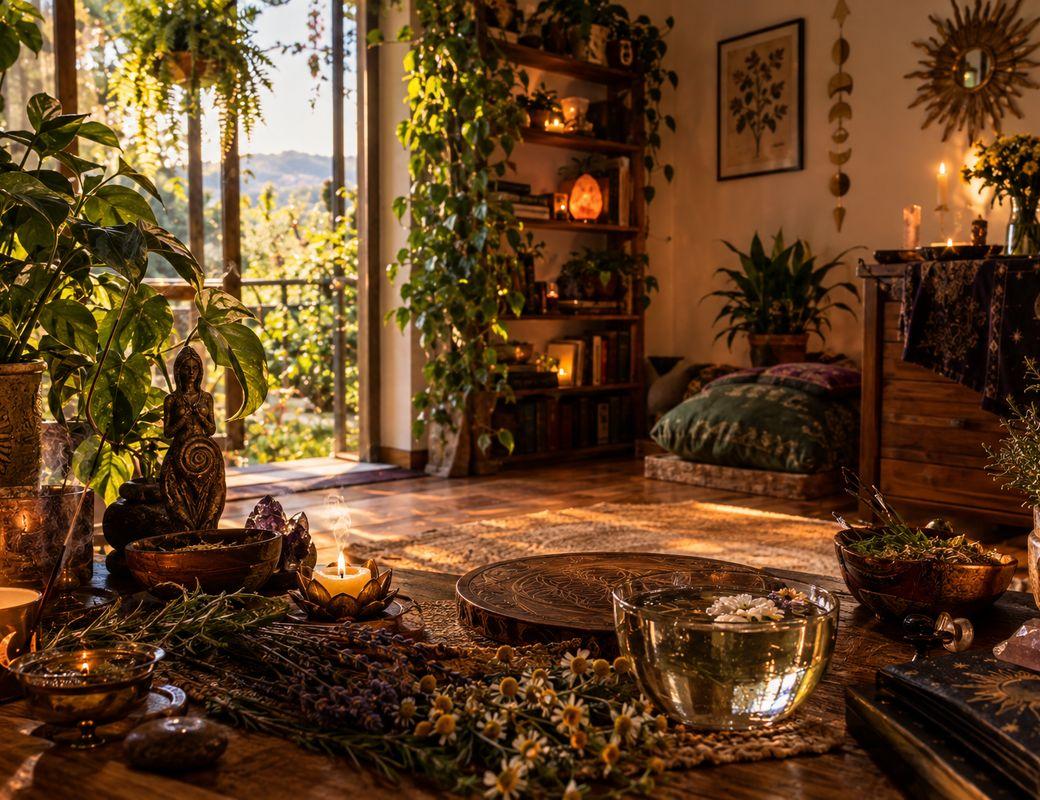
Transforming the space where you live into a place of presence, intention, and connection with nature
There's a question that few people ask when they begin their spiritual practice:
What is your home saying about your energy?
Not just through the decoration, colors, or objects we choose for each room, but through the way we move, rest, work, and relate to the space we inhabit.
Your home also participates in your experience.
This is where we can find an interesting conversation between Feng Shui and natural witchcraft practices.
They aren't the same tradition and have different origins and foundations. Feng Shui belongs to Chinese cultural context and works with, among other aspects, the organization of spaces in relation to the flow of qi, yin and yang, and the configurations of nature.
Natural witchcraft, on the other hand, can use elements found in nature—such as plants, herbs, stones, water, fire, and wood—as instruments of connection, intention, and ritual practice.
When these perspectives engage with each other respectfully, a powerful possibility emerges:
caring for your home as part of your own spiritual path.
🌿 your home is more than just a setting
In the Feng Shui tradition, the relationship between construction, nature, and the circulation of qi holds an important place. Gardens, water, stones, plants, and the arrangement of structures themselves were conceived in relation to the natural environment.
For those practicing natural witchcraft, this awareness can bring a simple reflection:
the space where we perform our rituals also deserves to be cared for.
Before lighting a candle to manifest an intention, we can observe the table where it will be placed.
Is there too much clutter?
Is the environment neglected?
Is there room to breathe?
The question shifts from being just "what can I put here?" to:
"What does this space need?"
This shift in perspective transforms how we relate to our home.
🕯️ Physical cleaning as ritual
One of the simplest ways to begin is by cleaning.
You don't need to turn every cleaning session into a magical ritual. The conscious act of removing what's broken, accumulated, or no longer serving a purpose can represent an important shift.
Open the windows, let light in, remove objects that no longer make sense, clean forgotten corners, and tend to your plants.
Afterward, if it's part of your practice, you can complement the moment with a ritual element: a candle, a prayer, an appropriate herb, or incense.
First comes caring for the space. Then comes the intention.
This also prevents spirituality from becoming a collection of objects.
🌱 Plants: life within the home
Nature holds an important place both in the traditional aesthetic of Chinese gardens and in contemporary natural spirituality practices. Chinese culture has a long tradition of observing mountains, water, plants, and landscapes as expressions of nature's vitality.
In natural witchcraft, plants can take on yet another dimension.
An herb can be used in a bath, a plant can accompany an altar, dried leaves can participate in a ritual, and a potted plant can represent care, growth, and presence.
But there's an important distinction:
you don't need to attribute supernatural powers to every plant for it to have meaning within your practice.
Caring for a plant can also be a concrete way to develop attention, responsibility, and connection with natural cycles.
🪵 The five elements and the language of home
Here we need to be careful not to mix different concepts.
Traditional Feng Shui works with its own systems, including the five elements—wood, fire, earth, metal, and water—related to the energetic dynamics of Chinese thought.
This isn't simply equivalent to the five elements used in many Western witchcraft traditions.
In practice, we can observe which qualities appear in a given environment:
🌱 Wood: growth, movement, vitality.
🔥 Fire: light, action, expression.
🌍 Earth: stability, support, presence.
⚙️ Metal: order, precision, clarity.
💧 Water: flow, depth, movement.
The purpose isn't to turn this into a rigid formula.
It's to use the elements as a language of observation.
🛏️ The bedroom: the space of retreat
The bedroom is one of the most important spaces for this practice because it's directly related to rest and intimacy.
Rather than filling it with spiritual objects, try doing the opposite.
Reduce the excess, keep only what truly conveys tranquility, choose pleasant lighting, and use comfortable fabrics.
If you use herbs or scents, choose ones suited to the environment and your sensitivity.
For natural witchcraft, the bedroom can also receive a small element of protection or intention, such as an appropriate plant, a stone, or a meaningful object.
The goal isn't to create an altar in every room. It's to make the space support what you want to experience in it.
🍳 The kitchen: where magic becomes matter
Few spaces represent the connection with nature as well as the kitchen.
Herbs, spices, fruits, seeds, water, and fire are part of it daily.
For those practicing natural witchcraft, the kitchen can transform into a true space of everyday magic.
Preparing tea with attention, growing herbs, cooking a meal with intention, organizing spices mindfully, and giving thanks for food can transform a common activity into a conscious experience.
Magic doesn't need to be separate from life.
It can also happen while you prepare what will nourish your body.
🚪 The entrance: what arrives and what remains
The entrance to your home deserves attention because it represents the first contact with the environment.
Keep this space clean, well-lit, and free from unnecessary accumulation.
In practice, it can also be an interesting place to establish a simple intention upon entering:
"May what enters this home contribute to my well-being."
🌿 Feng Shui ritual with natural witchcraft inspiration
Choose a room that needs renewal.
Before starting, open a window, remove anything that's broken, accumulated, or no longer useful, and physically clean the space.
Then choose one natural element to remain there: a plant, a stone, a container with water, a piece of wood, a candle, or another object that makes sense to you.
Light a candle, if it's safe to do so, and spend a few minutes observing the environment. Ask:
"What do I want to feel when I'm here?"
Choose a word: calm, protection, creativity, prosperity, rest, or clarity.
Then, organize the space so that this intention has a place in everyday life.
This is the heart of the ritual:
not just wishing for change, but preparing the environment to sustain it.
✦ When your home begins to reflect who you're becoming
One of the greatest transformations happens when we realize that organizing our home doesn't just mean making it beautiful.
It means deciding what stays. What goes.
Feng Shui offers us an ancient tradition for observing the relationship between space, nature, and flow. Natural witchcraft can add to this experience a ritual and conscious relationship with natural elements.
Integration must happen with respect.
We don't need to turn Feng Shui into "Chinese witchcraft," nor turn natural witchcraft into Feng Shui.
We can learn from each tradition without erasing their differences.
And most importantly, we can bring this learning to something very concrete:
the way we care for the place where we live.
Because a home doesn't need to be perfect to be sacred.
It needs to be inhabited with presence.
🌿 May your home be a place where your energy can breathe, where nature can enter, and where what you wish to cultivate finds space to grow.
✨Light on your path ☀︎︎
𝒫ℴ𝓇
𝒮𝒶𝓃𝓉 𖦹
Responses
No responses yet — start the conversation.