A space that heals💛
Neuroarchitecture: why we feel at ease in some rooms and want to escape from others
Article · 4 min read · ·
We're used to thinking that architecture is just buildings. Walls, roofs, windows.
But actually, architecture is a dialogue between space and people. And this dialogue has a neurobiological foundation.
Neuroarchitecture is a field at the intersection of brain science and environmental design. It studies how the space around us affects our consciousness, emotions, and even neural connections.
Have you ever noticed that you feel calmer in one room and more anxious in another? This isn't just a "mood." It's your brain's response to architecture.
How does this work in real life?
Imagine two rooms.
The first: high ceilings, large windows, plenty of light, wooden floors.
The second: low ceiling, dark walls, a small window, heavy curtains.
Which one makes it easier to breathe? Where do you want to stay, and where do you feel the urge to leave quickly?
That's neuroarchitecture at work.
Our brain is an incredibly complex neural network. It's not isolated. Every day it interacts with space. Light, color, ceiling height, window shape, even wall materials—all of this becomes "input data" for our consciousness.
What can space do?
It can:
- reduce or increase stress levels,
- help you focus or scatter your attention,
- give you a sense of safety or anxiety,
- inspire or, conversely, depress.
Research shows that spaces with high ceilings stimulate abstract thinking. Cozy, enclosed spaces promote concentration. Natural materials and light reduce anxiety.
The numerological layer: numbers and space
Every space has its own energy. In numerology, we look at numbers to understand a person. But space can also be "read" through numbers.
Number 1 — space for one. It requires order, clarity, minimal objects. If there's chaos in such a space—energy stagnates.
Number 3 — a space for creativity. Lots of light, colors, open shelves, the ability to rearrange things.
Number 4 — a space of stability. Clear structure, symmetry, solid materials.
Number 6 — a space of love and warmth. Soft light, textiles, family photos, coziness.
Number 9 — the energy of wisdom. This is a space for deep contemplation, for reflection and inner silence.
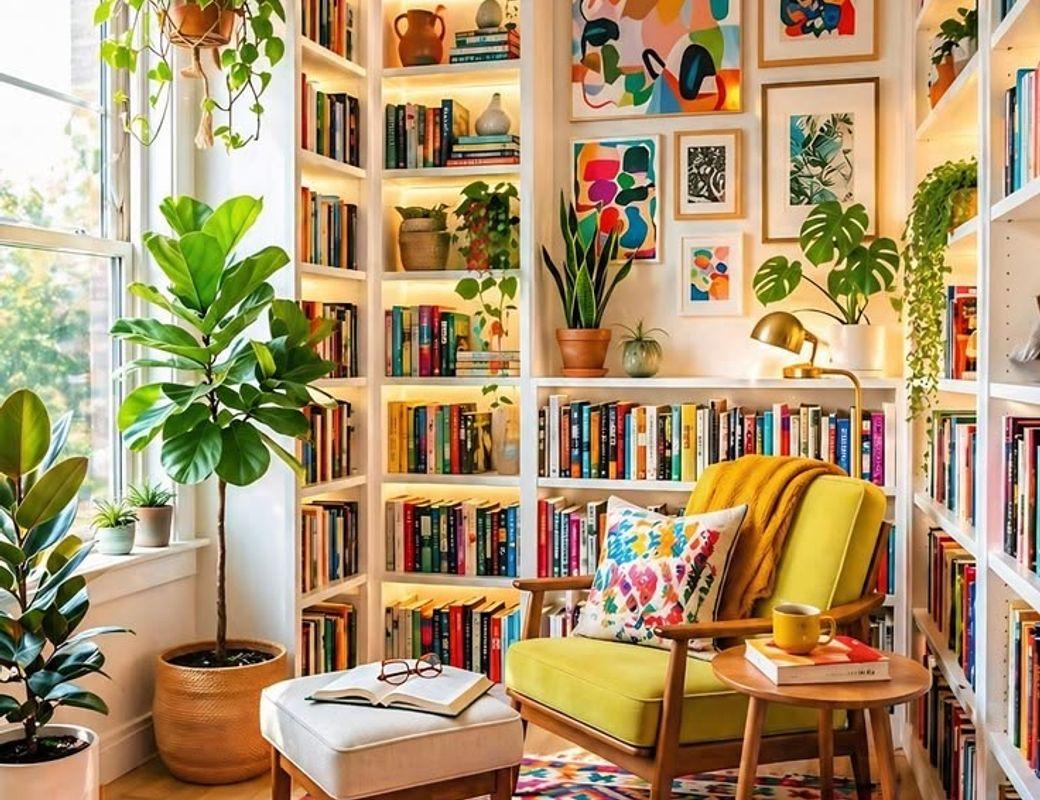
A home or public library is a perfect example of this energy. Books arranged in a certain order, soft light, a comfortable armchair by the window—this isn't just interior design. It's a space where thought flows deeper and slower. Where you can pause, reflect, and hear yourself.
If you have such a place in your life—treasure it. If not—create at least a small corner where it's quiet, where there's a book, where you can be alone with yourself.
What can you do right today?
Every day we enter a space—our home, office, room. And this space "speaks" to us in a language we don't always hear.
But we can learn to hear it.
Notice where it's easy to breathe. Where thought flows freely. Where you want to stay—and where you don't want to return.
A few simple recommendations:
Windows. If you have the opportunity—spend more time by the window. Natural light reduces stress levels and improves mood.
Order. Visual noise is a burden on the brain. Remove the excess—and it will be easier to breathe.
Color. Warm and soft shades (blue, green) calm the nervous system. Bright and saturated colors (red, orange) invigorate, but can be overwhelming.
Nature. Even just a view of trees from the window helps reduce anxiety and restore attention.
Mirrors. Don't place a mirror opposite the bed—it creates a subconscious feeling of being "watched" and interferes with relaxation.
Light. Replace cold white light with warm light, especially in the evening. This helps the brain switch to rest mode.
In numerology, we look at numbers to understand ourselves.
In neuroarchitecture, we look at space—and through it, we can also understand ourselves.
Sometimes it's enough to simply move a chair to the window or remove unnecessary items from the desk to feel that the space has begun to breathe with you. The energy of the space changes its flow—and stagnant places begin to come alive.
The space we live in is not just a backdrop. It's a mirror of our inner world.
If you feel tired, anxious, or stuck—look around. Perhaps your space has been asking for change for a long time💫
And these changes can be quite small: light, order, a quiet corner. But it's often with these that inner movement begins.
Because by changing the space around us—we change ourselves. Where we feel comfortable and cozy, we feel happier✨
Every like 🌙 you leave under the article is an important energy exchange, thanks to which this space continues to live and shine.
Thank you for your resonance.
Ingrid 🕊
Responses
No responses yet — start the conversation.