7𝓭𝓪𝔂𝓼7𝓮𝓵𝓮𝓶𝓮𝓷𝓽𝓼7𝓹𝓻𝓪𝓬𝓽𝓲𝓬𝓮𝓼 🔯
𝙳𝚊𝚢6: 𝙼𝚘𝚘𝚗, 𝚝𝚑𝚎 𝚎𝚕𝚎𝚖𝚎𝚗𝚝 𝚘𝚏 𝚌𝚢𝚌𝚕𝚎𝚜
Article · 3 min read · ·
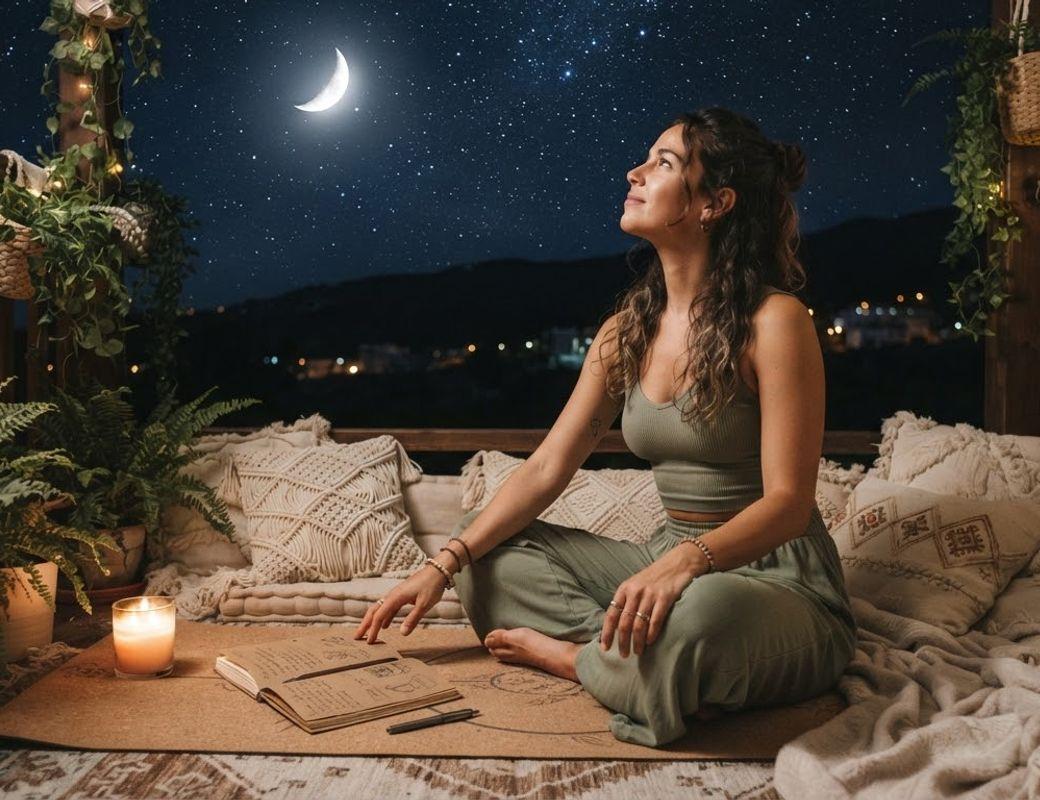
A contemplative practice for observing nature's rhythms
The Moon accompanies the Earth in a continuous cycle of phases. Its appearance changes throughout the month according to its position relative to the Earth and the Sun, creating one of the most easily observable celestial rhythms to the naked eye. For centuries, this cycle has been used by different cultures to organize calendars, agricultural activities, celebrations, and religious practices. The Moon has also become a touchstone for contemplative practices and connection with natural cycles. In witchcraft, observing the Moon can be a simple way to reclaim this awareness of time's passage. Rather than trying to rush every process, contemplation allows us to recognize that nature works through rhythms, changes, and intervals.
🌙 The Moon as an experience of presence
Observing the Moon requires no advanced knowledge of astrology. You can simply follow its transformations throughout the month and notice how the sky changes from one night to the next.
This observation creates a different relationship with time. The lunar cycle doesn't need to be interpreted to be meaningful. The very experience of looking up at the sky, perceiving the current phase, and remaining in silence for a few minutes already transforms our attention.
For this portal, we'll use the Moon as an object of contemplation and record.
⸻
🕯️ Lunar Contemplation Ritual
You will need:
- a place where you can observe the sky;
- a notebook;
- a pen;
- a candle.
Choose a night when the Moon is visible.
Before you begin, turn off your phone or put it on silent mode. Sit comfortably and observe the Moon for a few minutes. Don't try to create an interpretation. Observe its shape, its luminosity, and the position it occupies in the sky.
Then, close your eyes and take five slow breaths.
Open your eyes again and spend a few more minutes observing. When you finish, record in your notebook: the date, the lunar phase, the approximate time, and a brief description of what the sky was like. Close by saying:
"I acknowledge the cycles of nature and honor my own timing.
I observe without rushing, I welcome change, and I allow each stage to have its space.
May I know when to move forward, when to stay, and when to simply observe."
Extinguish the candle and close the practice.
⸻
🌙 Transform observation into a habit of knowing
An interesting way to deepen this practice is to follow the Moon for a month.
You don't need to perform a ritual every night. Simply record some observations throughout the weeks: the phase, the appearance of the sky, and any natural occurrence that catches your attention.
Over time, you begin to perceive the lunar cycle in a concrete way, rather than relying solely on calendars or apps. This record can also become a small lunar journal, gathering sky observations, drawings, photographs, and notes.
⸻
🌙 What this sixth portal teaches
Fire taught us to act.
Water, to release.
Air, to perceive.
Earth, to sustain.
Plants, to establish a conscious relationship with nature.
Now, the Moon teaches us to follow the cycles.
Not every transformation needs to be immediate.
There are processes that unfold while we observe, learn, and await the necessary time for something to reveal itself.
The Moon doesn't maintain the same appearance throughout the month. And precisely because of this, we can recognize it anew every night.
🌙 Day 6 of 7 — I follow.
I honor the cycles, observe the changes, and find presence in each step of the journey. 🌙✨
✨Light on your paths ☀︎︎
𝒫ℴ𝓇
𝒮𝒶𝓃𝓉 𖦹