The Light on the Mountain
The Hermit, Virgo, and the Archetype of Sacred Solitude
Article · 17 min read · ·
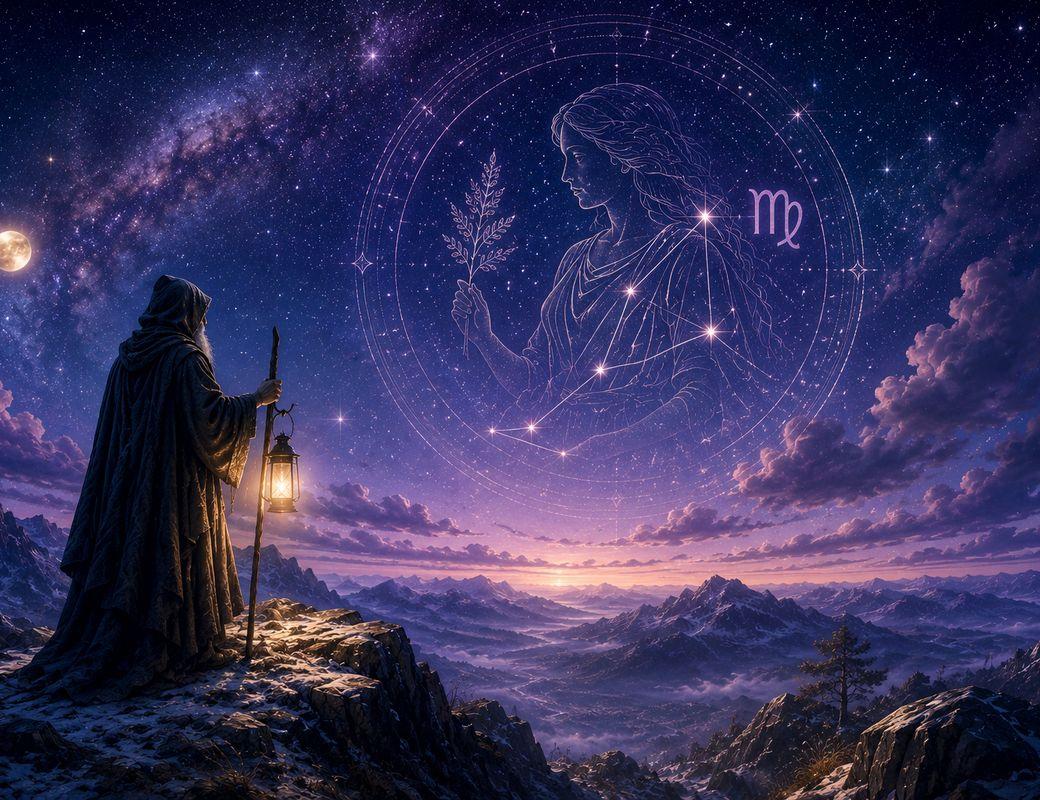
There is a figure who appears in nearly every mythology the world has ever produced. He stands apart from the crowd, on a mountainside, in a cave, or at the edge of a forest, carrying a light no one asked him to bear. He did not withdraw from the world because he failed it. He withdrew because he sensed that the deepest truths cannot be discovered amid constant noise. They require silence, patience, and the courage to look inward before speaking outward.
That figure is the Hermit.
In the tarot, the Hermit is the seeker of wisdom, the pilgrim who chooses contemplation over applause and discernment over certainty. In astrology, his closest counterpart is Virgo, the mutable Earth sign ruled by Mercury, whose greatest gift is not perfection but perception. Beneath Virgo’s reputation for analysis, precision, and practicality lies a profound devotion to separating what is essential from what is merely distracting.
Together, the Hermit and Virgo reveal an archetype far older than either tarot or astrology alone. Across cultures, religions, and philosophies, we encounter the same solitary guide: the sage who leaves society not to escape it, but to understand it more deeply before returning to serve it with greater clarity. Whether embodied by philosophers, monks, prophets, or wandering mystics, this figure reminds us that wisdom is seldom found in the crowd. It is cultivated in solitude and carried back into the world as an act of service.
This is why the Hermit and Virgo belong together so naturally. Both teach that discernment is an act of devotion. Both remind us that refinement begins by removing what is unnecessary. And both understand that genuine insight rarely arrives all at once. Like the lantern the Hermit carries through the darkness, it illuminates only the next faithful step, trusting that the path beyond will reveal itself in time.
The Card
The Hermit is the ninth card of the Major Arcana, and the number itself is significant. Nine represents completion, the culmination of experience before a new cycle begins. It is the final single digit, a threshold between what has been learned and what is yet to unfold. By the time the Fool encounters the Hermit, he has already passed through the Magician’s awakening, the Empress’s abundance, the Emperor’s authority, and the Hierophant’s traditions. He has tasted the world in all its complexity. The next lesson cannot be found through action alone. It must be discovered through reflection.
The traditional Rider–Waite–Smith image presents an elderly figure standing atop a snow-covered mountain, wrapped in a simple gray cloak. In one hand he carries a weathered staff, the companion of pilgrims who have traveled long enough to understand that endurance matters more than speed. In the other, he raises a lantern whose light pierces the surrounding darkness.
Every element of the card speaks the language of restraint.
The mountain symbolizes perspective earned through effort. One does not arrive at its summit by accident. Each step requires discipline, patience, and a willingness to leave behind what is unnecessary. The gray cloak strips away status and ornament, suggesting that wisdom is indifferent to wealth, acclaim, or personal identity. The Hermit has not abandoned the world because he despises it. He has simply learned that truth is often easier to hear once the noise has faded.
The lantern, however, is the heart of the card.
Within its glass shines the hexagram, the six-pointed star traditionally known as the Seal of Solomon. Formed by two interlocking triangles, one reaching upward toward the heavens and the other descending toward the material world, it symbolizes the reconciliation of spirit and matter, contemplation and action, heaven and earth. The Hermit carries this union with him, reminding us that wisdom is not found by rejecting the physical world but by seeing the sacred within it.
Perhaps the most remarkable feature of the lantern is what it does not do. It does not flood the mountainside with light. It reveals only the next few steps.
This is the Hermit’s great lesson.
Wisdom is rarely the ability to see the entire journey. More often, it is the humility to recognize the next right step and the patience to trust that the path will continue to unfold. In this way, the lantern becomes a symbol of discernment rather than certainty, illuminating only what is necessary for the present moment.
It is here that the Hermit’s connection to Virgo begins to emerge.
Virgo is often described as the sign of analysis, precision, and careful observation, but these qualities arise from a deeper impulse: discernment. Like the Hermit, Virgo seeks to distinguish what is essential from what is superfluous, what is true from what merely appears convincing. Neither rushes toward easy answers. Both understand that clarity is rarely instantaneous. It is cultivated through quiet attention, thoughtful examination, and a willingness to move deliberately rather than impulsively.
Earlier tarot traditions portrayed this figure quite differently. Before the lantern became his defining attribute, the Hermit often appeared as Father Time, carrying an hourglass instead of a light. That image emphasized Saturn’s relentless passage of time, reminding viewers that mortality strips away illusion and reveals what truly matters. The evolution from hourglass to lantern marks a profound shift in symbolism. Time alone does not produce wisdom. Reflection does. The Hermit teaches that every passing year offers the opportunity for greater understanding, but only to those willing to pause long enough to receive its lessons.
The Maiden of Discernment
Virgo is the sixth sign of the zodiac, a mutable Earth sign ruled by Mercury and traditionally symbolized by the Maiden carrying a sheaf of wheat. At first glance, the image appears to celebrate agriculture and the approaching harvest. Yet beneath its pastoral simplicity lies one of astrology’s most profound symbols. The wheat does not merely represent nourishment. It represents discernment—the patient work of separating grain from chaff, substance from excess, and what endures from what must be left behind.
That act of separation defines Virgo more than any popular stereotype ever could.
Modern astrology often reduces Virgo to perfectionism, meticulous organization, or an obsession with details. While these qualities may appear in certain personalities, they are only surface expressions of a much deeper impulse. Virgo is not driven by the desire for flawlessness. It is driven by the pursuit of integrity. It asks whether something is accurate, useful, and worthy of preservation. When Virgo refines, it does so not to criticize but to reveal what is essential.
This symbolism is reflected in Virgo’s place within the zodiac itself. Arriving at the close of summer, Virgo presides over the threshold between growth and harvest, when nature quietly asks a series of difficult questions. What has truly matured? What remains unfinished? What deserves to be gathered, and what should be returned to the earth? Harvest is not simply abundance. It is evaluation. It is the wisdom to recognize that not everything planted is meant to be kept.
Here we begin to understand why the Hermit and Virgo have been linked within the Western esoteric tradition.
The Hermit’s lantern and Virgo’s sheaf of wheat tell the same story in different symbolic languages. One illuminates the path ahead; the other separates nourishment from waste. Both require patience. Both require careful attention. Neither offers immediate gratification. Their gifts emerge only through disciplined observation and the willingness to slow down enough to perceive what others overlook.
Mercury, Virgo’s ruling planet, deepens this relationship.
Mercury is commonly associated with communication, commerce, learning, and the swift exchange of ideas. In Gemini, Mercury expresses itself outwardly, gathering information, making connections, and delighting in possibility. In Virgo, however, Mercury turns inward. Instead of collecting more knowledge, it examines what has already been gathered. Instead of asking endless questions, it patiently weighs the answers. Gemini explores the landscape of thought; Virgo cultivates it.
This quieter expression of Mercury mirrors the Hermit’s journey perfectly. The Hermit is not searching for more information. He is seeking understanding. Knowledge accumulates through experience, but wisdom emerges through reflection. The distance between the two is precisely where Virgo does its finest work.
For this reason, Virgo has long been associated with service, though the word is often misunderstood. Service does not mean self-erasure or endless sacrifice. Rather, it is the offering of one’s cultivated gifts for the benefit of something greater than oneself. A physician refining a diagnosis, an artisan perfecting a craft, a scholar preserving knowledge, or a gardener tending the soil all embody Virgo’s highest expression. Their work is an act of devotion made visible through precision.
The Maiden herself carries a similar meaning.
Despite centuries of misunderstanding, Virgo’s virginity has never been primarily about sexuality. In the ancient world, the virgin represented wholeness, sovereignty, and independence—a person who belonged first to herself and therefore could dedicate her life to wisdom, justice, or the sacred without compromise. The Greek goddess Astraea, often associated with Virgo, remained on earth through the decline of humanity until injustice became unbearable, only then ascending to the heavens as the constellation we recognize today. Her story is not one of innocence but of incorruptibility.
The Hermit embodies this same spiritual independence. Like the Maiden, he cannot be persuaded by popularity or distracted by appearances. Both figures stand apart from the crowd, not because they reject humanity, but because they understand that truth is often discovered only after one has stepped outside the noise of collective opinion.
Seen together, the Hermit and Virgo reveal two expressions of the same archetype. One carries a lantern through the darkness. The other carries the harvest gathered through careful discernment. Both remind us that wisdom is not found by accumulating more, but by refining what we already possess until only what is true remains.
The Lantern in Daylight
Few historical figures embody the Hermit’s archetype more vividly than Diogenes of Sinope, the fourth-century BCE Cynic philosopher who wandered the streets of Athens carrying a lantern in broad daylight. When questioned about this peculiar spectacle, he famously replied that he was searching for an honest man.
The image is deliberately paradoxical.
Why carry a lantern beneath the midday sun?
Diogenes understood that his audience could already see with their eyes. What they lacked was the ability, or perhaps the willingness, to see with discernment. His lantern was never meant to illuminate the streets of Athens. It exposed the darkness hidden beneath society’s assumptions, conventions, and comforting illusions. Ordinary daylight revealed appearances. The philosopher sought something deeper: truth.
In that sense, Diogenes carried the same lantern later placed in the Hermit’s hand.
Neither figure claims to possess all wisdom. Instead, both invite us to question what passes for certainty. The Hermit’s light does not overwhelm the darkness or eliminate every doubt. It simply reveals enough to continue the search with integrity. Wisdom, in both traditions, is not the absence of questions but the refusal to settle for easy answers.
This relentless pursuit of truth also reflects Virgo at its highest expression.
Virgo’s discernment is often mistaken for skepticism or criticism, yet its true purpose is neither cynicism nor fault-finding. It is the patient discipline of testing appearances against reality. Like Diogenes, Virgo asks whether something is genuine before accepting it. It is less interested in comforting beliefs than in ideas capable of withstanding careful examination.
Diogenes lived according to that principle with uncompromising intensity. Rejecting wealth, status, and social convention, he reportedly made his home inside a large ceramic storage jar and embraced voluntary poverty as a declaration of independence. His philosophy insisted that happiness could not be purchased, inherited, or bestowed by society. It arose from living in harmony with nature and freeing oneself from unnecessary desires.
His methods, however, were anything but gentle.
He mocked politicians, ridiculed philosophers, and famously challenged Alexander the Great himself. When the conqueror asked whether there was anything he could do for him, Diogenes replied, “Stand out of my sunlight.”
The exchange has endured for centuries because it captures the Hermit’s peculiar authority. Diogenes possessed no throne, no army, and no political office, yet he remained utterly unmoved by the presence of the most powerful man in the known world. His independence came not from status but from inner freedom, a quality neither wealth nor power could bestow.
Centuries later, Friedrich Nietzsche deliberately echoed this same image in The Gay Science. His “madman” runs into the marketplace carrying a lit lantern and crying out that he is searching for God. Like Diogenes before him, the absurdity is intentional. The lantern is not needed because the world is physically dark. It is needed because spiritual clarity has become obscured by complacency, convention, and the illusion that familiar answers are sufficient.
The lantern, then, becomes more than a recurring symbol. It is an enduring metaphor for awakened consciousness. Across philosophy, literature, tarot, and astrology, it reminds us that genuine wisdom begins the moment we recognize that seeing is not the same as understanding.
This is the path walked by both the Hermit and Virgo. One carries the light through the mountains. The other carries it into the harvest of the mind. Together, they teach that discernment is not merely the ability to detect error. It is the courage to keep searching for truth, even when everyone else believes the search is already over.
The Wise Old Man Across Cultures
The Hermit does not belong to any single religion, philosophy, or civilization. He is one of humanity’s oldest archetypes, appearing wherever people have sought wisdom beyond the distractions of ordinary life. Though his clothing, language, and customs may change from one culture to another, his essential purpose remains remarkably consistent. He withdraws from the familiar not to abandon the world, but to understand it more deeply.
Carl Jung recognized this recurring figure as the Wise Old Man, an archetype of inner authority that emerges when knowledge matures into wisdom. Unlike kings, priests, or judges, the Wise Old Man derives no legitimacy from office or inheritance. His authority rests entirely upon experience transformed through reflection. He does not tell us what to think. Instead, he invites us to see more clearly for ourselves.
The Hermit fulfills precisely this role within the tarot. He offers no commandments, performs no miracles, and promises no shortcuts. His lantern is held just high enough to illuminate the next step, reminding us that wisdom is not a destination handed to us by another but a path we must walk ourselves.
This archetype appears throughout the world’s mythologies.
In the Arthurian legends, Merlin repeatedly withdraws into the forests of Britain, emerging only when his counsel is truly needed. His power lies not in political authority but in the insight gained through contemplation, patience, and an intimate relationship with the natural world.
Across India, the ancient tradition of the ṛṣis, or seers, describes sages who retreated into forests and mountains to seek direct knowledge of ultimate reality. Their teachings became the foundation of the Upanishads and shaped the philosophical traditions of Hinduism for millennia. Likewise, the vanaprastha, or “forest-dweller,” stage of life encouraged individuals to gradually leave behind worldly obligations in favor of spiritual reflection, recognizing that wisdom often requires distance from the demands of ordinary society.
Chinese tradition offers a similar image in the Taoist mountain sage. Rather than striving to master nature, these hermits sought harmony with it, believing that clarity emerged not through force but through alignment with the Tao, the underlying order flowing through all existence. Their retreats into the mountains were acts of participation rather than escape, allowing them to observe the rhythms of the natural world until those rhythms became their own.
Whether we encounter Merlin in Britain, a Taoist sage in the mountains of China, a forest seer in India, or the Hermit standing alone upon his snow-covered peak, the lesson remains remarkably consistent. Wisdom cannot be inherited, purchased, or imposed. It must be cultivated through patient attention, honest self-examination, and the willingness to spend time in silence.
Virgo embodies this same archetype in astrological form.
Its celebrated powers of analysis are not ends in themselves. They are tools for cultivating discernment, allowing the individual to separate lasting truth from passing distraction. Like the Wise Old Man, Virgo teaches that genuine understanding is earned through careful observation rather than impulsive judgment. Both remind us that authority begins within and that the clearest guidance often comes from the quietest voice.
Across continents and centuries, the Hermit continues to reappear because every generation eventually confronts the same realization: there comes a point when external answers are no longer enough. The maps provided by family, society, religion, or tradition can carry us only so far. Beyond that threshold, each of us must become the traveler, the seeker, and ultimately, the keeper of our own lantern.
The Return from Solitude
It is easy to mistake the Hermit for a symbol of isolation, withdrawal, or even loneliness. Yet every tradition we have explored offers the same correction. The Hermit does not leave the world because he has rejected it. He steps away so that he can return with clearer eyes.
This distinction matters.
Loneliness is the pain of unwanted separation. Isolation is the absence of meaningful connection. Solitude, however, is something altogether different. It is a deliberate encounter with oneself, chosen not as an escape from life but as a way of participating in it more honestly. The Hermit embraces solitude because it creates the conditions in which wisdom can emerge.
Virgo reflects this same rhythm.
Its gift is not perfectionism, as it is so often portrayed, but discernment. Virgo reminds us that every harvest requires examination, every craft demands refinement, and every meaningful act of service begins with the willingness to see clearly. The sign asks us to separate what nourishes from what merely occupies our attention, what is essential from what is excess. Like the Hermit’s lantern, Virgo’s wisdom does not illuminate everything at once. It reveals what is necessary for this moment and trusts that tomorrow’s insight will arrive tomorrow.
Perhaps this is why the Hermit continues to appear across cultures and throughout history. Whether as Diogenes searching for an honest man, a Desert Father praying in silence, a Taoist sage retreating into the mountains, Merlin waiting in the forest, or the Wise Old Man of Jungian psychology, the archetype answers a universal human need. There comes a point in every life when external authorities can guide us no further. The answers we seek cannot be borrowed. They must be discovered through reflection, patience, and the courage to remain with difficult questions long enough for understanding to take root.
The modern world rarely rewards this kind of patience. We are encouraged to move faster, consume more information, form quicker opinions, and measure our worth by our visibility. Silence is often mistaken for absence, and contemplation for inactivity. Yet the Hermit quietly challenges those assumptions. He reminds us that wisdom cannot be rushed, and that the deepest transformations often occur far from public view.
Virgo season offers us an annual invitation to practice this forgotten discipline.
It asks us to pause before reacting, to observe before judging, and to refine before reaching outward. It encourages us to examine our lives with honesty, to release what no longer serves us, and to carry forward only what has proven true. In doing so, Virgo transforms discernment into an act of service, reminding us that the clearest vision is often the greatest gift we can offer the world.
The Hermit’s lantern was never meant to illuminate the entire mountain.
It was only ever meant to reveal the next faithful step.
That has always been enough.
For the Hermit, wisdom is not the certainty of seeing the whole path. It is the humility to trust the light already in your hands.
For Virgo, discernment is not the pursuit of perfection. It is the quiet devotion to what is true.
Together, they teach us that the journey toward wisdom has never required us to know everything. It has only ever asked us to take the next step with clarity, patience, and the courage to keep walking.
Responses
No responses yet — start the conversation.