Spica: The Wheat Bearer of Virgo
The Star That Turned the Harvest Into a Goddess, and the Goddess Into the Sky
Article · 15 min read · ·
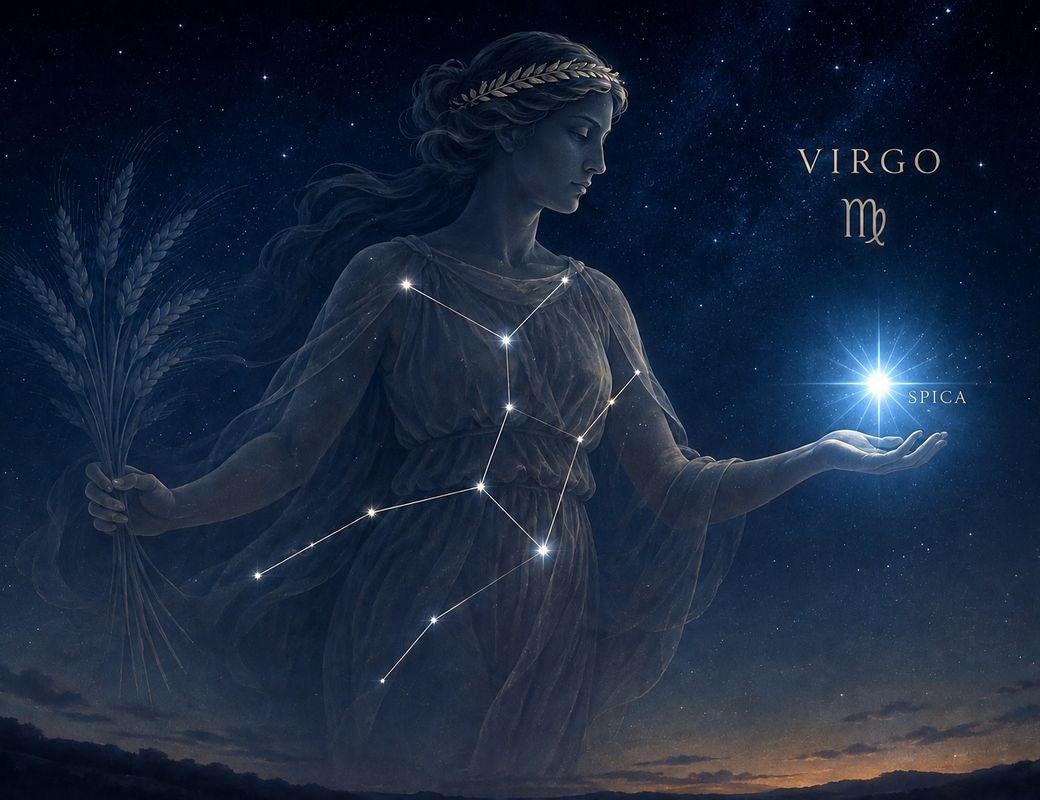
Introduction: The Point of Light in the Virgin’s Hand
Late in spring, as the constellations of winter finally slip below the western horizon, a brilliant blue-white star rises in the southeastern sky. It does not blaze with the dazzling intensity of Sirius, nor does it command attention like the royal Regulus. Instead, Spica shines with a quieter elegance, steady, luminous, and unmistakable once you know where to look.
For thousands of years, that gentle light has represented something far greater than a distant star. It has symbolized the harvest itself, the promise that careful labor will one day bear fruit.
Spica is the brightest star in the constellation Virgo, and its name comes directly from the Latin word spica, meaning “an ear of grain.” Ancient sky watchers envisioned Virgo as a woman holding a stalk of wheat, with Spica marking the glowing head of grain in her outstretched hand. That simple image became one of the most enduring symbols in the ancient world. Across centuries and civilizations, it gathered stories of Demeter and Persephone, Ceres, Astraea, and the sacred relationship between human survival and the changing seasons.
Unlike many bright stars associated with kings, warriors, monsters, or great beasts, Spica belonged to the fields.
Its appearance helped mark the turning agricultural year, reminding early civilizations when seasons of planting, growth, harvest, and rest were approaching. Long before mechanical clocks or printed calendars, humanity looked upward to measure time. The heavens became a calendar written in light, and Spica was one of its most recognizable seasonal markers.
Before exploring the myths that gathered around this remarkable star, it helps to understand the celestial beacon itself, a stellar system whose apparently peaceful light conceals something far more powerful.
But before looking more closely at the star itself, it helps to begin where ancient observers did: by finding Spica in the seasonal sky.
Finding Spica in the Spring Sky
Virgo is the second largest constellation in the night sky, yet it is surprisingly subtle. Unlike Orion with its bright belt or Leo with its distinctive sickle, Virgo has no immediately recognizable outline. Most of its stars are relatively faint, making the constellation difficult to trace without a guide.
Spica changes that.
It serves as Virgo’s brilliant anchor, drawing the eye toward the celestial figure hidden among the surrounding stars.
The easiest way to locate it is through the classic stargazer’s phrase:
“Arc to Arcturus, then spike to Spica.”
Begin by following the graceful curve of the Big Dipper’s handle. Continue that arc until you reach the orange glow of Arcturus in the constellation Boötes, then extend the same curve farther south until you arrive at the blue-white brilliance of Spica.
Once found, the star is unmistakable, shining almost alone beneath the sprawling form of Virgo.
Virgo becomes especially prominent in the evening sky during late spring and early summer in the Northern Hemisphere, following Leo as the zodiac progresses across the heavens. Together with Arcturus and Regulus, Spica forms the Spring Triangle, a seasonal pattern that has helped generations of sky watchers orient themselves among the stars.
For ancient civilizations, however, these stars were more than beautiful landmarks.
Their appearances and disappearances helped mark the passage of the year. In societies where survival depended upon understanding seasonal change, observing the sky was not merely an intellectual pursuit. It was practical knowledge.
The heavens served as both clock and calendar.
And few stars carried the agricultural symbolism of Spica.
Once Spica has been found in the sky, another question naturally follows: what, exactly, is that brilliant point of blue-white light?
Spica, the Blue-White Giant
While ancient cultures saw Spica as a sacred ear of grain, modern astronomy reveals something equally extraordinary.
What appears to the naked eye as a single, tranquil point of light is actually a pair of enormous stars locked together in an extraordinarily close celestial dance.
Officially designated Alpha Virginis, Spica lies approximately 250 light-years from Earth and ranks among the brightest stars visible in the night sky. Though it appears solitary, it is a binary system composed of two massive blue stars orbiting one another roughly every four days.
Their orbit is so tight that their mutual gravity distorts their shapes, stretching them away from perfect spheres.
The larger star contains roughly eleven times the mass of our Sun and shines with tens of thousands of times its luminosity. Its companion, although smaller, is still far larger and hotter than the Sun. Surface temperatures exceeding 20,000 Kelvin give the system its distinctive blue-white brilliance, the signature of exceptionally hot stars.
Beneath Spica’s calm appearance lies tremendous energy.
Only precise astronomical observations reveal the subtle variations in brightness created as the stars race around one another, each exerting enormous gravitational force upon its companion. These characteristics have made Spica particularly valuable to astronomers studying the lives and evolution of massive binary stars.
Its eventual fate will be as dramatic as its present existence.
Over millions of years, interactions between the two stars may radically alter the system. Their evolution could eventually produce stellar merger, supernova explosions, or other violent transformations characteristic of massive stars approaching the ends of their lives.
Yet this hidden violence is not what humanity has traditionally remembered when looking at Spica.
To generations of sky watchers, its light meant ripening grain, returning abundance, and the reassurance that patient labor might eventually yield a harvest.
That symbolism would become inseparable from one of the ancient Mediterranean world’s most powerful myths.
And it is here that Spica begins to move from astronomy into something more intimate: a story about grief, separation, and the return of life itself.
Demeter and Persephone: Grief Written Into the Seasons
To the ancient world, grain was far more than a crop.
It was civilization.
Wheat and barley could be stored through winter, traded across kingdoms, offered to the gods, and transformed into the bread that sustained entire cities. A successful harvest meant stability and survival. A failed harvest could mean hunger, social unrest, or catastrophe.
By placing an ear of grain in Virgo’s hand, ancient sky watchers transformed agriculture into something sacred.
Spica became a celestial reminder of humanity’s dependence upon both earth and sky.
No myth captures that relationship more powerfully than the story of Demeter and Persephone.
Demeter, the Greek goddess of grain, agriculture, and fertile fields, watched over the growth of crops and the abundance of the earth. When her daughter Persephone was taken into the underworld by Hades, Demeter’s grief overwhelmed everything else.
She withdrew her gifts from the land.
Crops withered.
Fields became barren.
Famine spread across the world.
The earth itself seemed to mourn with her.
Eventually, even the gods recognized that humanity could not survive while Demeter grieved. Zeus intervened, sending Hermes into the underworld to arrange Persephone’s return.
But Persephone had eaten pomegranate seeds in the realm of Hades, binding her to the underworld for part of each year.
A compromise followed.
For part of the year, Persephone would live upon the earth with her mother. For the remainder, she would return below.
The Greeks saw the changing seasons reflected in that cycle of reunion and separation.
When Persephone returned, Demeter rejoiced and life awakened in the fields. When Persephone descended again, growth receded and the earth moved toward winter.
The story transformed the agricultural year into something deeply human.
Spring was reunion.
Winter was grief.
The harvest existed between them as proof that life had returned.
Ancient observers carried this symbolism into the stars. Some identified Virgo with Demeter herself, forever holding the precious grain that nourished humanity. Others associated the maiden with Persephone, whose movement between worlds mirrored the cycle of growth, harvest, death, and renewal.
In either interpretation, Spica became the glowing ear of wheat in the goddess’s hand.
And beneath the myth lies a truth older than Greece itself: nature does not promise that nothing will be lost.
It promises that loss and renewal belong to the same cycle.
Every field left barren through winter contains the possibility of another spring. Every harvest exists because something was first planted in darkness and allowed to grow unseen.
Spica became the light of that promise.
But the grain-bearing maiden was not the only figure ancient people saw in Virgo. The same constellation also became the home of another goddess, one whose story turned from the cycles of the earth toward the question of justice itself.
Astraea: The Maiden Who Became the Stars
While Demeter and Persephone connect Virgo to the rhythms of the earth, another ancient tradition looked toward the same constellation and saw something different.
They saw Astraea.
Astraea was the virgin goddess of justice, innocence, and moral order. According to Greek and later Roman tradition, she lived among humanity during the legendary Golden Age, a period when mortals and gods were still close and the world existed in harmony.
Justice did not need to be enforced because people lived justly.
Generosity outweighed greed.
Violence had not yet become ordinary.
Humanity existed in balance with itself and the natural world.
But as the mythical Ages of Man passed, that harmony deteriorated.
Conflict spread. Greed deepened. Violence became more common. One after another, the gods withdrew from humanity.
Astraea remained longer than the rest.
She stayed because she hoped humanity might change.
Eventually, even she abandoned the earth.
According to the tradition, Astraea ascended into the heavens and became Virgo. Nearby Libra came to represent the scales of justice, preserving her presence in the sky long after justice had supposedly vanished from the world below.
Seen through the story of Astraea, Spica becomes something more than grain.
It becomes a memory.
The star represents the abundance and goodness of a world humanity once possessed and then lost, a small light preserving the possibility that balance might still be restored.
At first, the myths of Demeter and Astraea may seem unrelated. One speaks of a grieving mother and the seasons. The other tells of a divine maiden abandoning a corrupted world.
Yet both revolve around the same idea.
Something precious can be lost.
The fertile earth can become barren. Justice can disappear. Harmony can fracture.
But memory remains.
And where memory survives, restoration remains imaginable.
Whether Spica was understood as the grain sustaining human life or the light of justice lingering above it, the star carried an unusually hopeful message.
The world may decline.
The fields may empty.
Winter may come.
But what has been lost is not necessarily forgotten.
As Greek stories and symbols moved into the Roman world, however, the grain in Virgo’s hand came forward once again, now through the figure of Ceres and the practical realities of feeding an empire.
Ceres and the Roman Harvest
As Greek culture spread throughout the Mediterranean, many of its gods found parallel identities within Roman religion.
Demeter became closely associated with Ceres, the Roman goddess of agriculture, grain, fertility, and the cultivation of the earth.
The Romans preserved many elements of the Greek mythology surrounding Demeter and Persephone, but Ceres also occupied an important place within Roman civic and agricultural life. Her domain was not merely symbolic. Grain was one of the foundations of the Roman world.
The name Ceres has survived into modern language through the word cereal, a linguistic reminder of just how deeply the goddess became associated with humanity’s staple grains.
Wheat, barley, and other crops were not simply food.
They were political stability.
They fed families, armies, cities, and an expanding empire. Rome’s vast population depended upon enormous quantities of grain moving through complicated systems of agriculture, trade, taxation, and distribution.
The harvest was therefore both sacred and practical.
Roman farmers and astronomers watched stars such as Spica as part of the larger seasonal sky. The appearances and disappearances of prominent stars could accompany familiar shifts in weather and agriculture, helping people situate themselves within the annual cycle.
One especially important astronomical event was a star’s heliacal rising, its first visible appearance in the eastern sky shortly before sunrise after a period hidden by the Sun’s glare.
Ancient agricultural calendars frequently connected celestial observations with the expected timing of seasonal work.
The sky did not replace careful observation of the land. It worked alongside it.
Farmers watched the stars, weather, soil, plants, and animals together, reading the natural world as an interconnected system.
Within that world, Spica’s symbolism was almost inevitable.
A brilliant star placed directly in the hand of the celestial maiden appeared as grain suspended in the heavens.
The connection between Ceres and Spica therefore extended beyond mythology. Festivals honoring Ceres celebrated the fertility of the earth and acknowledged a reality ancient societies understood intimately: human prosperity depended upon forces no civilization could completely control.
Rain had to fall.
Seeds had to germinate.
Fields had to survive.
Harvest had to arrive.
The abundance of the entire community rested upon that fragile chain.
Where the Greek story of Demeter and Persephone emphasizes personal grief and reunion, Roman traditions surrounding Ceres increasingly reflected stability, agriculture, social welfare, and civic prosperity.
A successful harvest nourished far more than individual households.
It nourished Rome itself.
Spica, shining from Virgo’s hand, became a perfect symbol for that dependence, joining celestial observation to one of the most fundamental facts of ancient life.
No matter how powerful the empire became, Rome still needed the grain to grow.
Over time, however, Spica’s meaning moved beyond the fields and the myths surrounding them, entering another tradition that looked to the heavens for signs of human character, opportunity, and fortune.
Spica in Astrology: The Star of Brilliant Fortune
Mythology remembered Spica as grain, goddess, justice, and harvest.
Astrology came to know it as something else as well.
Fortune.
For more than two thousand years, astrologers have regarded Spica as one of the most favorable fixed stars in the heavens, associating it with talent, protection, intelligence, artistic ability, recognition, and success.
Yet Spica’s astrological symbolism has never been entirely about luck falling effortlessly from the sky.
Its older agricultural imagery gives that fortune another dimension.
A field does not produce grain overnight.
Seeds are planted long before the harvest appears. The soil is prepared. Crops are tended. Weather is endured. Work continues even when there is little visible evidence that the effort will succeed.
Only later does the field reveal what all that labor produced.
Spica carries much the same symbolism.
Traditional astrologers associated the star with exceptional ability in areas such as the arts, science, literature, learning, philosophy, and public life. A prominent Spica was often interpreted as an indication of natural gifts combined with the possibility of recognition.
But gifts alone are not the harvest.
They must be cultivated.
Perhaps that is why Spica’s reputation feels so different from the dramatic symbolism attached to many other famous fixed stars. It does not suggest conquest or domination. Its fortune is quieter.
Preparation meeting opportunity.
Skill becoming mastery.
Potential finally becoming visible.
Because of the precession of the equinoxes, Spica now falls within the tropical zodiac sign of Libra, although astronomically the star remains part of the constellation Virgo.
That creates an interesting symbolic overlap.
Virgo brings associations with cultivation, service, craftsmanship, discernment, and careful refinement. Libra brings balance, justice, beauty, relationship, and harmony.
Together they echo the ancient figures already standing behind the star.
The grain-bearing maiden and Astraea’s scales meet in the same point of light.
Perhaps this helps explain why Spica retained such a favorable reputation across so many centuries of astrology.
It represents abundance, but not excess.
Success, but not domination.
Recognition, but not conquest.
Its message is remarkably consistent with the harvest imagery from which its name emerged.
Good fortune may open the door.
But someone still has to plant the field.
Taken together, those layers of meaning—harvest, justice, patience, loss, renewal, and cultivated fortune—lead back to the quieter reason Spica has remained so enduring.
A Star Worth the Wait
Spica does not carry the mythology of a warrior star.
There are no great monsters attached to its light, no legendary kings marching toward conquest, no prophecy of destruction written into its rising.
Its story is quieter.
And perhaps that is precisely why it has endured.
For thousands of years, people have looked toward Spica and seen the rhythms upon which ordinary life depends: planting and harvest, loss and return, labor and reward, winter and spring.
The Greeks saw the grain of Demeter and the promise that life could return after barrenness.
In the same constellation, they remembered Astraea, the maiden of justice who left humanity behind yet remained visible among the stars.
The Romans saw the agricultural abundance of Ceres and the fragile prosperity of a civilization dependent upon fertile fields.
Astrologers saw talent, protection, opportunity, and success that could emerge when ability was carefully cultivated.
Different cultures gave Spica different names and meanings, yet again and again they arrived at remarkably similar ideas.
Nothing worthwhile appears all at once.
A harvest begins beneath the soil.
Healing often begins before we can see it.
Knowledge grows quietly.
Skill develops through repetition.
A life is built through countless acts too small to seem important when they occur.
Only later do we recognize the harvest.
That may be Spica’s oldest lesson.
The ancient people who watched this star understood patience in a way modern life often encourages us to forget. They knew that there were seasons when the field looked empty even though something had already begun beneath the surface. They knew that winter was not evidence that spring had failed to exist. They knew that seeds disappeared into darkness before they ever reached toward light.
Spica gave that understanding a place in the heavens.
The next time Virgo stretches across the seasonal sky, follow the curve of the Big Dipper’s handle to Arcturus, then continue onward until you reach that solitary blue-white star.
There, in the maiden’s outstretched hand, is the same point of light watched by farmers, astronomers, priests, poets, and storytellers across centuries.
Empires rose and fell beneath it.
Religions changed.
Calendars changed.
The names of the gods changed.
Spica remained.
Still shining.
Still holding its grain.
Still reminding anyone willing to look upward that not every season is meant for harvesting. Some are meant for planting. Some for waiting. Some for surviving the winter.
And when the season finally turns, what seemed quiet and empty may reveal that it was growing all along.
Responses (3)
More from the Magazine
1 Week of prAna | Vol. 4: 🗺️ Scorpio Stellium Mission
— The Reality Scanner, the luxury of silence, information detox, and the fertile void
Welcome to Scorpio Season
A Time of Transformation, Rebirth, and Personal Power
1 Week of prAna | Vol 3: 📈 The Rx Journey and the Crimson Tide
A phased roadmap to navigate these transits — Realist Zero Delulu strategy ✘ ⇥ ✔︎ Zen Truelulu