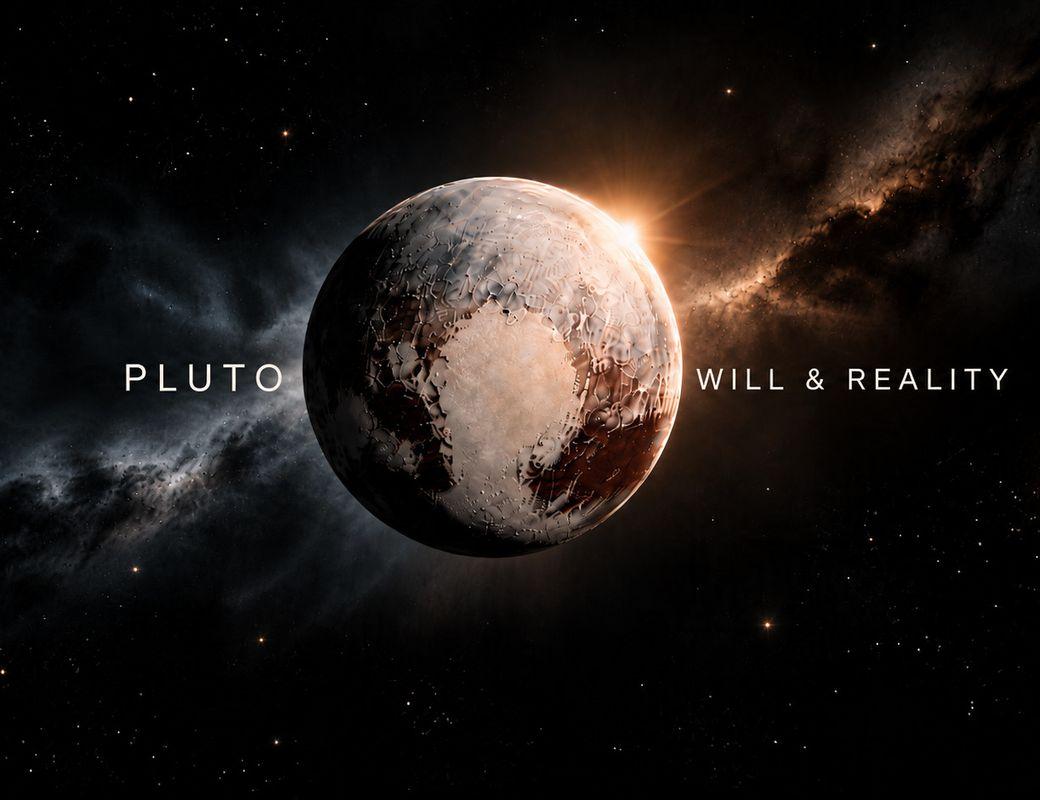
Pluto: What Happens Between “I Want” and Reality
Why our desires can differ from reality — and what clue the natal chart may offer here
Article · 9 min read · ·
There is one thing that, I think, almost everyone has noticed.
We can know very clearly what we want. We can imagine a certain life, relationship, job, income level, home, or project of our own. A desire can exist for years and feel completely real.
But time passes — and reality looks different.
Someone wants a relationship but remains alone. Wants to earn more, but keeps returning to roughly the same numbers. Feels they have abilities, but somehow those abilities never become a profession or a concrete result.
This raises an interesting question:
why does our “I want” not always become “this exists in my life”?
Continuing my exploration of Pluto, I want to look at it from exactly this angle.
Some of the key ideas explored in this article — including the relationship between Pluto, the Martian and Venusian principles, and the symbolism of spirit and matter — were inspired by the work of astrologer Pavel Andreev.
In the first article, we already talked about its connection with crises, life force, sexuality, power, deep transformation, and the ability to recover afterward.
Now, let’s try to understand Pluto’s energy even better — and look at it as a force that connects inner intention with its manifestation.
Pluto’s Symbol Already Offers an Interesting Clue
Several astrological glyphs are used for Pluto. One of them consists of three elements: a circle, a crescent, and the so-called cross of matter.
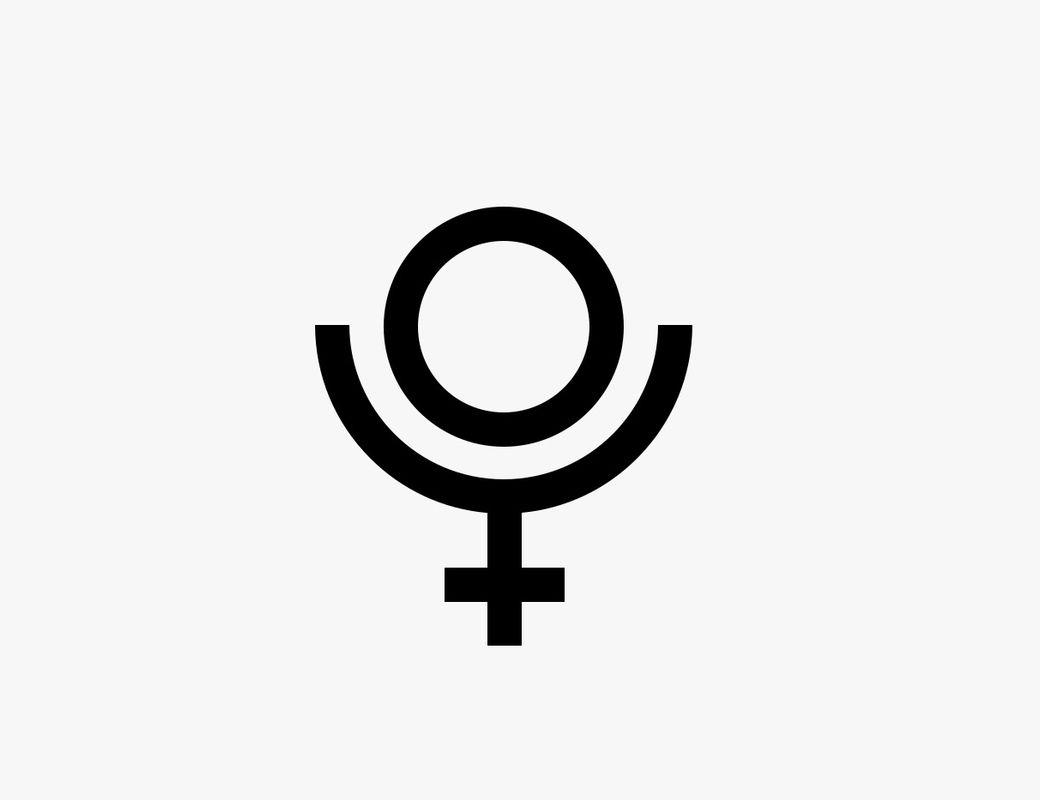
In one esoteric tradition of interpreting planetary symbols, the circle is associated with spirit, the crescent with the soul and the receptive part of the human being, and the cross with the physical body and matter.
In Pluto’s glyph, the circle seems to rest within the bowl of the crescent, while the entire structure stands on the cross of matter.
The circle can also be associated here with the solar principle — the inner center, will, and intention. The crescent refers to the lunar principle — the ability to receive, feel, and experience.
This is only one symbolic interpretation of the glyph, but I like how logically it resonates with the theme of this article.
Something is born within us. We feel it, perceive it, give it meaning. And then all of that still has to take form in the physical world.
And this brings us to spirit and matter.
Spirit and Matter
Much of what we create in our own lives first exists only within us.
An idea. A desire. An image. An intention. A decision.
A thought:
“I want this.”
It does not yet exist in physical reality, but a direction has already appeared within us.
For convenience, I will call this part spirit. Not in a religious sense, but as an inner active principle — an impulse that directs energy and urges it to manifest.
In astrological symbolism, one of the clearest parallels here is Mars.
Mars is associated with desire, impulse, initiative, and action. It is the energy of “I want”, given direction: “I go,” “I take,” “I do.”
But desire alone is not enough.
There is another pole — matter.
Our body. Other people. Objects. Money. Work. Concrete actions. Physical possibilities. Everything we come into contact with in the real world and can receive, create, feel, or experience.
In the model I am proposing here, this principle is connected with Venus — with attraction, pleasure, value, relationships, and our ability to come into contact with what we desire.
If we simplify it greatly:
Mars — “I want.”
Venus — “I receive and experience.”
And between them appears Pluto.
Pluto as the “+” Sign
And Pluto here takes the place of the “+” itself.
It is connected with the force that joins these two parts — with the ability to carry an inner impulse through the body, action, and interaction with the world so that a desire can take form.
We can call this synergy.
There is an impulse.
There is matter.
And there is something that allows one to change the other.
In an ideal model, everything would look fairly simple:
I want → I act → it becomes part of my life.
But our conscious “I want” and our actual ability to live through what we desire can be two very different things.
This is where Pluto becomes especially interesting.
You Also Have to Be Able to Withstand Your Desire
Imagine someone who says:
“I want to earn a lot of money.”
At the level of intention, everything is clear.
But with a lot of money can come big decisions, responsibility, uncertainty, competition, the need to put a price on your work, manage resources, and take risks.
The person genuinely wants the result.
But are they ready to live within the reality that this result will create?
Another example:
“I want a great love.”
But a close relationship requires meeting a real person — their individuality, desires, and boundaries. It can involve attachment, sexuality, jealousy, fear of loss, and the need to trust and negotiate.
A person can sincerely want love and, at the same time, protect themselves from part of the experience it will bring.
And then the gap appears between:
“I want”
and
“I can live through this.”
In astrological tradition, Pluto is associated with intensity, power and powerlessness, control, crises, and deep processes of transformation.
So I find it interesting to add another function to its symbolism:
Pluto shows our ability to withstand the energy of our own desire strongly enough for it to take form.
What the Body Has to Do With It
Every manifestation ultimately passes through the body.
We can imagine anything, but then we still have to talk, work, meet people, learn, move, make decisions, withstand pressure, go through failures, and do something again.
So for me, “bringing spirit and matter together” means helping an inner desire meet what we are actually able to do, withstand, and experience in reality.
This also makes Pluto’s connection with vitality — with great life force — easier to understand, especially where a person has to withstand a high degree of intensity.
And this is also where its connection with sexuality becomes clearer.
Sexuality in the natal chart, of course, cannot be reduced to a single planet. The entire structure of the chart matters here: Mars, Venus, the Moon, Pluto, houses, and aspects.
But sexual experience itself demonstrates the principle we are talking about very clearly.
There is desire and impulse — Mars.
There is attraction, pleasure, the body, and contact with the object of desire — Venus.
And there is the moment when the inner “I want” becomes a physical experience.
Pluto adds intensity here: the strength of desire, immersion, a large amount of physical and psychological energy, the theme of control, and the possibility of losing it.
That is why sex is one of the clearest examples of how desire meets the body.
But the same principle works far beyond sexuality.
Money, work, creativity, relationships, power, ambition — almost any material result travels the path from an inner image to manifestation.
And it is the space between these two points that interests me most.
But a New Form Rarely Appears Out of Nowhere
Here another important side of Pluto appears.
If we want to change reality, an inner impulse alone is not enough.
The new needs space.
And our lives are already filled with something: habits, relationships, work, obligations, ideas about ourselves, and the ways we manage our time, money, and energy.
So bringing something new into form often means changing the form that already exists.
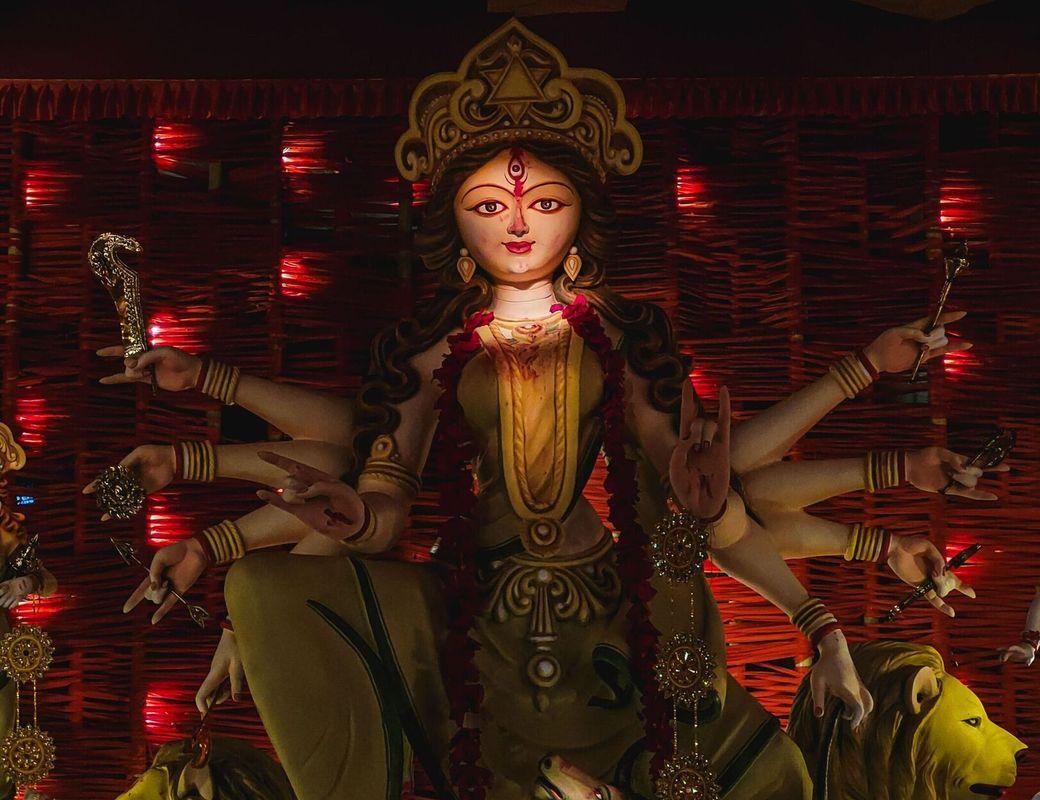
And here I think of the image of the Hindu goddess Kali.
I am not equating Kali with Pluto. They come from completely different cultural and religious systems. But some of their themes resonate with each other in interesting ways.
Kali is associated with Shakti — divine feminine power, as well as with time and transformation. Her image brings together immense life force, destruction, protection, and the maternal principle.
Look at her many-armed depictions as well. Her hands may hold weapons alongside symbols of protection or blessing.
For me, one idea here is especially interesting:
the same force can destroy and preserve.
It can cut away what no longer works.
Protect what needs to continue living.
Destroy an old form and release the energy that had been contained within it.
Something ends.
Energy is released.
And it gains the possibility of taking another form.
In the first article, I already wrote about crisis as a moment when a system has to reorganize itself in order to continue existing.
The image of Kali helps us feel this idea almost physically:
the force of life can also be the force capable of destroying what prevents life from continuing.
And in this sense, Pluto can be seen not only as a force that helps a desire take form, but also as a force that clears space for it.
From “I Want” to “I Can”
And now we can bring all of this together.
Suppose a person wants a different job, a higher income, a relationship, recognition, freedom, or a completely new way of life.
The inner impulse already exists.
But for a new reality to emerge, the old structure may need to change: acting differently, withstanding more, freeing up time and resources, reconsidering habits, and parting with what keeps energy locked in the old pattern.
And here Pluto is the power and force that allows an inner impulse to pass through reality and change it.
So there may be a very strong:
“I want.”
within us.
But actual manifestation requires something else to gradually appear alongside it:
“I can withstand this.”
“I can make space for this in my life.”
“I can let go of what stands in its way.”
And this brings us to the announcement of the next article in my Pluto series.
We will talk about working with Pluto consciously.
By this, I mean gradually and healthily becoming more familiar with the intensity Pluto symbolizes in our natal chart: developing our capacity to handle more energy, power, pressure, and transformation.
First, I will go through several general ways of working with Pluto, and then we will look at Pluto in all 12 houses of the natal chart and try to understand through what kinds of experiences we can develop a greater capacity for its energy.
So that we can gradually shorten the distance between:
“I want”
and
“I can live through this.”
What do you think about this way of looking at Pluto? As always, I’d be happy to hear your thoughts and experiences in the comments. ✨
Comments


Show more