PARTIAL LUNAR ECLIPSE IN PISCES
WHAT THE MOON REVEALS WHEN IT NEARLY DISAPPEARS
Article · 6 min read · ·
August 28, 2026 | 04:12 UTC | 4°51' Pisces Umbral magnitude: 0.9319 | 93.2% of the Moon in Earth's shadow Duration of partial phase: 3 hours and 18 minutes Visible from: Europe, Africa, Iceland, the Americas, eastern Pacific
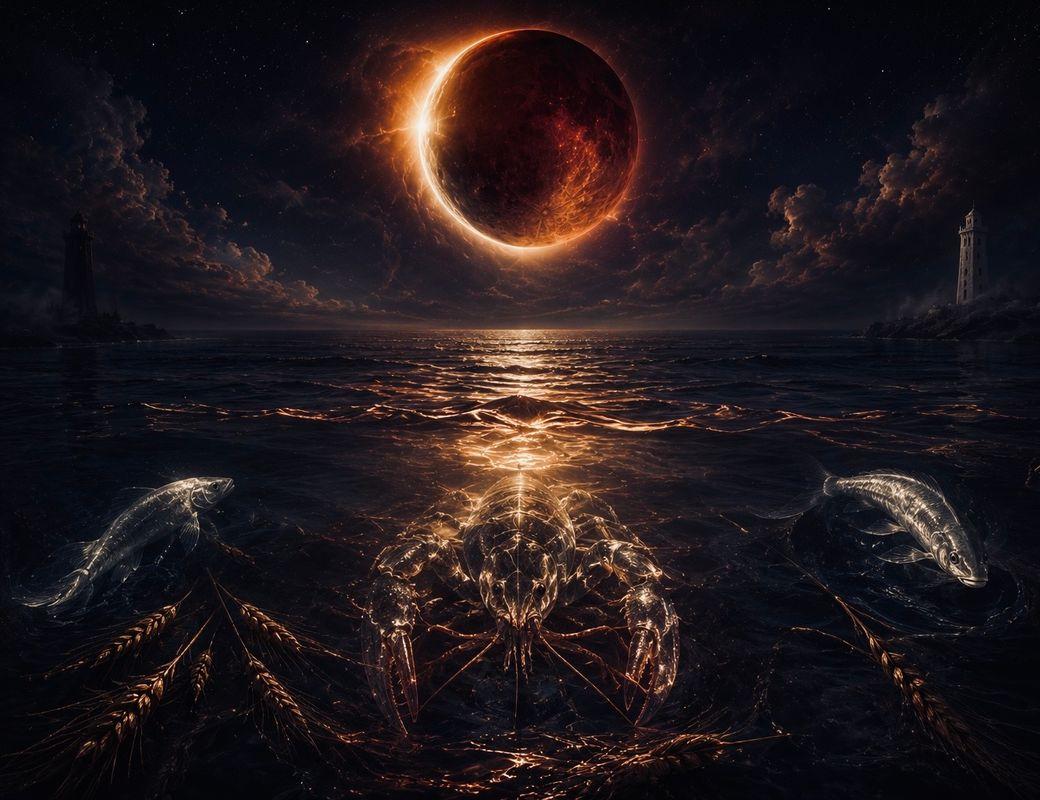
Astronomically, this eclipse is classified as partial because the Moon doesn't pass completely into Earth's central shadow. But 93.2% of its disk moves through the umbra. What this produces visually is nearly identical to a total eclipse: the Moon darkens, takes on a reddish hue, and remains cloaked in shadow for over three hours.
In astronomical practice, the difference between this eclipse and a total one is a fraction of a percentage point. In astrological practice, this distinction matters too: in symbolic reading, total eclipses tend to be interpreted as moments of complete closure, while partial eclipses typically reveal themselves in stages. What appears here may not present itself all at once.
The Close of a Two-Year Cycle
This eclipse is the sixth in a series of seven occurring along the Virgo-Pisces axis, which in astrological interpretation began in September 2024 and concludes in February 2027.
With the shift of the Lunar Nodes to the Leo-Aquarius axis on July 26, this Pisces eclipse occurs outside the new nodal axis. It's the penultimate eclipse of the old series. The last will come in February 2027. After that, traditional astrology indicates there won't be another eclipse in Pisces until 2034.
For those who have followed the themes that emerged since September 2024 around the Virgo-Pisces axis, this eclipse can be read symbolically as the moment when a two-year narrative begins its actual closing. What has been worked with during this period, what exists between analysis and intuition, between what can be measured and what can only be felt, is reaching its penultimate turning point.
The Virgo-Pisces Axis
The opposition between Virgo and Pisces is one of the zodiac's most specific because it places two modes of knowing in direct tension.
Virgo examines, verifies, categorizes. It's the sign that trusts what can be demonstrated. Pisces dissolves, intuits, contains what resists categorization. It's the sign that knows things it cannot prove.
The Sun in Virgo, at the moment of this eclipse, stands in close conjunction with Mercury, which passed through cazimi the day before. The analytical side is at its peak of clarity and precision. The Moon in Pisces, eclipsed by Earth's shadow, stands on the opposite side: the realm where clarity doesn't reach.
The eclipse illuminates the tension between these two ways of knowing. What Virgo's analysis couldn't capture over the past two years may gain visibility through Pisces now. What Pisces carried as diffuse feeling may find, through the Sun in Virgo, a way to be articulated.
Uranus in Square: The Eclipse's Tightest Aspect
Uranus stands at 5°37' Gemini, forming a square to the solar-lunar axis with less than one degree of separation. This is the tightest aspect in the eclipse chart.
In astrological interpretation, Uranus in Gemini is associated with the disruption of established patterns of thought and communication. In square to a lunar eclipse, this planet can be read as an element of unpredictability that arrives from outside what was being anticipated or planned.
One way to work symbolically with this square is to observe that the period's most significant information may not arrive through the expected channel. Virgo's careful planning and Pisces' open intuition may both be equally surprised by something arriving from a direction different from either. 🥀
Jupiter Trine Saturn: The Structural Support
In the eclipse chart, Jupiter in Leo forms a trine with retrograde Saturn in Aries. In traditional astrology, Jupiter is the ruler of Pisces, the sign of the eclipsed Moon. That the Moon's ruler is in favorable aspect with the planet of structure is a configuration that can be read as support for what this eclipse reveals.
The clarity that emerges during this period may find, in the Jupiter-Saturn trine combination, a field where it can be sustained with more solidity than usual. In astrological interpretation, an eclipse with the Moon's ruler in harmonious aspect to Saturn suggests that what is revealed has the potential to become something concrete over the course of the closing cycle.
The Saros Cycle Connection
This eclipse belongs to Saros 138. On August 28, 2007, a total lunar eclipse occurred at a very similar degree of Pisces, within the same Saros cycle. Each eclipse in a Saros series shares symbolic characteristics with previous ones.
For those who remember what was unfolding in mid-2007, this period may offer an interesting personal context, without implying a repetition of the same events. The astrological tradition uses these correlations as material for reflection, not prediction.
The Esoteric Meaning: Qoph and the Threshold Between Worlds
In the Hermetic system of the Golden Dawn, Pisces corresponds to the Hebrew letter Qoph and to Arcanum XVIII: The Moon. The path of Qoph connects Malkuth to Netzach, from the densest plane of manifestation to the sphere of beauty, love, and sensory perception.
The Moon in the Tarot shows a crustacean emerging from the depths of water, a dog and a wolf howling at the Moon, two pillars in the background. The path of Qoph is the threshold between what is conscious and what is still emerging from the depths. It's the territory where forms have not yet taken definite shape.
A lunar eclipse in Pisces, within Hermetic reading, can be interpreted as the moment when the very light that illuminates this threshold is temporarily reduced. What normally remains semi-visible in this transitional territory may, by contrast, reveal itself more clearly precisely because the usual light has changed in quality.
The crustacean of Arcanum XVIII emerges slowly. The eclipse in Pisces can be read as the moment when something that was in the depths becomes visible enough to be recognized, even if not yet completely formed.
How to Work Symbolically with This Eclipse
Observe what has been carried since September 2024. The Virgo-Pisces axis has been working symbolically with the relationship between what can be systematized and what resists systematization. It may be useful to look at what has changed in this area since the cycle began.
Pay attention to what the square with Uranus brings. What arrives from an unexpected direction during this eclipse and in the surrounding days may contain relevant information for the closure of the two-year cycle. It's worth recording before evaluating.
Use the Sun in Virgo and Moon in Pisces axis to examine a specific tension. Where do you trust analysis more than intuition? Where has intuition proven more reliable than analysis? This eclipse may offer clarity about this particular balance.
Consider what still needs to be completed before the series' last eclipse in February 2027. As the penultimate eclipse in Pisces, this can be read symbolically as the moment to identify what still needs attention before the cycle's definitive closure.
Reflection
93.2% of the Moon is in shadow. Not the totality. A thread of light remains visible at the edge of the lunar disk, enough for the eclipse to be classified as partial rather than total.
This astronomical detail carries a symbolic correspondence that partial eclipses often bear: the closure the cycle asks for may not arrive all at once. Something remains visible while the rest dissolves.
Pisces, the zodiac's last sign, is the territory where distinctions between one thing and another become more porous. The eclipse here doesn't ask for immediate resolution. It asks that what has been in process since 2024 be recognized at the point it has reached, even if not yet completely concluded.
The crustacean emerges slowly. That's enough for now.
O que você carregou nesses dois anos sem ainda conseguir nomear completamente pode estar começando a encontrar a forma que precisava.
Responses
No responses yet — start the conversation.