LILITH.
WHAT REMAINED AFTER THEY TRIED TO ERASE IT
Article · 6 min read · ·
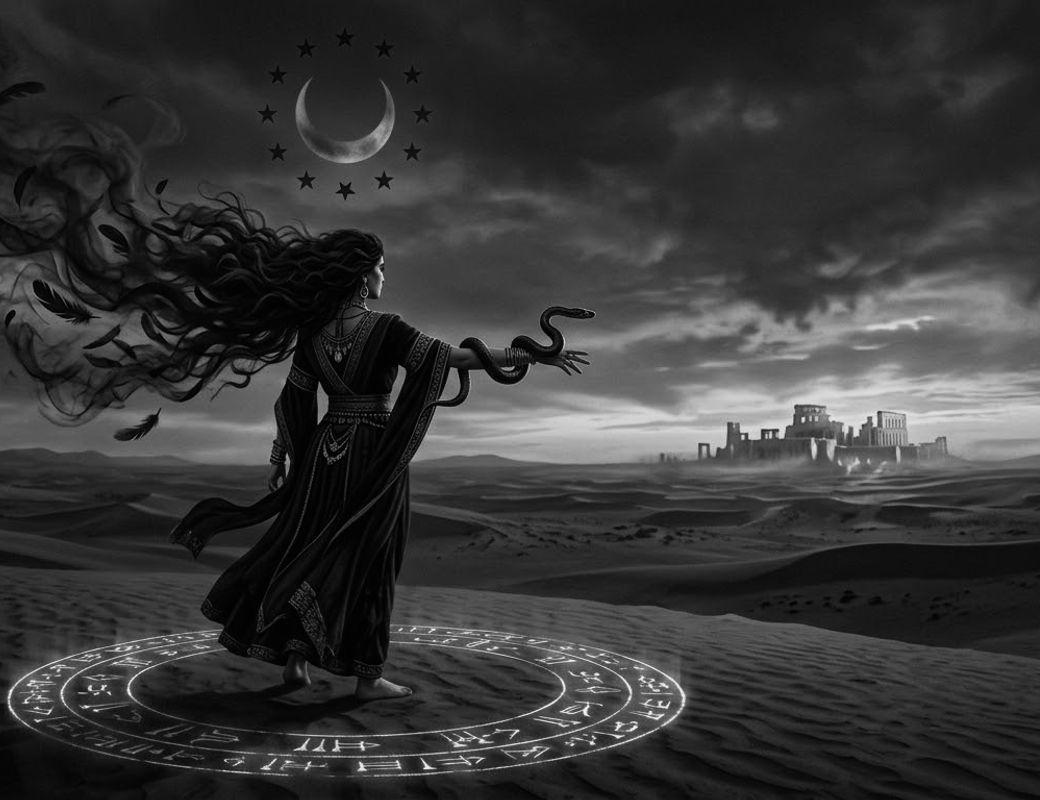
Lilith is one of the oldest symbols astrology has absorbed. It's also one of the most distorted along the way.
To work with her seriously, you need to trace the path in reverse: go from the most recent version back to the oldest, layer by layer, and examine what each tradition added, what it removed, and why. What remains after this journey is more precise and more useful than any definition that circulates easily.
The Three Liliths in the Astrological System
Before the mythology, a technical clarification that most articles about Lilith ignore.
There are three Liliths in the astrological system, and they aren't the same thing.
Mean Black Moon Lilith is the most commonly used point. It corresponds to the average position of the lunar apogee, the point where the Moon is farthest from Earth in its elliptical orbit. It isn't a physical body. It's a mathematical point in space, calculated from the average of the Moon's actual orbital oscillation.
True Black Moon Lilith is the actual lunar apogee, which oscillates back and forth as it advances. More astronomically precise, less stable in ephemerides.
Asteroid Lilith (1181) is an actual physical body, discovered in 1927 and named after the myth. It has a different nature from the two previous mathematical points.
When astrologers talk about Lilith without specifying, they're usually using Mean Black Moon Lilith. It's what apps typically show and what most contemporary astrological interpretations work with. All three points can be used together by those familiar with the system, but to understand the symbol, Mean Black Moon Lilith is the entry point.
The Oldest Origin: Sumeria
The name Lilith first appears in Sumerian text dated to approximately 2000 BCE, in the Huluppu poem, part of the Inanna cycle.
In the Sumerian narrative, a creature called Lilitu inhabits the hollow trunk of a tree that Inanna wants to transform into a throne and bed. Gilgamesh cuts down the tree. Lilitu flees to the desert.
She isn't yet the Lilith that later tradition will elaborate. She's an entity of winds and storms, associated with the liminal, with what cannot be domesticated, with what inhabits the spaces between inhabited places. The Sumerian tradition didn't judge her definitively. She simply existed where humans couldn't control the environment.
The Hebrew Elaboration
The Hebrew Bible mentions Lilith only once, in Isaiah 34:14, as a creature of the desert among the animals that will inhabit the ruins of Edom. The verse is descriptive, not narrative.
The story most people know, Lilith as Adam's first wife, comes from a much later text: the Alphabet of Ben Sira, dated approximately between the 8th and 10th centuries CE. This text is considered parodic by some scholars and probably wasn't conceived as serious theology, but it was the version that circulated and took hold.
In the Alphabet of Ben Sira, Adam and Lilith were created simultaneously, both from the dust of the earth. Conflict arises when Lilith refuses the position of sexual submission. She invokes God's ineffable name, acquires wings, and goes to the Red Sea. Three angels are sent to bring her back. She refuses. She accepts a curse and remains in exile.
What this narrative records, regardless of what it intended to do, is the memory of a figure who chose exile at the cost of remaining diminished. This choice is the core of what later astrological reading will work with. 🥀
The Kabbalistic Tradition
In Kabbalah, Lilith occupies specific territory: the Qliphoth, the shells or husks that the tradition describes as the reverse of the Tree of Life. Each Sephirah has its Qliphotic counterpart, the excess or absence of the quality the Sephirah represents in its balanced form.
Lilith is associated with the Qliphoth of Malkuth and, in some sources, with that of Yesod. In the Kabbalistic tradition, she represents the attraction toward the unmanifest and toward what resists form. Not simply evil, as the punitive reading wants, but the excess of attraction to chaos before form.
What Kabbalah preserves that later tradition lost is this: Lilith isn't the opposite of the divine. She's what exists before creation orders itself into recognizable forms. This corresponds with what astrology will do with the symbol.
What Contemporary Astrological Reading Works With
Modern psychological astrology, particularly what developed from the 1970s onward, found in Lilith a symbol for something that other categories didn't capture precisely.
Black Moon Lilith in the birth chart is associated with the point where the person was exiled or shamed for being too much, for existing in a way the environment didn't tolerate. It might be the sexuality that had to be hidden, the anger that was classified as unacceptable, the strength the surroundings treated as a threat, the knowledge that was dismissed before being heard.
The symbol also points to where this person carries their rawest form of power, precisely because it was never domesticated. What was exiled was never integrated into the system of norms. It remained in its original form.
This has a specific quality: Lilith's wound and Lilith's power are in the same place. You can't access one without crossing through the other.
Why This Matters Especially for Women
The Lilith narrative was constructed by traditions that had an interest in classifying her as dangerous. What makes her dangerous, in these texts, is precisely what she refuses: the position that diminishes her. She's called a demon for saying no when the cost of saying yes was herself.
For the audience reading these articles, this structure is recognizable. Not as distant mythology, but as lived pattern: the woman who doesn't yield at the wrong point is frequently labeled with the same terms ancient texts used for Lilith. Difficult. Dangerous. Too much.
The astrological reading of Lilith doesn't romanticize this. It acknowledges the cost. And it also acknowledges what remains intact in those who paid that cost without betraying what they knew was true.
The Three Questions Black Moon Lilith in the Birth Chart Poses
Where your Black Moon Lilith is, there's a place where you were taught to be ashamed of something that in you is strength. The question isn't what happened. It's what you did with what happened.
The second question is about exile: what did you suppress to remain in environments that didn't tolerate the complete version of you?
The third is the most direct: what do you know about yourself that was never confirmed by anyone around you, but that remains true regardless?
These three questions don't have answers in the article. They have answers in the life of whoever is reading.
What Comes Next
On September 14, Mean Black Moon Lilith enters Capricorn. Lilith will remain in this sign until the end of 2027.
To understand what this transit means, it was first necessary to understand who she is. Capricorn will bring Lilith into contact with the territory of structure, authority, what has been built over time, and the cost of existing fully in systems that were designed without considering what she represents.
That's the article that comes after this one.
O que foi exilado não desapareceu. Ficou mais selvagem do lado de fora.
Responses (3)
More from the Magazine

SCORPIO SEASON
THE DAY VENUS MEETS THE SUN AT THE HEART OF THE UNDERWORLD

¿A QUÉ SABE TU OTOÑO?
Hay estaciones que se viven con los ojos, pero el otoño está hecho para saborearlo con el alma.
1 Week of prAna | Vol. 4: 🗺️ Scorpio Stellium Mission
— The Reality Scanner, the luxury of silence, information detox, and the fertile void