IMBOLC.
WHAT GROWS BEFORE IT APPEARS
Article · 6 min read · ·
August 1, 2026 | Southern Hemisphere Midpoint between the Winter Solstice and the Spring Equinox
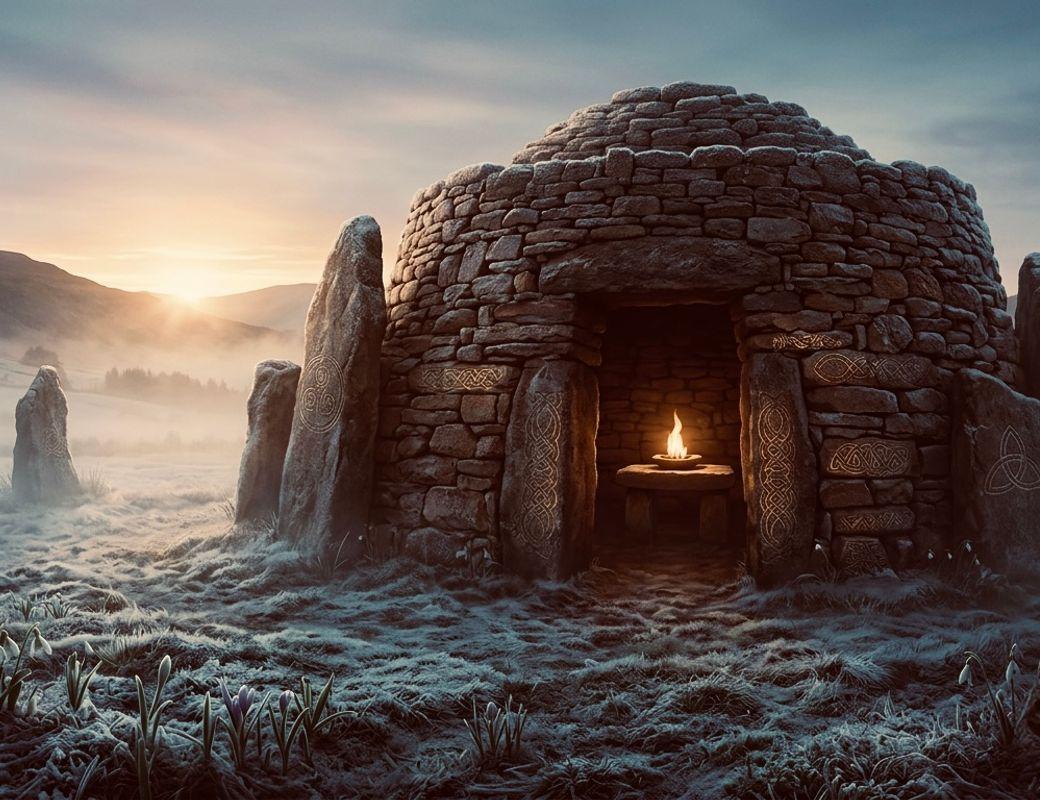
The word imbolc comes from Old Irish i mbolc: in the womb. It was the name the Celts gave to the time when sheep became pregnant, when life had already been conceived but had not yet emerged into the world. The festival didn't celebrate the arrival of spring. It celebrated the moment before, when spring was still inside something, waiting.
This etymological detail changes everything about how we read this date.
What's Still Cold Outside
August in the southern hemisphere isn't spring. The mornings still bite. The ground is still hard across most regions. Anyone looking outside sees nothing that justifies a celebration.
And that's the central point of Imbolc: the celebration happens before the evidence.
The seed has already made the decision to germinate. The days have already started growing, minute by minute, since the June solstice. The sheep already carries life within her before any external sign confirms it. Imbolc is the recognition that the process is already underway even when nothing visible proves it yet.
The traditions that took this festival seriously weren't being naive about the cold. They were developing the capacity to recognize what exists before it can be seen.
The Fire That Never Went Out
In Kildare, Ireland, there was a sanctuary dedicated to Brigid where a fire burned without interruption. Pagan priestesses maintained it for centuries. When Christianity arrived, Brigidine nuns took over the duty. The fire continued.
In 1220, Bishop Henry de Loundres ordered the flame extinguished, arguing the practice was pagan. The nuns relit it. The bishop extinguished it again. The nuns relit it again. This cycle repeated for decades.
In 1993, the Brigidine sisters formally lit the Perpetual Flame of Kildare in a public ceremony in the town square, where it remains to this day.
What this fire represents goes beyond symbolic continuity. A flame that survived centuries of religious suppression, wars, deliberate attempts at extinction, and continues to be lit by the hands of women who understand what it means—this flame has real history behind it.
Imbolc is the festival of this fire. Of what persists even when the environment is hostile to its existence. 🥀
Brigid: What the Triple Goddess Really Governs
Brigid is described as a triple goddess: healing, poetry, smithcraft. These three areas seem disparate until you realize what they have in common.
Smithcraft works with raw metal and transforms it into something functional and precise. Healing works with a damaged body and transforms it into health. Poetry works with common language and transforms it into something that endures beyond the moment it was spoken.
What Brigid governs is the transformation of raw material into something refined by fire. Not the fire that destroys. The fire that reveals the form that was inside the material waiting to exist.
At Imbolc, this principle applies to what's in the womb. What in you is still in a raw state, that hasn't yet found the form it will have when it emerges into the world? What do you carry that's still being forged?
The Relationship with Samhain
Imbolc and Samhain stand at opposite points on the wheel of the year. Six months separate the two.
Samhain, which was the subject of my article published on May 1st, asked for descent. Honoring the ancestors, acknowledging what died, crossing the thin veil to what lies beneath the visible.
Imbolc, six months later, asks for ascent. What was processed in the dark during winter begins to move toward the surface.
The two dates are part of the same process. What Samhain revealed about what needed to be released becomes, at Imbolc, the available space for what will grow. They're not opposites. They're sequence.
Those who moved through Samhain consciously will feel Imbolc differently than those who didn't. Because what rises at Imbolc has more space when what Samhain asked for was genuinely left behind.
The Esoteric Meaning: The Quickening
Ancient birthing traditions used the word quickening to describe the moment when a mother feels the baby move for the first time. It's the moment when the life inside her becomes perceptible from the inside out. Not to the world yet. To her.
Imbolc is the quickening of the earth.
In the Hermetic tradition, this process corresponds to the alchemical phase of citrinitas, the yellowing, the third phase of the work that follows nigredo and albedo. Nigredo was Samhain, the blackening, the descent, the dissolution of what doesn't serve. Albedo was winter, the whitening, purification in the dark. Citrinitas is the beginning of gold emerging, the first visible warmth after the cold white.
Brigid as goddess of transforming fire corresponds to this phase. The fire of Imbolc isn't the great fire of Beltane that will arrive in November. It's the small fire, the first perceptible warmth, enough to move what was immobile in the cold.
How to Work with Imbolc
Light fire with specific intention. The fire of Imbolc marks the first conscious movement toward what will grow. A candle is enough. What matters is that you know what you're illuminating with it, what's emerging from winter's darkness into the returning warmth.
Name what's in the womb. What in you has been conceived but hasn't yet been born? The project that hasn't emerged yet. The change that's in process but without external evidence. What you know is growing before you can show it to anyone. Imbolc is the festival of recognizing this state.
Make something with your hands. Brigid's tradition has a concrete physical dimension: the hands that weave the reed cross, that tend the fire, that forge metal. Creativity at Imbolc isn't abstract. It passes through the body. Cook something, weave something, plant something, build something small with your hands. The physical act is part of the ritual.
Examine what remains from Samhain. What was acknowledged in May that hasn't yet been integrated? What did you honor as finished but is still asking for attention? Imbolc sometimes reveals that Samhain's work didn't completely end.
Reflection
The sheep doesn't wait for spring to become pregnant. She carries life during the cold, when the external environment offers no confirmation that it will work.
Imbolc is the recognition that the most important decisions rarely have external support at the moment they're made. The seed has no guarantee of germinating. The flame of Kildare had no guarantee it wouldn't be extinguished again. The fetus has no certainty of what it will find when it emerges.
What Imbolc traditions preserved isn't optimism. It's the capacity to keep carrying what's still in the womb even when the cold outside offers no evidence that it will be worth it.
O fogo que você mantém aceso quando quando ninguém está olhando é o único que tem calor suficiente para aquecê-la quando o inverno passa.
Enter quote text...
Responses
No responses yet — start the conversation.