Human Design Fundamentals - a six week series
Week Two | The Bodygraph - learning to read your own map.
Article · 4 min read · ·
Seeing your Human Design chart for the first time can sometimes be overwhelming. It does not look like a horoscope wheel or a personality questionnaire. It looks like a technical diagram, geometric and precise, part circuit board and part sacred symbol, as though someone took the interior of a cathedral and cross-referenced it with an electrical schematic. Most people stare at it for a moment, feel a flicker of recognition they cannot quite locate, and then wonder where to begin.
This is where we begin.
The Bodygraph is the visual centrepiece of Human Design. Generated from your birth date, birth time, and place of birth, it is a map of your unique energetic architecture, showing how energy moves through you, where it is consistent and reliable, and where it is open and receptive to the world around you. It is not a map of who you should become. It is a map of who you already are.
The chart itself is built from three interlocking layers: the nine centres, the thirty-six channels, and the sixty-four gates. Understanding how these relate to one another is the foundation of everything that follows in this series, so it is worth taking each in turn.
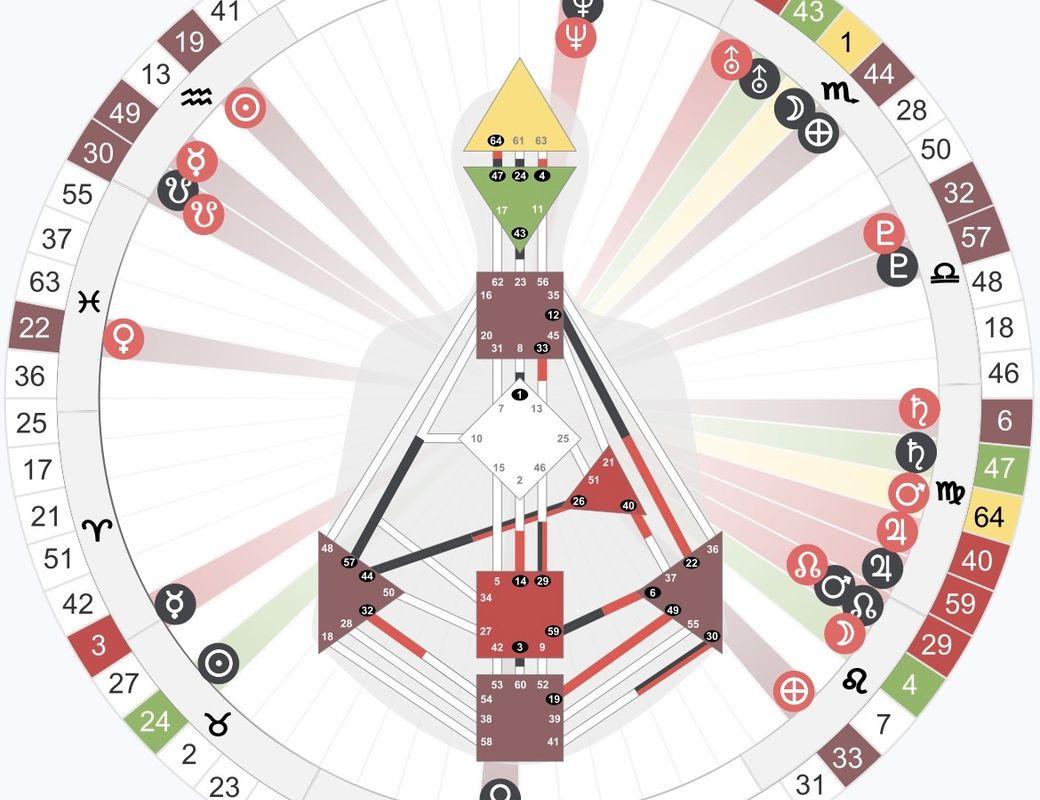
The nine centres are the large geometric shapes you see inside the Bodygraph, the triangles, squares, and diamonds arranged in a specific configuration that mirrors, loosely, the Hindu Brahmin chakra system, though it is not identical to it. Each centre governs a distinct domain of human experience. The Head Centre processes inspiration and mental pressure. The Ajna Centre manages conceptualisation and analysis. The Throat Centre governs communication and manifestation. The G Centre holds identity and direction. The Heart Centre carries willpower and ego. The Solar Plexus Centre manages emotion and feeling. The Sacral Centre holds life force and generative energy. The Spleen Centre governs instinct, immunity and present-moment awareness. The Root Centre processes adrenaline and the pressure to move.
Each of these centres will appear in your chart as either defined or undefined, which simply means either coloured in or white. Defined centres, those that are coloured, represent energy that is consistent and reliable within you, a fixed frequency that runs regardless of who you are with or where you are. Undefined centres, those that are white and open, represent places where you are designed to receive, amplify and be influenced by the energies of the people around you. Neither is better than the other. They are simply different functions, and understanding which of your centres falls into which category is one of the most immediately useful things Human Design offers. We will go much deeper into this distinction next week.
Running between the centres are the channels, thirty-six in total, each one a complete circuit connecting two centres. When a channel is fully activated in your chart, meaning both of its gates are defined, it appears as a thick coloured line. These defined channels are the highways of your consistent energy, the qualities and capacities that are reliably yours. They contribute directly to your Type, which we will explore the following week, and to the overall feel of your energetic presence in the world.
The gates are the finest layer of the Bodygraph, sixty-four in total and corresponding directly to the sixty-four hexagrams of the I Ching. Each gate sits at one end of a channel, at a specific point within a centre, and carries a particular archetypal quality or theme. When a gate is activated in your chart without its connecting gate on the other end also being activated, it appears as a hanging line, a potential waiting for completion, a frequency you carry that seeks resonance. This is one of the ways Human Design explains the pull of certain people into your life: they carry the gate that completes your open channel, and the circuit closes.
To get your own Bodygraph, you will need your birth date, birth time, and place of birth as accurately as possible. Birth time in particular matters here, more than it does in some other astrological systems, because the chart calculates two distinct positions simultaneously: your conscious sun position at the moment of birth and your unconscious position from approximately eighty-eight days before birth, the moment your neutrinos imprinted your design at the foetal stage. Both positions contribute gates to your chart, and together they create the full picture. A free chart calculator is available on my website, Kalasa.au.
Once you have your chart in front of you, do not try to decode everything at once. The Bodygraph rewards patience. For now, simply notice which centres are coloured and which are white. Notice whether there are many defined channels, thick coloured lines running between centres, or relatively few. Notice where the white space is. That white space is not absence. It is where your greatest sensitivity lives, and also, as we will explore in the weeks ahead, where much of your conditioning has entered.
The map is in your hands now. Next week we begin learning what it is actually telling you. If you feel the call, join my free Skool Community
Next week: The Five Types. The most important thing your chart reveals, and what it means for how you move through the world.
Responses (2)