AUGUST NEW MOON
TOTAL SOLAR ECLIPSE IN LEO
Article · 7 min read · ·
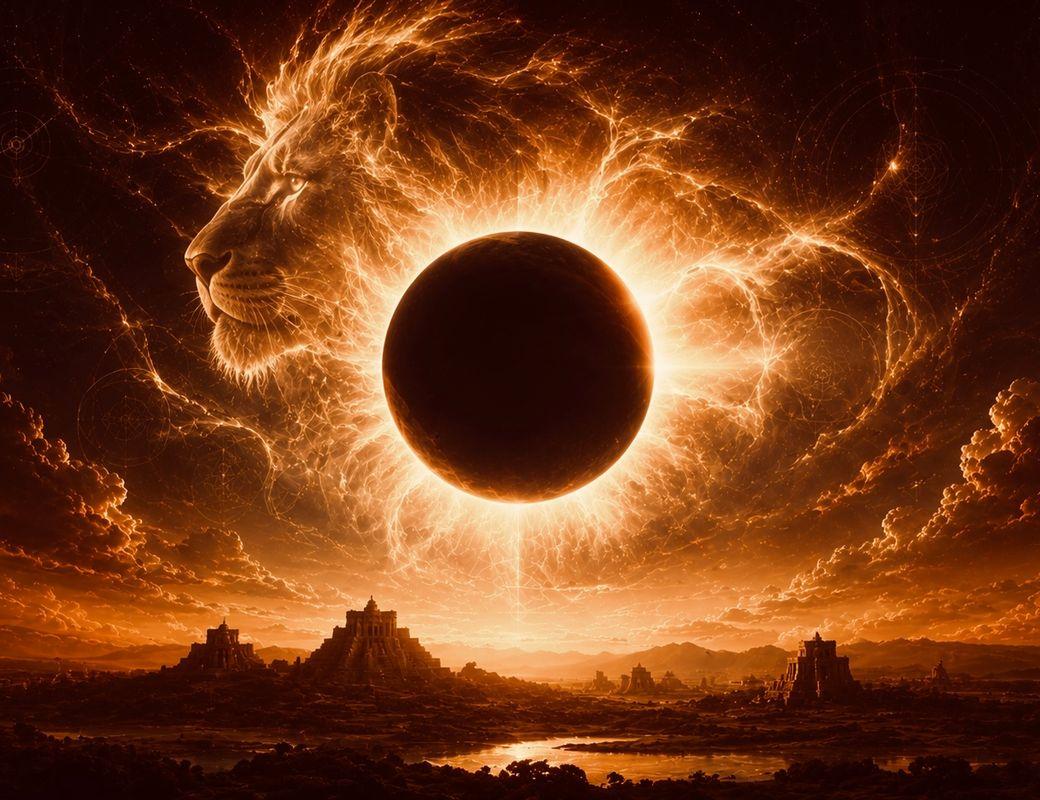
THE TWO MINUTES AND EIGHTEEN SECONDS THAT RESTART THE CYCLE
August 12, 2026 | 5:47 PM UTC | 20°08' Leo
Total Solar Eclipse | Duration of totality: 2 minutes and 18 seconds
Path of totality: Greenland, Iceland, northern Spain
For 2 minutes and 18 seconds, the Sun disappears in the middle of the day.
The Moon positions itself between Earth and the Sun with a precision that still feels uncanny when you examine the numbers: the Moon is 400 times closer to Earth than the Sun, and the Sun has 400 times the diameter of the Moon. The result is that the two, seen from here, have exactly the same apparent size. This is why the lunar disk covers the solar disk perfectly, and why the solar corona becomes visible during totality.
Astronomy explains the mechanism. The initiatory tradition explains what the mechanism represents: the source of all light and orientation briefly goes dark so that what was being hidden by the light can be seen.
What A Total Solar Eclipse Does That An Ordinary New Moon Doesn't
Every new moon is the point of least light in the lunar cycle. A seed. The beginning of something that will grow over the next two weeks.
A total solar eclipse operates on another register. The light doesn't just diminish: it disappears completely for those in the path of totality. The field is interrupted. What was in motion stops. What was being built gradually has a moment of rupture before continuing.
Astrologically, solar eclipses open six-month cycles. Whatever is inaugurated or ended in this August window will develop until the opposing lunar eclipse in February 2027. Everything that emerges today is not commentary. It's the first paragraph of a chapter that will take six months to write.
Eclipse on the South Node: What This Changes
The Lunar Nodes shifted to the Leo-Aquarius axis on July 26. The South Node is in Leo. When a solar eclipse occurs near the South Node, the nature of the cycle it inaugurates is specific: completion before new beginning.
Most articles about this eclipse will focus on Leo energy as new beginning, visibility, expression. This reading is correct, but incomplete.
An eclipse on the South Node asks you to resolve what was left pending before inaugurating the next cycle. The South Node in Leo is identifying what needs to be released: identity built upon external recognition, expression that exists to be seen, the brilliance that needs an audience to justify its value.
This eclipse doesn't begin where you are now. It begins where the old pattern ends. 🥀
The Stellium in Leo
At the moment of the eclipse, four planets are in Leo: Sun, Moon, Mercury, and Jupiter.
Mercury at 5° Leo brings language and narrative into the eclipse field. What is said and communicated in this window will carry the weight of a seed for six months. The story you're telling about yourself now, to yourself and to the world, enters the field of the cycle that's beginning.
Jupiter at 9° Leo amplifies everything the eclipse plants. This is one of the rarest qualities of 2026: a total solar eclipse with Jupiter in the same sign. What is genuine will find expansion. What is performance will find the cost of sustaining something without roots.
All four in Leo together create an amplification field without recent precedent. What you consciously inaugurate today will find more support than a solar eclipse under normal conditions would offer.
The Connection to 1999
Eclipses belong to series called Saros cycles. Eclipses in the same series occur every 18 years, 11 days, and 8 hours, at the same point in the zodiac with a 2° shift.
The eclipse of August 11, 1999, in the same Saros cycle as this 2026 one, was the most watched in history up to that moment. It occurred at 18°21' Leo and its path of totality crossed Cornwall, central Europe, Turkey, Pakistan, and India. The catastrophic prediction surrounding it didn't materialize. What did materialize was an entire generation that developed a fascination with eclipses and astrology.
Those born around 1999 are now in their mid-twenties. This eclipse in 2026, 27 years later, returns to the same Leo territory with the same sign. What was planted in that generation in 1999 finds a point of revision and maturation now.
The Partial Grand Sextile
At the moment of the eclipse, there's a rare configuration in the sky: Venus in Libra, Mercury and Jupiter in Leo, Uranus in Gemini, Neptune in Aries, and Pluto in Aquarius form a partial grand sextile, each in sextile with the next.
A grand sextile is a pattern of harmony between six points of the zodiac. When complete, it forms a six-pointed star. What this pattern offers is unusual for an eclipse: instead of just pressure and rupture, there's a network of support among the planets involved. What is inaugurated today has access to multiple channels of simultaneous amplification.
This doesn't soften the eclipse. It still interrupts, still resets, still ends what needed to end. But what comes after the interruption will have more available pathways than an isolated eclipse normally offers.
The Esoteric Meaning: The Crown That Only Appears in Darkness
In Egyptian tradition, the solar eclipse was called Nheni, the embrace. The Moon embracing the Sun until the light disappeared and the priests could see what the brightness of day normally prevented: the stars, the solar corona, and what inhabited the space that ordinary light covered.
The solar corona, the Sun's outermost atmosphere, is visible only during the totality of an eclipse. At any other time, the Sun's own light obscures it. To see the Sun's halo, the Sun must disappear.
This has direct correspondence with what this eclipse asks: what in you only becomes visible when ordinary noise stops? What exists beneath Leo's performance that daily performance doesn't allow to appear?
In the Tree of Life, the letter Teth corresponds to Leo and the path between Chesed and Geburah. Strength that doesn't need to demonstrate strength. The eclipse at 20° Leo, with the South Node in the same sign, is the path of Teth being traveled in the direction of release: what was strength carried as weight can be set down. What is kept after that will be lighter.
How to Work with This Eclipse
Identify what is being completed. Before planting new intention, examine what the South Node in Leo is asking to end. What pattern of seeking recognition has reached the limit of its usefulness? What in you was still waiting for external validation to feel valid?
Use the 2 minutes and 18 seconds consciously. If you have access to a live broadcast of the totality, observe the moment when the light disappears. Not as spectacle, but as a marker. What do you want to end with that light? What do you want to begin when it returns?
Name what you want to inaugurate in this six-month cycle. A solar eclipse with Jupiter in the same sign amplifies what is planted consciously. What you say aloud today, what you write, what you communicate with intention, enters a field that will expand until February 2027.
Pay attention to what appears in the 72 hours around the eclipse. The pre- and post-eclipse window has a quality of revelation. What appears as insight, as unexpected conversation, as perception that arrived without you looking for it, is material from the cycle being inaugurated.
Reflection
For 2 minutes and 18 seconds, the stars become visible in the middle of the day. The sky that otherwise only appears at night reveals itself during the totality of a total solar eclipse. What the ordinary Sun obscured with its own light becomes, for moments, perceptible.
The initiatory tradition in various cultures around the world identified this moment as a portal: an interval in ordinary time where what lies beyond everyday perception can be touched.
This eclipse in Leo isn't asking you to shine brighter. It's asking you to discover what shines when the need to be seen stops.
O sol que desaparece por dois minutos e dezoito segundos volta com um ciclo que não existia antes.
Comments